Global movement towards representative legislatures
St. Louis, Missouri, 18 October: A world-wide movement towards establishing legislative bodies that are fully representative finds expression in the staged reading of “Our Common Lot” by David Grant. The short play is written for an international conference, “Democracy for the 21st Century,” to be held in December at the Library of Alexandria, Egypt.
In the play, Marisa, Alma, Sami, and Ali live in a city embroiled in conflict and violence — the Regime, the Opposition, the Opposition to the Opposition. When the fighting stops, they ask themselves: What is the best way to move forward? “Our Common Lot” argues for choosing legislators in the way that the first democracy did – by random lot, known as ‘sortition.’
In the original Athenian democracy, sortition was regarded as a principal characteristic of democracy. Most recently the city of Melbourne, Australia has used a random sample of citizens to determine its ten-year financial plan. Two-thirds of the recent Irish Constitutional Convention was composed of sortitionally-chosen citizens.
The reading of “Our Common Lot” is its world premiere. The ensemble includes Adam Flores, Carl Overly, Jr., Erin Roberts, and Jacqueline Thompson. Continue reading →
The Chinese language blog ideochina.com – 思想中国 – has an article about the troubles of the elections-based system of government (what may be termed “eklogocracy”). Among other ideas for reform, the article mentions proposals involving sortition.
Abstract:
In the past quarter of the century,democracy has won the day,with most countries in the world claiming themselves to be democracies. However, the glory is fleeting. In exactly the same period of time, the advancing step of western democracy starts faltering, and its theory is being challenged in an unprecedented way. The idol of democracy is entering into twilight, surrounded by more and more pessimistic views. Theorists of democracy have now started to reflect on the inherent deficiencies of representational democracy, rethink electoral democracy, and seek to return to real democracy by exploring various institutions that can involve the participation of the populace.
The author appears to be an Equality-by-Lot reader.
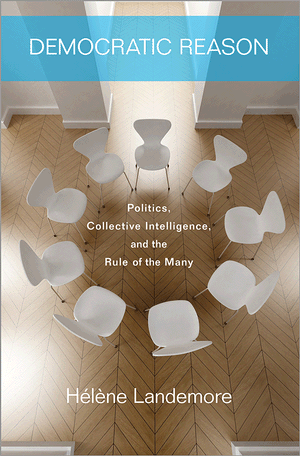
That makes the second Spitz (for outstanding work in democratic theory) to a Sortinista in three years, following John McCormick’s Machiavellian Democracy in 2013.
Filed under: Academia, Books, Sortition | Comments Off on News: Democratic Reason wins 2015 Spitz Prize for work in democratic theory
Two 45-member Citizens’ Assembly Pilot Projects will each be held over two weekends, in Sheffield on 17-18 October and 7-8 November, and in Southampton on 24-25 October and 14-15 November.
Imagine that the Fed were to announce that, a year from today, it would pick a digit from zero to 9 out of a hat. All currency with a serial number ending in that digit would no longer be legal tender. Suddenly, the expected return to holding currency would become negative 10 percent.
This, was the suggestion put forward in 2009 by the economist N. Gregory Mankiw, chairman of the Council of Economic Advisers under President George W. Bush, to overcome the ‘problem’ that the dollar/pound/euro in your pocket could not be taxed when inflation falls below zero.
Ray Fisman, a Boston University economist, and Daniel Markovits from Yale Law School write in Slate about “The distributional preferences of an elite”, a study they recently published in Science magazine. In the final paragraphs they say:
Elites’ preferences matter. The American elite overwhelmingly dominates both campaign finance and political lobbying, and American policymakers themselves come overwhelmingly from elite circles—the powerbroker Yale Law alumni mentioned above represent just the tip of a vast iceberg.
Our results thus shine a revealing light on American politics and policy. They suggest that the policy response to rising economic inequality lags so far behind the preferences of ordinary Americans for the simple reason that the elites who make policy—regardless of political party—just don’t care much about equality. Hemingway’s illusory but widely shared view that the only thing that separates the rich from the rest is their money thus disguises a central pathology of American public life. When American government undemocratically underdelivers economic equality, the cause is less party than caste.
Democracy gives the mass of citizens a path for protest when the gap between ordinary views and a closed rank of elite opinion grows too great. The populist insurgencies that increasingly dominate the contests to select both the Republican and Democratic candidates in the upcoming presidential election show the protest path in action. Elites—in both parties—remain baffled by Donald Trump and Bernie Sanders’ appeal; and they prayerfully insist that both campaigns will soon fade away. Our study suggests a different interpretation, however. These bipartisan disruptions of elite political control are no flash in the pan, or flings born of summer silliness. They are early skirmishes in a coming class war.
This topic came up recently. Here is the most thorough discussion of this matter in the primary sources that I am aware of. Aristotle is describing here (Politics, 1317a-1318a) what he considers as the conventional wisdom of his time:
And for this inquiry we must take into view all the features that are popular and that are thought to go with democracies; for it comes about from combinations of these that the kinds of democracy are formed, and that there are different democracies and more than one sort. In fact there are two causes for there being several kinds of democracy, first the one stated before, the fact that the populations are different (for we find one multitude engaged in agriculture and another consisting of handicraftsmen and day-laborers, and when the first of these is added to the second and again the third to both of them it not only makes a difference in that the quality of the democracy becomes better or worse but also by its becoming different in kind); and the second cause is the one about which we now speak. For the institutions that go with democracies and seem to be appropriate to this form of constitution make the democracies different by their combinations; for one form of democracy will be accompanied by fewer, another by more, and another by all of them. And it is serviceable to ascertain each of them both for the purpose of instituting whichever of these kinds of democracy one happens to wish and for the purpose of amending existing ones. For people setting up constitutions seek to collect together all the features appropriate to their fundamental principle, but in so doing they make a mistake, as has been said before in the passage dealing with the causes of the destruction and the preservation of constitutions. And now let us state the postulates, the ethical characters and the aims of the various forms of democracy. Continue reading →
Shlomo Papirblat reports from Brussels in the Israeli newspaper “Haaretz”:
A proposal to select the members of the Belgian Senate at random gains surprising support from politicians in Brussels. The chairperson of the socialist party: “Traditional politics is ailing and new ways have to be considered.”
Senior politicians in Brussels are supporting a legislative reform that could revolutionize Belgian democracy: according to the plan members of the Senate – the upper chamber of the nation’s parliament – would be selected in a lottery that would be held once every four years among the citizenry. The chairperson of the socialist party in the Belgian parliament, Laurette Onkelinx, a former vice prime minister, is saying that “traditional politics is ailing and new ways have to be considered.”
In an interview prominently published Wednesday in the highly regarded “Le Soir” Onkelinx explains that “today’s politicians are generally required to get involved in burning social issues but they are behind – they can’t keep up. On the other hand, more and more grassroot and activist-developed social initiatives are involved in generating solutions.” When addressing the question of who can democracy of “professionals” can be combined with present-day requirements, she said that she thinks that “sortition needs to be adopted to bring normal people to the legislature, at least half the members of the house.”
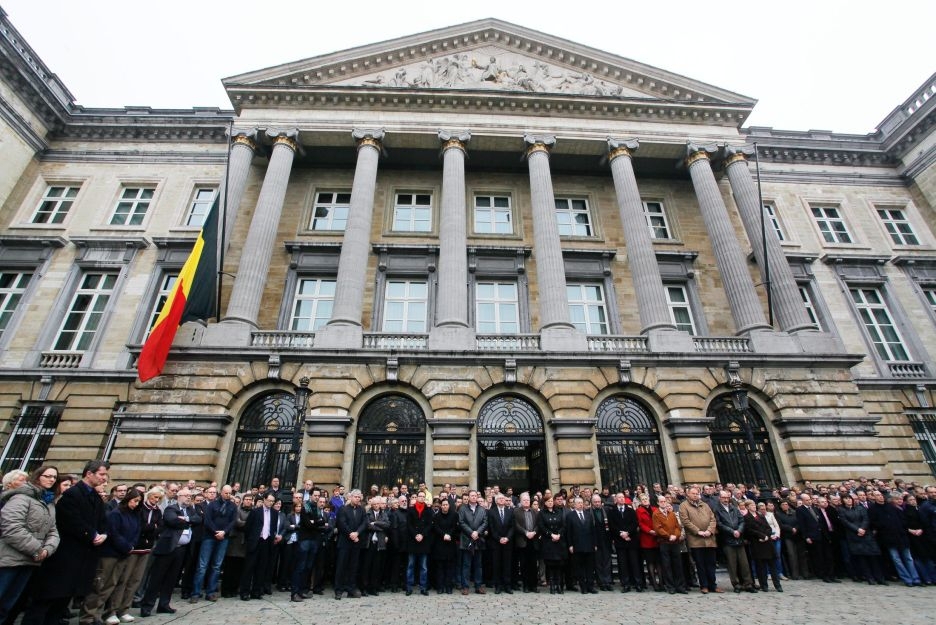
Parliament members standing outside the federal parliament building in Brussels, 2012
Sortition makes an appearance in the German public discourse. swissinfo.ch has an English translation of a German article which proposes short-term allotted bodies with decision making power whose agenda is externally determined. The article’s author is described as follows:
Timo Rieg, a German journalist and biologist. He developed and tested the “Youth Citizens Jury”, a form of youth parliament in which members are selected through a draw. He is the author of 18 books. His most recent publication, Democracy for Germany, examines a combination of citizens’ parliament, a directly elected government and referendums.
An excerpt from the article:
‘Citizens’ parliament’
One could firmly establish [a] procedure, which could be called the “citizens’ parliament”. Week by week, 200 new members, selected each time by a draw, could meet in the citizen’s parliament. They could listen to experts and lobbyists in a plenary session, have discussions with their jury and small groups, ask questions, suggest changes and entrust the governing authority to make improvements.
The outcome of this process would be a clear recommendation, a law (or its repeal), and the result is, unlike today’s parliament, always representative! Thus the citizen’s parliament is a “mini-populus”, an almost exact miniature replica of the general public.
All schools of thought, all social backgrounds, all occupations, artistic interests and hobbies would be proportionally represented. No one and nothing would be forgotten, and yet it’s both technically and financially a manageable size. Continue reading →



 Adam Cronkright
 Ali
Ali Ahmed R. Teleb
 avanderven
 avergne
 Alex Kovner
 azakaras
 Brett Hennig
 campbellwallace
 Simon Threlkeld
 Nick Coccoma
 codyhipskind
 Common Lot Sortitionist
 Conall Boyle
 constitutionalism
 davidschecter
 graytmatter
 gtridimas
 H.J. Hofkirchner
 Hanspeter Rosenlechner
 James Kierstead
 John Burnheim
 jgarry20151
 Jochen Krattenmacher
 johnedwardtaylor
 johnhuang865
 Jonathan Crock
 keithsutherland
 Jacob Richter
 kkoreilly
 lukewhito
 SimonPek
 Nathan El
 Nicholas Gruen
 Owen Shaffer
 Patrick Chalmers
 Paul Gölz
 peterstone
 Pierre-Etienne Vandamme
 pronfeld
 Emil
Emil rcaze
rcaze richwbrown
 Roger Knights
 roslynfuller
 Pierre-Etienne Vandamme
 shaharavin
 tbouricius
 Ted Wachtel
 Joshua Laferriere
 theodorestathis
 towardsautonomyblog
 Wayne Liebman
 Yoram Gat
 Oliver Milne
 Equality by lot