The French citizen convention on the climate: the endgame


Florent Gougou and Simon Persico write in La Vie des idées about the approaching culmination of the French citizen convention on the climate and how its work should be translated into policy. They find the use of a referendum particularly appealing. Also included in the article is the useful chart above comparing along several dimensions the makeup of the French National Assembly to that of members of the convention (which were selected to reflect the makeup of the French population).

Deciding together: The citizen convention on the climate and the democratic challenge

Now that the citizen convention on the climate is drawing to a close, how should the proposals of the allotted citizen be made into policy within the framework of the a democratic process? What place and shape should a referendum take within the political decision-making?

In the weekend of June 19 to 21, the 150 citizens allotted to the citizen convention on the climate will meet for the last time in order to conclude their work. Two essential points will be on their schedule. The first is finalizing the list of proposals that they will hand to the executive, and more broadly to the French people. The second is choosing the legal mechanisms by which a decision would be made regarding those proposals: executive orders, legislation or through a referendum.
Continue reading

Reginald Walter Macan: early sortition advocate

The February 1892 issue of The Classical Review (vol. 6, No. 1/2) has a review by Reginald Walter Macan of James Wycliffe Headlam’s Election by Lot at Athens which was published the year before.
Macan talks approvingly of Headlam’s analysis of the rationale behind the use of sortition in Athens:

The Lot was used in the Athenian democracy for two main purposes, as Mr. Headlam explains clearly enough: to constitute bodies, that represented the sovran people, or were committees, commissions of the same (p. 161); to secure rotation of office (p. 94) — both these purposes being subordinate to the supreme end, the sovranty of the whole people.

However, in regards to the representation function, Macan is radically reinterpreting Headlam. The “representation” discussed in page 161 of Headlam’s book is that of carrying out technical, apolitical functions which require no judgement and which any Athenian would have performed in the same way.

The inspectors, then, were appointed by the people to act as stewards or bailiffs. The people was the owner of a large business establishment; the inspectors had to do the work of superintendence over the workmen which the owner had not time to do himself. They were a committee of the Assembly, or council, who were appointed by lot because they represented the whole people. The whole of the demos could not go together to the dockyards to see that the new ships which had been ordered were properly built, so they deputed a few of their number to do so, and as a matter of course, as in all such committees, made the appointment by lot.
Continue reading

Taylor: The principle of distinction at Athens

A 2007 paper by Claire Taylor (“From the Whole Citizen Body?”, Hesperia 76, 2007) explores the composition of elected and allotted bodies in Athens.

From the Whole Citizen Body? The Sociology of Election and Lot in the Athenian Democracy

Abstract: In this article the author examines the sociology of selection procedures in the Athenian democracy. The role of election and lot within the political system, the extent (or lack) of corruption in the selection of officials, and the impact of the selection procedure on political life are considered. A comparison of selection procedures demonstrates that the lot was a relatively democratic device that distributed offices widely throughout Attica, whereas elections favored demes near the city. The reasons for these different patterns of participation are examined.

Taylor’s findings, which rely on deme-membership statistics of holders of various Athenian state offices, confirm the theoretical expectations: elections favored city demes while sortition did not.
Continue reading

Dutch sortition website

Tegen Verkiezingen (Against Elections) is a dutch website informing and advocating for sortition. In addition to content in Dutch, the website has occasional news about sortition in the Netherlands in English.

A recent item, for example, describes an interview of David Van Reybrouck on Dutch TV on the topic of citizens’ assemblies on climate change – the one in France and a potential one in the Netherlands. In the interview, we learn, Van Reybrouck tells the story of how he met President Macron and how that led to the creation of the French convention citoyenne pour le climat:

Then the interviewer wants to know more on how Van Reybrouck managed to sell the concept of sortition to the French president, Mr. Macron. Van Reybrouck already told about this in the interview on BNR Newsradio a year ago, but now we get to hear some additional details. When one of the guests at the lunch table points out to Macron that Van Reybrouck is working on ‘a revolutionary model for democracy’, Macron immediately gets very interested, forgets about the food on his plate, and concludes after a thirty-minute converstation with Van Reybrouck on sortition: “C’est formidable! C’est formidable!” (That’s wonderful! That’s wonderful!) and expresses “Merci, merci infiniment!” (Thank you so much!) at the end of the conversation. Two weeks later, his prime minister started talking about sortition-based citizens’ assemblies on tv, resulting in the Convention Citoyenne pour le Climat, the French Citizens’ Assmembly (CA) on Climate Change.

Buchstein: Democracy and lottery: Revisited

Ten years ago Hubertus Buchstein pinned some high hopes on the application of sortition in government (“Reviving Randomness for Political Rationality”, Constellations 17(3), 2010):

[T]he horizon for further development of randomly selected councils boils down to two options. One can either stay on the beaten path and continue working with the experiments and projects described above with their non-binding status. That would amount to supporting commendable projects instructive about democracy, which admittedly remain mere ornaments of the political system’s routines, projects that participants expect to have little tangible influence, thus engendering the problems of motivation. Or the standing of randomly selected councils could be reinforced; their integration in existing institutional arrangements with a clearly defined and binding set of competencies would form the culminating point of such a reform policy.

There is much to be said for the fact that random selection, if used wisely, could prove a useful complement to the procedures in place until now. And if we have the courage to make such changes, there is reason to believe that judicious integration of components of lotteries in modern democracies can contribute to a reform policy model, relevant beyond nation-states and the example of the EU, for coping with the institutional demands of the spatial transformation of democracy beyond the framework of the nation-state currently on the agenda. Resorting to chance in such a program of policy for democracy is not an expression of resignation or fatalism, but instead of democratic experimentalism striving to increase democracy’s potential for rationality.

A decade later, Buchstein is singing a very different tune (“Democracy and lottery: Revisited”, Constalleations 26(3), 2019). Buchstein now opens his article with some accusations directed toward sortition advocates and with some skeptical questions:
Continue reading

Étienne Chouard: Public decision-making from the perspective of the common good, Part 5/5

Previously published parts of this essay are the Introduction, Part 1, Part 2, Part 3 and Part 4.

(ii) Constitutional workshops, a practical tool for popular education for training a multitude of citizen constitution-writers, guardians of the common good
Representative government (falsely called “representative democracy” – a deceptive oxymoron) is a regime of domination of the voters by the elected, was never willfully adopted and was imposed from the outset by the elected (Sieyes, Madison, etc.). The solution will not come from the elected, who are the problem since they usurp the constitutive power. The solution must come from elsewhere: from the citizens themselves.

The emancipation of the voters, their transformation into citizens, demands the institution of their political empowerment and it should therefore be the voters who practice constitution-writing themselves.

1. A citizen worthy of this name must be vigilant, and therefore a constitution-writer

Vigilance has long been described as an essential quality of a citizen.

Plato:

When a man will not himself hold office and rule, his chief penalty is to be governed by someone worse [Republic, Book 1, p. 347c].

Thucydides:

A man who takes no part in political matters we regard not as unambitious but as useless [Pericles’s Funeral Oration, The Peloponnesian War, Book 2.34-46].

Continue reading

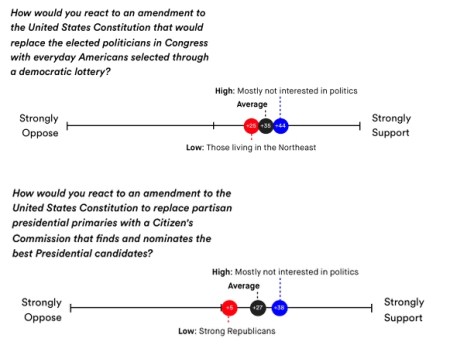
Americans support constitutional amendments replacing voting with lotteries

The chart below is excerpted from the results of an opinion survey conducted for “of by for” – an organization working “to get past parties and politicians and put everyday people front and center”. The organization has high profile sortition advocates such as Lawrence Lessig, James Fishkin and Jane Mansbridge as advisors.

US Sortition Foundation meeting this Sunday

Announcement by Owen Shaffer.

The US chapter of the Sortition Foundation is featuring a presentation from of by for at it’s Sunday online meeting, with a particular emphasis on the work they have done regarding messaging related to sortition. They have passed along some links that provide useful context for the upcoming conversation:

  • Sharing Sortition With Some Soul is an essay that explains some of the major stumbling blocks we run into when talking about sortition and deliberative democracy
  • of by for Polling Results shares key findings from a United States survey they conducted related to messaging and appeal of lottery selection at the highest levels of government
  • Their website (www.joinofbyfor.us) attempts to incorporate their approach to messaging to pitch and generate excitement around a Citizens’ Congress

That’s Sunday 3 May at 4pm Eastern US Time, 3pm Central, 2pm Mountain and 1pm Pacific. Email Owen Shaffer at dShaffer@Lander.edu by Saturday to ensure you receive the connection information in a timely manner, or you can join our email list at http://lists.sortitionfoundation.org/subscribe/usa.

Advantages and Disadvantages of Sortition

This is the second post in a series on Barbara Goodwin’s classic work on sortition Justice by Lottery, University of Chicago Press, Chicago, 1992. The first post is here.

At the start of Justice by Lottery, Barbara Goodwin gives an overview of the history of sortition, which in the beginning was bound up with war and religion. Victory in war meant division of the spoils and since most warriors were full time farmers in their day job (professional soldiers were an innovation of Phillip of Macedon), land grants (hence “lots” of land) to veterans for their service served as a sort of pension.

Tangibles as well as intangibles like power have been distributed by lot since early times. God instructed Moses to order the Jews to divide up tracts of land by lots, and this method of distribution is frequently mentioned in the Old Testament. Land in Athenian colonies was distributed by lot to cleruchs (veterans), and the Romans also parcelled out landholdings for veteran soldiers by lot, to ensure that the most fertile land was impartially distributed: this too, presumably, was God’s reasoning in the case of the Jews.

The Greek word for veteran, “cleruch,” was bound up with clerisy or random distribution. It is also the root of a common word for Christian leaders, clergy. In Christianity, the practice of electing officers at every meeting by lot may have been common in early centuries, but later the clergy disapproved and the practice was restricted to heretical outliers, such as the Gnostics. In Hellas, random choice was not primarily religious, as Goodwin points out. “Despite the Greek predilection for giving political rituals a religious gloss, it appears that no divine weight was accorded.” It was also a Roman tradition, though in different form.

In Rome, the augurs had special responsibility for supervising lots as well as for reading entrails, and they adopted as their symbol the urn, from which lots were drawn. But the reasoning behind their usage of the lot also seems to be common-sense and secular: the lot was chiefly used as a convenient means of determining which of various necessary tasks would be performed by officers of equal rank, such as the two consuls.

Continue reading

Levinson likes Sortition

Noted American Constitutional scholar Sanford Levinson seems to have recently read David Van Reybrouck’s Against Elections. He is full of praise for the book and for sortition in general. His main concern about elections is apparently about rational ignorance, so he focuses on the idea of elections by jury. Displaying an interesting mix of elitist and democratic sentiments, Levinson makes the following comments:

We could obviously discuss at length the degree to which the restricted list generates truly “representative” candidates, given the role played by money or well-located interest groups. That’s the subject for other postings. Rather, let’s assume for the moment that the candidate-selection process is acceptable, and we’re concerned only with how we should structure the choice by the citizenry of who should occupy the offices in question.

I am assuming that any and all trained social scientists would agree that a well-chosen representative sample will produce more “representative” outcomes, whether one is testing the distribution of public opinion or, as in the hypothetical case the selection of a president, than does the baroque process by which we conduct elections. The laity, on the other hand, I suspect would be appalled at this suggestion because we have built up over the years a true mystique about elections per se. Continue reading