Malcolm Gladwell on sortition

Malcolm Gladwell is a well-known popular science author. Gladwell has a podcast called “Revisionist History”. A recent episode of the podcast is devoted to sortition, with much of it being about Adam Cronkright’s work in applying sortition to student bodies in schools in Bolivia. Gladwell himself visits a school in the US and finds that the students are receptive to the idea. He also mentions the idea of using a lottery to allocate research funds.

Testart on democracy, democratic debate and citizen power, Part 2/2

This is the second part of a translation of a 2017 interview in Le Comptoir with Jacques Testart, a prominent French biologist, and long-time advocate for citizen power. The first part is here.

Le Comptoir: Citizen juries have so far been employed in a consultative role. Can you explain what those procedures are and within which frameworks they do they work?

Testart: The democratic procedures for citizen juries or assemblies are very vague. The principle is always to ask a group of allotted people to express their opinion on a certain problem. Citizen conferences, which are the most well-formed model, were invented by the Danish parliament in the 1980’s, perhaps because the Danish MPs are less conceited than ours. They noted that they were unqualified to politically manage technological and medical problems.
Continue reading

Democracy according to Richelet

The Richelet dictionary, edited by César-Pierre Richelet and first published in 1680, was one of the first dictionaries of the French language. The dictionary defines “Democracy” as follows:

Democratie: Gouvernement populaire. État populaire. Forme de gouvernement où les charges se donnent au sort.

Or, translated to English:

Democracy: Popular government. A popular state. A form of government where offices are distributed by lot.

(Thanks to Arturo Iniguez for noting this historical fact.)

Bellon: The sortition pandemic

A column by André Bellon, July 7th, 2020.

This is not the first time that I opine on sortition, but addressing this matter seems to me more and more necessary in view of the avalanche of commentary which has accompanied the celebrated “Citizen Convention for the Climate”.

If the advocates of sortition were able to appear for a while like dreamers, they are now showing their toxicity. They are now are now no longer merely asking us for a convention aimed to enlighten public decision making. They are now demanding an allotted parliament. Considering, with much justice, that the elected do not represent the voters any more, they are not trying to redefine the mandate of the elected. They are proposing to suppress the voters.

An so, Jacques Testart conjures up an allotted constitutional assembly. Just that! The legal expert Dominique Rousseau, who constantly criticizes universal suffrage – which he falsely associates with abbé Sieyès – asks for a new deliberative assembly formed by sortition. To justify his request, he declares: “The nation has its chamber, then national assembly. The territories have theirs, the senate. The citizens, who are everything in society but nothing in its institutions, should have their chamber as well”. Beyond this far-fetched argument, Rousseau feels that in order to be truly represented, the citizens should no longer be voters. To be consistent, he opposes the popular initiative process (référendum d’initiative citoyenne) because it could “ask about the reestablishment of the death penalty, citizen preference or the preventative detention of sexual deviants?”.
Continue reading

The OECD: Innovative Citizen Participation and new Democratic Institutions: Catching the Deliberative Wave

A newly published document from the Organisation of Economic Co-operation and Development draws on data collected from nearly 300 case studies from 1986 to October 2019. Its 200 pages cover randomly selected Citizens’ Assemblies, Juries, Panels and ‘other representative deliberative processes’.

This research and proposals for action fit within the organisation’s work on innovative citizen participation, which seeks to guide countries on the implementation […] of the 2017 Recommendation on Open Government.

The acknowledgements include many regular participants on the Equality-by-Lot blog.

The Canadian organization MASS LBP and the OECD will be launching the publication with a 60-minute Zoom event on 15 July 2020 at noon.

The Potential of Weighted Sortition

This is the 5th post in a series on Barbara Goodwin’s classic work on sortition Justice by Lottery, University of Chicago Press, Chicago, 1992. Previously published parts: 1, 2, 3, 4.

Sortition is hiring without human intervention using random rather than reasoned criteria. Weighted sortition, though, is a statistical narrowing down of randomly chosen job candidates to the more ready among workers available. In Barbara Goodwin’s words, they are “lotteries where some people get extra chances of winning according to their personal characteristics or qualifications.” More broadly, the chances of “winning” a position can be micro-managed to take in any number of other factors beyond qualifications, such as need and desert, both personal and social, both present and future.

Goodwin’s “Justice by Lot” introduced to me the idea of weighted sortition. True, she dismisses it as “impure” compared to completely random sampling of the entire population, but the idea has intrigued me ever since I encountered it here. Admittedly, playing with percentages increases the complexity of choices, but complexity, in an age of supercomputers, data mining and artificial general intelligence (AGI), is not the obstacle it was even ten years ago. A weighted lottery allows for intriguing possibilities never imaginable before. It can factor into every hire whatever evidence-based social science deems well grounded, including experience, aptitude, personal choice and even broader social goals. The difficulty is that the advantages of sortition itself have to be clear to a broad proportion of the population before weighted sortition comes into play, as Goodwin points out,

Only by participation, which is a continuous process, would people acknowledge the authority of a social lottery [p. 71].

Continue reading

Shaw: A transfer of power from the elite to the masses

Ethan Shaw advocates sortition in International Policy Digets:

Voter reform in America aims to increase turnout in elections, however, this focus dismisses the glaring weaknesses of the American democratic process. Congressional approval ratings are abysmally low, and you have probably heard the phrase “Congress is not doing their job” countless times. The problem is not about the accessibility to the ballot box; it is the inconsequentiality of voting that keeps people home on election day. So how does one solve the systemic issues with Congress that promotes voter apathy? By going back to the birthplace of democracy.

A Civic Duty to Legislate

The United States should have mandatory legislative service. Ancient Athenian citizens were randomly selected to serve a 1-year term in a legislative assembly. This process is known as sortition and has been purported by democratic reformists across the globe. In the American political discourse, sortition has never been fully discussed as a viable replacement to the current legislative infrastructure. Many individuals scoff at the idea, worried that random selection will create a legislature full of inept buffoons.

Continue reading

US Sortition Foundation meeting: Inside the first US climate change citizens’ assembly

Announcement by Owen Shaffer.

The next US Sortition Foundation online Chapter Meeting features an inside view of how a citizens’ assembly, and a movement, is built! Maxim Lowe and their team from Washington state are developing a citizens’ assembly to address climate change. They solicited the support of five state legislators, and all are working together to build the citizens’ assembly. More information about their movement can be found here. Note their media attention under “About Us.”

We meet online on Tuesday 7 July at 9pm Eastern US Time, 6pm Pacific. Email Owen Shaffer at dShaffer@Lander.edu for more information.

Macron “accepts all but three” of the CCC’s 149 recommendations

RFI reports:

A day after a powerful push by the Greens in French municipal elections, President Emmanuel Macron on Monday vowed to speed up environmental policies – promising an extra €15 billion to fight global warming over the next two years, and throwing his support behind two referendums on major climate policy.

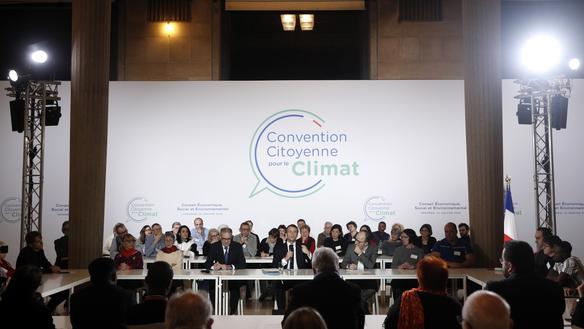
Macron was responding to proposals put forward by the 150-member Citizens Climate Convention (CCC), a lottery of French people chosen to debate and respond to the climate challenges facing society.

During a meeting in the gardens of the Elysée Palace, Macron told convention members that he accepted all but three of their 149 recommendations which would, he promised, be delivered to parliament “unfiltered”.
Continue reading

Feertchak: The Citizen Convention for the Climate does not meet with unanimity

With the Citizen Convention on the Climate publishing its report, Alexis Feertchak writes in the Le Figaro about early reactions.

The Citizen Convention for the Climate does not meet with unanimity
June 20th, 2020

The 150 allotted citizens are voting this weekend for as many environmental proposals. But since its introduction, reactions to this body have been mixed.

“Involve citizens in the governance of transportation at the local level as well as at the national level.” The “technical” tone of this proposal makes it sound more like a recommendation in report of the state bureaucracy than a conclusion of a citizen assembly chosen by lot. It is one of the points that are regularly made on the social networks: if we involve citizens directly in democratic deliberation, we should have been able to get more original results than that one.

Rather than being original, the 150 proposals or so, showing a leftist slant economically, seem quite familiar. Responding to the proposal of reducing the work week to 28 hours (a proposal that was eventually not presented), increasing the minimum wage, taxing dividends, etc., Philippe Bas, senator for [the center-right party] Les Républicains and head of the laws committee, twitted: “The results of the so-called citizen convention are a disappointment: a rehashing of the hymn book of the environmental lobby, (…) economic ignorance, total lack of legitimacy. Sortition exposed as a democratic deception!”
Continue reading