


Steve Taylor, a Senior Lecturer in Psychology at Leeds Beckett University wrote a piece in The Conversation offering his explanation for trouble with the electorlist system. Taylor writes:
The ancient Greeks practised direct democracy. It literally was “people power”. And they took measures specifically to ensure that ruthless, narcissistic people were unable to dominate politics.
Recent political events show that we have a great deal to learn from the Athenians. Arguably, a key problem in modern times is that we aren’t stringent enough about the people we allow to become politicians.
There’s a great deal of research showing that people with negative personality traits, such as narcissism, ruthlessness, amorality or a lack of empathy and conscience, are attracted to high-status roles, including politics.
In a representative democracy, therefore, the people who put themselves forward as representatives include a sizeable proportion of people with disordered personalities – people who crave power because of their malevolent traits.
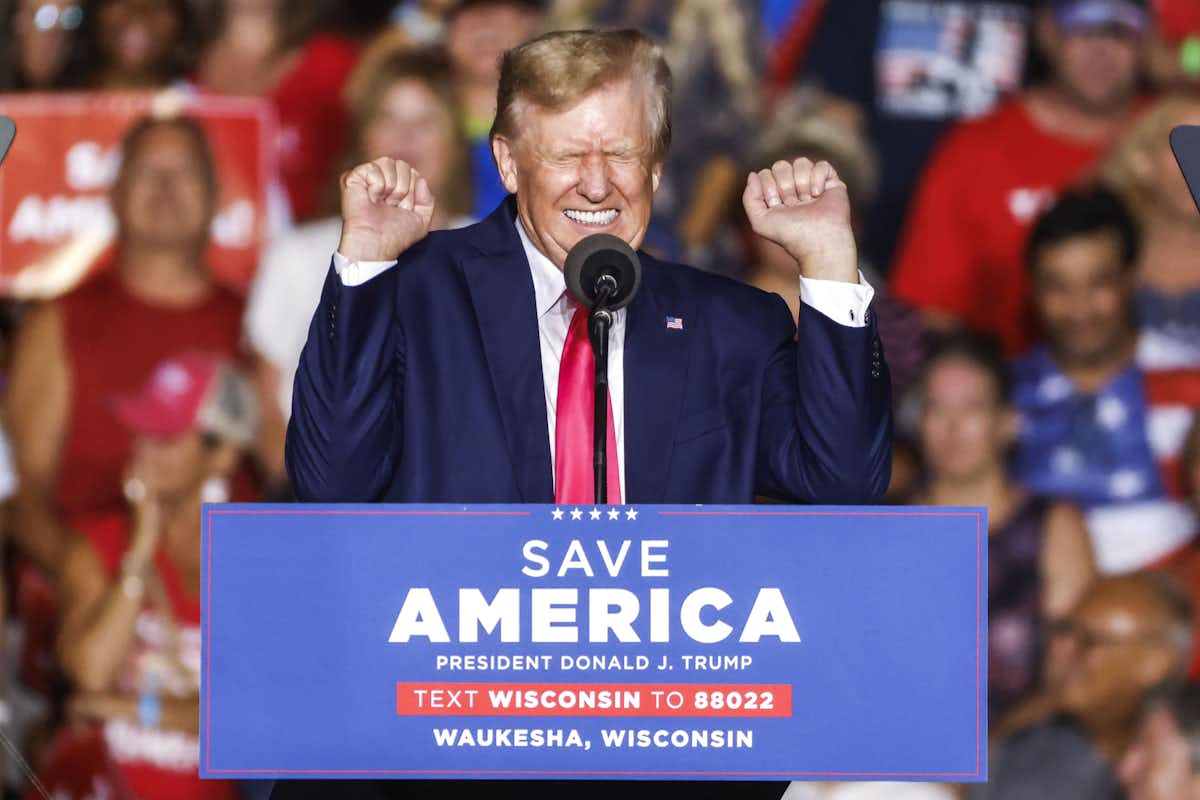
And the most disordered and malevolent personalities –the most ruthless and amoral – tend to rise to the highest positions in any political party, and in any government. This is the phenomenon of “pathocracy”, which I discuss at length in my new book DisConnected.Numerous American mental health professionals have argued that Donald Trump has a serious personality disorder which made him unfit for the role of president. This included the president’s niece, Mary Trump – a qualified psychologist.
One of the key concerns was his apparent failure to take responsibility for his actions or mistakes. Under Trump, the US government effectively became a pathocracy.
Donald Trump screwing up his face and making fists with his hands at a podium reading ‘Save America’.
Trump probably would have found ancient leadership less appealing. EPAIn the UK, Boris Johnson has shown similar personality traits. The most recent example was his petulant, narcissistic reaction to the House of Commons report that found he had deliberately misled parliament on multiple occasions while in office.
Time and again, Johnson has arguably shown a self-deluded inability to admit to mistakes or take responsibility for his actions – along with traits of dishonesty and glibness – which are characteristic of a “dark triad” personality.
According to Taylor, then, the problem is psychological. Elections are putting crazy people into power. Using Trump and Johnson as targets is of course convenient for promoting this idea among the educated classes, who see these politicians as having been propelled into power by the ochlocratic passions of the rubes, passions we have been warned against by Madison and Plato and many others.
Unfortunately the time has passed where we could simply ignore the ochlos and put Hillary Clinton and other members of the natural aristocracy directly in power. But instead we have sortition, which Taylor praises for its Madisonian virtues:
[Sortition] was a way of ensuring that ordinary people were represented in government, and of safeguarding against corruption and bribery.
The Athenians were aware that this meant a risk of handing responsibility to incompetent people but mitigated the risk by ensuring that decisions were made by groups or boards. Different members of the group would take responsibility for different areas and would act as a check on each other’s behaviour.
[Sortition and ostracism] would be a way of reducing the likelihood of people with personality disorders attaining power since they would make leadership positions less attractive to ruthless and amoral people.
Direct democracy means less individual power and more checks and limitations to individual authority. Governments and organisations become less hierarchical, more cooperative than competitive, based on partnership rather than power.
This means less opportunity for disordered people to satisfy their craving for dominance in the political sphere. We would then become free of pathocracy, and all of the chaos and suffering it causes.
The question of why the ochlos prefers the people with personality disorders over the natural aristocracy seems to have never occurred to Dr. Taylor.
Filed under: Academia, Athens, Elections, History, Press, Sortition, Theory |
 Adam Cronkright
 Ali
Ali Ahmed R. Teleb
 avanderven
 avergne
 Alex Kovner
 azakaras
 Brett Hennig
 campbellwallace
 Simon Threlkeld
 Nick Coccoma
 codyhipskind
 Common Lot Sortitionist
 Conall Boyle
 constitutionalism
 davidschecter
 Ethan McCutchen
 graytmatter
 gtridimas
 Henry Tuttle
 H.J. Hofkirchner
 HpR
HpR Carl Lundgren
 James Kierstead
 John Burnheim
 jgarry20151
 Jochen Krattenmacher
 johnedwardtaylor
 johnhuang865
 Jonathan Crock
 keithsutherland
 Jacob Richter
 kkoreilly
 lukewhito
 SimonPek
 Nathan El
 Nicholas Gruen
 Owen Shaffer
 Patrick Chalmers
 Paul Gölz
 peterstone
 Pierre-Etienne Vandamme
 pronfeld
 Emil
Emil rcaze
rcaze richwbrown
 Roger Knights
 roslynfuller
 Pierre-Etienne Vandamme
 shaharavin
 tbouricius
 Ted Wachtel
 Joshua Laferriere
 theodorestathis
 towardsautonomyblog
 Wayne Liebman
 Yoram Gat
 Oliver Milne

Just another example of Trump Derangement Syndrome. The collective West has gone mad. Brexit + Trump + Covid + Ukraine War have imploded the western mind–the more educated the Westerner the more deranged they’ve become. All this to AVOID possibly reflecting that 40 years of failed policy could even POSSIBLY be the reason for the resounding rejection of elitist policies and neoliberalism. Declining living standards, declining life expectancies, deindustrialization? No way, it’s just the uncouth masses, too dumb to obey their betters.
LikeLike
On the other hand, it is true that politics attract the wrong kind of people. But that’s always been the case; so blaming recent “populism,” i.e. rejection of elitism, cannot be blamed on this. Elections are problem precisely BECAUSE they do not respond to popular needs and therefore over time produce regular crises of legitimacy that can only be oppressed by either the use of force, massive propaganda, or war abroad to distract from tyranny at home.
LikeLiked by 1 person
> On the other hand, it is true that politics attract the wrong kind of people
The point is that this may be true, but it is not the root of the problem with electoralism. In terms of the quality of life of the majority of the voters, the nice, “sane” people – the Obamas of this world – are not much better than the “crazy” ones. The problem with electoralism is not psychological, it is sociological.
LikeLiked by 1 person
Good point but it depends on whether the “normal” ones like Obama are not also narcissistic & careerists—which people who had been following Obama tried to warn the public about.
LikeLiked by 1 person
It’s “both and.” Even if some mythological “natural aristocracy” of Madison won elections, they would still favor the elite and be undemocratic… But it is even worse than that! Instead, elections select for the the “natural sociopaths” (not all politicians, but enough to poison the well). Yoram implies that he disapproves of this psychological critique of elections. But I again say “both and.” Even if a person didn’t buy Yoram’s (and my) elite domination analysis, the psychological failings of elections are sufficient grounds for moving to sortition.
As for Yoram’s suggestion that the blame is being placed on the foolish voters… Again I say “both and.” The rational ignorance argument, (which Yoram also isn’t fond of) explains why public relations manipulation by skilled elites (whether psychologically malevolent or not) prevents voters from making thoughtful decisions in elections. This can be solved by a deliberative mini-public. People are either foolish or wise, depending on the circumstances and design of the decision-making process.
LikeLike
Maybe rational ignorance is problematic from a marketing perspective. Supporters of oligarchy constantly point out, the demos is ignorant, therefore we need guardians. The rational ignorance argument points out that sortition is basically transforming “shit into gold”. We take a bad thing, ignorant (idiotic) citizens and then transform them into informed rulers.
Why would Citizens’ Assemblies and Minipublics be better than what we have now? In contrast, the superior politician, shaped by experience and competitive election/market forces, proves his moral and intellectual superiority over the demos.
The inferiority of the demos is then ironically demonstrated with their choice of elected politicians. The demos constantly elects shrewd charlatans, again and again demonstrating the incompetence of the demos and the superiority of politicians who manipulate the masses.
A typical oligarchy supporter concludes, things can only get better when *my particular preferred oligarch* gains power, by election or alternative avenues. The oligarch supporter believes, “At least I’m a bit more informed than the rest of the masses”. He might even be right, because the masses are rationally ignorant whereas the oligarch supporter wastes his time on politics that he has no control over.
A sortition advocate needs to go out of the way to explain the alleged transformation that occurs in a deliberative minipublic. For an isolated, alienated American with NO experience in democratic deliberation except perhaps the online forum, the claims made are then also utterly alien.
In an online discussion, the discussion partner complains about government incompetence, likely driven by voter incompetence. When a sortition advocate proposes “more citizen power” as a solution, the discussion partner is incredulous. “Do you want more Donald Trumps / Marjorie Taylor Greens / etc etc etc running the show??” The science and empirics might demonstrate that we can polish a turd into gold. A typical election/oligarch supporter unfortunately has never seen it happen.
LikeLike
Terry, John,
> The rational ignorance argument, (which Yoram also isn’t fond of)
> Maybe rational ignorance is problematic from a marketing perspective.
This is not a matter of me liking it or not. It is also not a matter of marketing. The issue is that this argument cannot explain the problem with electoralism. As I have pointed out before (and I have not see this point addressed by the promoters of the rational ignorance argument here or elsewhere), as long as there are any good options on the ballot, voters do not need any deep political insights in order to get one of those good options into power. All they have to do is assess their own personal situation and decide whether this situation has been improving or deteriorating. If they keep “throwing the bums out”, then they are bound to sooner or later elect a good option, and then they can stick with that. The fact that this simple strategy does not produce good government indicates that there are no good options on the ballot.
The same argument also refutes the notion that the problem is that people with “negative personality traits” are attracted to politics. As long as there are on the ballot other people who lack those negative traits then the “throwing the bums out” strategy should work. The fact that it does not shows that this is not a matter of choosing the right people from the electoral menu, but rather that the electoral menu does not contain any good options.
LikeLike
>The issue is that this argument cannot explain the problem with electoralism.
Rational ignorance is compelling because of economic arguments and modeling. An example model is presented here: https://www.jasss.org/18/2/3.html
Let’s assume that elections are a competitive, two party market. In this model, voters are rational in that they vote for the party that lies closer to themselves in a “policy preference space”.
In this economic model, because of voter preferences, the two parties converge towards the preferences of the median voter. Democracy and elections are working as intended.
This model contradicts real world findings. In 2 party systems like the United States, the parties are not converging towards the median voter’s policy preferences.
The authors of the paper conclude from their model,
>Our results suggest that well-informed voters, uncompromising party leaders, and limited campaign donations can reduce the influence of special interest groups in a democracy, and furthermore, under such conditions, the wishes of the median voter may have a greater impact on legislative action.
If voters were indeed mostly rational we wouldn’t need sortition. Elections would do the job. I assert that voters are so bad at their job (for good, rationally ignorant reasons) that elections are a failure and therefore we need sortition to substantially elevate the capabilities of voters and transform them into jurors.
LikeLike
Yoram,
So you are not really arguing that rational ignorance (not wasting one’s time to become informed before an election since your one vote won’t make any difference) doesn’t exist, but rather that voters who know nothing about the candidates and have been manipulated could still by using the “throw the bums out” strategy when things are going badly, end up with decent government and then stick with it, IF there were any good candidates on the ballot. I disagree. In fact this was the topic of one of my serialized Substack book posts on Throwing the Bums Out cannot work as a strategy to move in a “desired” policy direction.
https://substack.com/inbox/post/127184567
Even if there were plenty of good candidates on the ballot, rational ignorance prevents elections from being democratic or delivering good government.
LikeLike
John,
> Rational ignorance is compelling because of economic arguments and modeling.
Nice models are useless (or worse than useless, they are misleading) if they do not describe reality. The median voter model, for example, ignores elite interests. It assumes that the competing elites’ only interest is in getting elected and policy is set to serve this purpose. This has things backwards – elites have some policy goals and they want to get elected in order to be able attain those goals.
> I assert that voters are so bad at their job (for good, rationally ignorant reasons) that elections are a failure and therefore we need sortition to substantially elevate the capabilities of voters and transform them into jurors.
How do you respond then to the point that merely following a “throw the bums out” strategy would be sufficient to obtain desirable policy for the voters, even if all they are aware of is their own personal situation?
LikeLike
Terry,
The text you linked to lends no support to your claim that “even if there were plenty of good candidates on the ballot, rational ignorance prevents elections from being democratic or delivering good government”.
It seems you are arguing that because there is a lot of randomness in real world events, it is hard to know whether changes in personal situation should be credited (or blamed) on the government or to chance. (By the way, a point of constructive criticism: I think you could make your argument clearer and more precise.)
This may be true in particular cases, but presumably we can agree that while there are of course events that are beyond the government’s control, government does have a significant impact on the quality of life of the citizens. Therefore, overall, over the a period of years and decades, good governments will tend to produce improving quality of life for the citizens. Thus, if the voters follow a “throw the bums out” strategy, good governments will tend to stay in power while bad governments will lose power quickly. As a result, we would expect to see a long-term increasing quality of life trend and generally high satisfaction with government. Obviously, this is not the case in the US and in the West overall.
LikeLiked by 1 person
>Nice models are useless (or worse than useless, they are misleading) if they do not describe reality.
Even incorrect models are useful as they give indications of what assumptions are faulty, and they give indications of what could be possible if particular assumptions are achieved. For example, this model helps dispel the assumption that voters vote rationally.
>The median voter model, for example, ignores elite interests.
The interests of the elite would be irrelevant if voters made informed choices. The model I link to presumes voters are able to discern the preferences & attributes of elected officials and then make a comparison – Is Candidate A more aligned with my preferences than Candidate B?
>It assumes that the competing elites’ only interest is in getting elected and policy is set to
In the model I link to, they specifically have an oligarchy/special interest model. Oligarchs donate to candidates who then transfer taxpayer money to the oligarchs.
A rational voter with full information would be able to discern which politician provides less transfers to oligarchs and therefore exert electoral pressure to minimize corruption, once again with simple Candidate A to Candidate B comparisons.
>even if all they are aware of is their own personal situation?
That is the crux of the problem. They’re only aware of their personal situation, not the attributes of politicians. Voters are rationally ignorant. That’s why that paper ends with the obvious conclusion, “We need well informed voters”. Easy to say, but how could you actually accomplish that? My answer is sortition.
LikeLike
> That is the crux of the problem. They’re only aware of their personal situation, not the attributes of politicians. Voters are rationally ignorant
You have not addressed my point: If there are good options on the ballot, then by employing the “throw the bums out” strategy, rationally ignorant voters could, by simply voting according to their own situation, select one of those good options over the long run. According to you, why doesn’t this happen?
On your other points:
> For example, this model helps dispel the assumption that voters vote rationally.
> The interests of the elite would be irrelevant if voters made informed choices.
These statements are both false, for the same reason. The model rests on the false assumption that elites’ main objective is to get elected. Since this assumption is false, the conclusion you draw from the model is false.
In fact, being elected is not an objective in itself but a tool for setting policy. As long as there is consensus among elites on a certain policy, they would all implement it once elected, no matter how the voters vote. Electoral competition is primarily about messaging rather than about policy. Policy competition occurs only on those secondary matters on which there are disagreements among the elites.
> A rational voter with full information would be able to discern which politician provides less transfers to oligarchs and therefore exert electoral pressure to minimize corruption, once again with simple Candidate A to Candidate B comparisons.
But if all politicians have the same interests and therefore act essentially in the same way, then no competition can occur. Your position is akin to saying that consumers can, by making choices among different brands, force the producers to sell their products at a loss. As far as the politicians and the associated elites are concerned, there is no point to being elected unless office is used to enrich themselves and their allies, in the same way that for producers there is no point in selling their products unless they make a profit.
LikeLike
> If there are good options on the ballot, then by employing the “throw the bums out” strategy, rationally ignorant voters could, by simply voting according to their own situation, select one of those good options over the long run. According to you, why doesn’t this happen?
I don’t think voters consistently practice retrospective voting, which is itself an inaccurate heuristic, that I don’t believe has convergence characteristics. Every time you vote against a politician because you feel bad, there’s no guarantee that the politician you vote for is better or worse. Which each retrospective vote, voters could potentially be throwing out the better candidate in favor of the worse.
Moreover I think it’s quite clear that marketing and advertising play enormous roles in determining election winners. Advertising can be used to make voters feel bad even if their situation has improved.
The use of highly inaccurate heuristics such as retrospective voting in my opinion makes “rational ignorance” more compelling, not less.
>In fact, being elected is not an objective in itself but a tool for setting policy. As long as there is consensus among elites on a certain policy, they would all implement it once elected, no matter how the voters vote.
Competent voters would understand how to participate in party politics and party primaries to ensure that there is real competition at the polls and candidates who would actually fight for their interests.
I think you’re emphasizing the treachery of elite politicians, but if voters were more competent, politicians wouldn’t be able to get away with that treachery.
LikeLike
> I don’t think voters consistently practice retrospective voting
Maybe not, but this is not a “rational ignorance” issue.
Moreover, you are now ascribing to voters behavior that is not rational. Namely, you are saying voters tend to vote against their own experience. They vote for politicians that provide worse results and against those that provide good results. That is, you are claiming voters are not just “rationally ignorant”. They are irrational and self-harming. That’s a classic elitist anti-democratic argument. Is that really what you are claiming?
> Every time you vote against a politician because you feel bad, there’s no guarantee that the politician you vote for is better or worse. Which each retrospective vote, voters could potentially be throwing out the better candidate in favor of the worse.
Yes, obviously there are events beyond the control of government which add uncertainty to the system. However, on average, over the long run, “good governments” should provide “good outcomes” and should therefore stay in power longer than “bad governments” which on average provide “bad outcomes”. Thus, if there are good options on the ballot, and voters apply the “throw the bums out” strategy, we should expect to generally have good governments and to have a trend of good outcomes. We don’t see this happening.
(It may be worth mentioning, BTW, that when we do see governments staying in power for a long time, being elected again and again, we usually attribute this to some form of oppression, rather than to the possibility that government is “good”. Our standards are so low that a government that seems to enjoy long term popular support is seen as something suspicious rather than a democratic success.)
LikeLike
Rational ignorance means voting is an unworkable tool for democracy, since voters inevitably don’t know enough about policy implications and the candidates. Yoram’s argument that simply picking any other candidates than the incumbent if the voter feels things have gotten worse lately (“throw the bums out”) completely fails. Especially when short term pain (such as taxes) is necessary for long term societal thriving (This is not only the case for climate change, but a good example).
IF the bulk of voters somehow actually had time and motivation to deeply examine policy proposals and implications (as in a sortition mini-public), they would re-elect a government that was making necessary investments to save them and their children from an environmental nightmare. But due to rational ignorance, this is exceedingly unlikely to happen. The party that makes needed investments may make people feel worse in the short term, inviting throwing-the-bums-out sentiments. What is WORSE, the politicians knowing that they won’t be rewarded by re-election for saving the planet and civilization, are unwilling to even advance such ESSENTIAL policies, because they know their political opponents will spin them as “harmful” and “unnecessary,” and the rationally ignorant voters may be swayed by the manipulation.
I am not disagreeing with Yoram’s elite interests argument here (though I do think he is stereotyping, and dismissing real variation among politicians). I am simply saying that even if Yoram’s core argument were WRONG, rational ignorance, by itself, is sufficient reason to do away with mass elections and implement sortition.
Both and.
LikeLike
Yoram, I am not making an elitist argument because I don’t think the elites are any better at voting than the rest of us. The problem of rational ignorance, and yes, irrational voting, infects the vast majority of all of society.
And yes, I think about all voters are irrational. Voters are not self-harming because the probability that each individual vote has any impact at all is about nil. Voters vote because they have been told that it is their civic duty to do so. Yet for example in America, the majority of eligible voters do not vote. Moreover in local elections where political impact is greater, participation rates are even lower. It seems as if a majority of people understand that voting is a waste of their time and therefore don’t bother to do so.
Because voting is irrational but not self harming, I think of it similar to buying a lottery ticket. We can project our hopes and dreams into this lotto ticket, or this ballot.
LikeLike
Terry,
> IF the bulk of voters somehow actually had time and motivation to deeply examine policy proposals and implications (as in a sortition mini-public), they would re-elect a government that was making necessary investments to save them and their children from an environmental nightmare. But due to rational ignorance, this is exceedingly unlikely to happen. The party that makes needed investments may make people feel worse in the short term, inviting throwing-the-bums-out sentiments.
Again we face the plight of the poor elites so committed to a better future but hampered by the foolish voters. It is a such wonder that those same elites are willing to risk the wrath of the voters on so many other matters: bailing out the banks while letting borrowers lose their homes, increasing profits for pharma and medical providers while letting the sick die due to lack of care, etc., etc., etc. It’s only when it comes to policies that actually help the population at large that they let themselves be constrained by base electoral calculations.
It’s not “both”. Yes, people are not familiar with policy details. But they don’t have to. If there were good options on the ballot they would get voted for. In fact, specifically on the issue of global warming, many parties have been voted into and out of power all over the Western world since this has become a political issue. If none of them has taken the necessary actions, clearly there are no options on the ballot for that. Yet you still blame the voters.
Terry, I would think you would be embarrassed writing transparently faulty apologias for the establishment.
LikeLike
John,
> Because voting is irrational but not self harming
As you describe things, voting not according to the “throw the bums out” rule for the “wrong party” is self-harming. It results in poor policy outcomes, while voting according to the rule would result in good policy outcome.
As for elitism: clearly the elites manage to take care of their own interests very well. They are getting more powerful and rich while the large mass of the people are getting disempowered and poor. So according to you it is the masses who are too stupid to know what’s good for them – the elites are doing just fine.
The reason people don’t vote is not because the weight of their vote is small but because they realize that there are no good options on the ballot. We’ve been through this cycle of “this time it’s different” so many times, it’s surprising some people have not yet realized the problem is with what’s on the ballot, not with the voters.
LikeLike
Yoram,
Imagine I am a resident of Houston, TX with a population of 2.5 million registered voters. Total turnout for the Houston mayoral election of 2019 was about 240,000 or about 10% of registered voters. The mayoral victory was 111,000 to 70,000 votes with a margin of about 40,000 votes.
Exactly what’s the probability that I, as an individual voter, has any impact on this local election? Do I as an individual have any way to influence the final outcome? Not really. I don’t have the ability to influence 40,000 people.
I’m talking about a mayoral election. I have even less influence in Congressional and presidential elections.
The math is too complex for me to understand, but generally when mathematicians calculate the likelihood that any of us has any individual impact on an election, the likelihood is about 0%.
Therefore voting isn’t a self-harming activity for an individual because each individual’s vote has no impact on the final outcome.
>They are getting more powerful and rich while the large mass of the people are getting disempowered and poor.
The powerful and rich don’t get their power from voting. Voting has no significant impact on their fortunes. Just like the poor, the rich and powerful also don’t waste their time studiously investigating candidates and becoming informed about candidates and policy. If the rich want influence, they simply use their money as a carrot and find a candidate who will bite.
>The reason people don’t vote is not because the weight of their vote is small but because they realize that there are no good options on the ballot.
Imagine the “best possible” candidate arrives on the Houston mayoral ballot, but unfortunately he has no money and no marketing. Nobody even knows who this person is. How can voters vote for the best when the information just isn’t out there to make that determination? Imagine the best candidate does a hell of a job and manages to convince 10,000 souls with his nonexistent marketing budget. That’s a hell of a feat. That earns him 5th place on the ballot. During pre-election polling he will be considered a likely loser for the entire race.
With First Past the Post voting you can’t just vote for your favorite. Voters, if they care enough to want to try to influence results, need to vote strategically. The typical strategy is to determine who are the top two “viable candidates” and vote for your favorite viable candidate. Because the “best candidate” is never considered viable throughout the entire campaign, “astute rational voters” will refuse to vote for him in order to maximize their ballot power.
“Rational, strategic thinking” actually makes voters vote against their interests! They settle for the best viable candidate instead of the best candidate, because the “spoiler effect” is a huge risk, because all elections with more than 3 candidates are unstable and susceptible to strategic manipulation. This is otherwise known as “Arrow’s Impossibility Theorem”.
So best candidate is going to lose if best candidate doesn’t have the money to play the game. Having “good options” is not enough. Electoral reform nerds have long recognized the deficiencies of First Past the Post voting and therefore recommend a variety of voting methods to attempt to make it easier to elect “best candidate”, to ensure that tactical voters don’t have to make compromises like the strategy I described above. If you truly believed what you are saying, that is the electoral reform we should advocate for. Voting methods such as “Condorcet methods” or “STAR voting” have, using flawed computer simulations, been predicted to perform far better to elect “best candidate” compared to First Past the Post.
But I’m sure you and I both believe that electoral reform is not enough. Even with a Condorcet ranked choice method, best candidate is still going to lose because of his inferior marketing campaign and inferior war chest. How can you vote for the best when you barely even know he exists?
So I don’t think it’s the lack of good options. Elections generally just are a terrible way to organize collective decision making. Marketing and capital is required to transmit information. There are no mechanisms to help facilitate information gathering and deliberation. We rely on the free market to do everything, and the free market is doing a terrible job.
LikeLike
Anonymous is correct… but it is even worse. I worked for over a decade as an election reform policy analyst on things like ranked-choice voting… But even with the best possible voting method, with laws that provide equal campaign funding to all candidates to address the money issue, and the best possible candidates able to leave their jobs and campaign full time, etc. elections STILL can’t work because of rational ignorance. Because voters know their one vote won’t change anything they won’t waste their time learning about policy options or candidates. Yoram derides this argument, by suggesting I am providing cover for elites or saying voters are “too stupid.” It is exactly the opposite. They understand that elections are a waste of their time and attention.
As for self harm… I refer you to a book by Bryan Caplan, “The Myth of the Rational Voter.” While I disagree with much of what he writes, especially his remedy (submit to technocratic rule), he also makes this point: Because voters know deep down that their vote won’t matter, many are able to extract some value from it by using it as a means of expression to vote symbolically to punish or praise people they’ve seen on TV. It is fine if they vote for candidates that would in fact do much harm to them, because their vote for that person won’t actually cause that candidate to win. Caplan coined the term “rational irrationality” to describe the dynamic where voters who have a world view or underlying set of biases that might lead to harmful policies, may gain some psychological pleasure from voting in accordance with their biases, even if the policies are in fact contrary to their demonstrably genuine interests. Since the risk of one’s vote actually affecting the world is nearly non-existent, it makes rational sense to vote in a way that “feels good” and affirms one’s ill-informed biases. This helps explain why many voters vote ideologically but objectively against their own interests.
LikeLike
John, Terry,
I see that you are now both in effect grudgingly conceding my original point that “rational ignorance” would not be sufficient to explain why elections do not provide good policy outcomes. Unfortunately instead of recanting you are now resorting to claims regarding voter irrationality.
As for the notion that this supposed voter irrationality could somehow be justified by having a large number of voters: I am not sure what your argument is. Why is the chance that there is one vote difference in the tally the relevant measure of the harm made by the wrong choice? First, why would we think that such a chance is even a well defined notion? Also, since the voter knows that the same “wrong choice” is made by many others like them, they should be quite aware that their behavior is in fact risky.
Moreover, why would people be wanting to vote for someone who makes their lives worse even if there is absolutely no risk in that? Because they’ve been manipulated into getting some twisted “psychological pleasure” from rewarding their abusers? Definitely seems like a contemptible form of stupidity.
It’s good that you mention Caplan, Terry. This guy represents the real face of the kinds of arguments that for no good reason you seem to be buying into and promoting here and in your book. Caplan is outright pro-oligarchy and is not ashamed to admit it. He is repulsive, but at least he is consistent. Using these arguments to promote democratic ideas makes no sense.
LikeLike
Yoram,
I think your counterclaim is just not justified. You assert that if there was a “good candidate” then surely voters would vote for him. That simply just does not happen in America, for all the reasons we have already raised.
The elites are not actively suppressing people from becoming candidates. The culprit here is Capitalism and limitations on propagating information. As any marketer knows, in order for people to buy your product they must be educated on your product’s existence. And that education – marketing – is ridiculously expensive. Analogously any candidate needs to spend enormous amounts of money to make the public aware of their existence.
It’d be ridiculous to blame normal people for not being aware of a politician’s existence. I haven’t bothered to learn about the benefits, the pro’s and con’s of every product on the market either.
Moreover the government is so huge it’s incredibly difficult for anybody to understand cause and effect. Imagine in Isreal you finally elect your 3rd party into the Knesset. These people are The Best Politicians who follow the Will of the People. They’ve managed to move from 0% of seats to 5% of seats!
Unfortunately because of their uncompromising vision to follow the Will of the People, perhaps they are unable to join the governing coalition. What’s the cause and effect here? Voters voted for Best Politicians, and there is absolutely NO effect. Politics is highly nonlinear and chaotic. Perhaps because of external factors the countries plunges into a recession. Under the heuristic of retrospective voting, the supporters of Best Party should find another party, getting rid of the Best Politicians. The dominating elites can even *engineer* a downturn to just punish supporters of the opposition. Using a flawed heuristic such as retrospective voting would cause voters to vote against Best Politician again and again. Practically, the Best Politicians are indistinguishable in consequence from the Worst Politician.
This isn’t the fault of voters. It’s the system that’s stupid.
LikeLike
John,
> The elites are not actively suppressing people from becoming candidates
They don’t have to – that’s the inherent elitist character of elections. This is the “principle of distinction” (Bernard Manin) that the Athenians were so well aware of and that we are trying so hard to ignore. Normal people cannot become viable candidates because to be a viable candidate someone has to be known by a noticeable fraction of the population, or to be supported by a powerful organization. Both of these are very atypical situations which apply – by definition – only to members of the elite.
> The culprit here is Capitalism and limitations on propagating information.
No – that’s a mis-analysis of the situation which implies that the problem is contingent (on capitalism, on advertising) – and so that it can be fixed. It cannot. It is inherent to the electoral mechanism.
> Imagine in Isreal you finally elect your 3rd party into the Knesset.
Actually, Israel has proportional representation so there are many small parties in the Knesset. Yet, the policy pursued is always pro-elite in a thousand ways (sometimes more shamelessly so, sometimes more timidly, but the general direction is always the same). How could it be otherwise? Do we really expect the elected to act against their own interests as members of the elite? Why should we? People, and groups of people, act in accordance with their own interests. So do the elected. So do the voters.
LikeLike
[…] the trend of previous years. Throughout 2023, there was a steady beat of activity around the world proposing or reporting the application of sortition in various ways for various purposes, along with a stream […]
LikeLike