


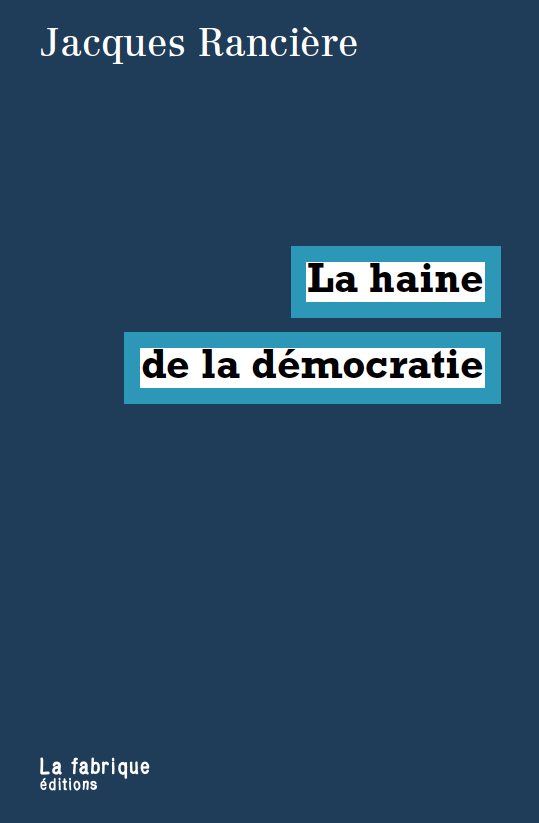
 The second chapter of Jacques Rancière’s Hatred of Democracy (2005), “Politics, or the Lost Shepherd”, contains a fairly long discussion of sortition and its relation to democracy. The following paragraph is from page 41 of the English translation:
The scandal [of sortition] is simply the following: among the titles for governing there is one that breaks the chain, a title that refutes itself: the [Plato’s] seventh title is the absence of title. Such is the most profound trouble signified by the word democracy. It’s not a question here of a great howling animal, a proud ass, or an individual pursuing pleasure for his or her own sake. Rather is it clearly apparent that these images are ways of concealing the heart of the problem. Democracy is not the whim of children, slaves, or animals. It is the whim of a god, that of chance, which is of such a nature that it is ruined as a principle of legitimacy. Democratic excess does not have anything to do with a supposed consumptive madness. It is simply the dissolving of any standard by which nature could give its law to communitarian artifice via the relations of authority that structure the social body. The scandal lies in the disjoining of entitlements to govern from any analogy to those that order social relations, from any analogy between human convention and the order of nature. It is the scandal of a superiority based on no other title than the very absence of superiority.
This is somewhat reminiscent of the “blind break” argument for sortition (by eliminating all reasons for selection, bad reasons are eliminated as well). Later on, for example, Rancière emphasizes the fact that when using sortition seeking power is not a prerequisite to attaining it. But the tone here is quite different. The emphasis is on rejecting traditional or “natural” reasons, reasons that dominate social relations throughout, reasons that justify the elevated status of established elites. It is the rejection of those traditional reasons that scandalizes those elites, as well as many among the masses who have internalized the justness or naturalness of those “distinctions”.
 Adam Cronkright
 Ali
Ali Ahmed R. Teleb
 avanderven
 avergne
 Alex Kovner
 azakaras
 Brett Hennig
 campbellwallace
 Simon Threlkeld
 Nick Coccoma
 codyhipskind
 Common Lot Sortitionist
 Conall Boyle
 constitutionalism
 davidschecter
 Ethan McCutchen
 graytmatter
 gtridimas
 Henry Tuttle
 H.J. Hofkirchner
 HpR
HpR Carl Lundgren
 James Kierstead
 John Burnheim
 jgarry20151
 Jochen Krattenmacher
 johnedwardtaylor
 johnhuang865
 Jonathan Crock
 keithsutherland
 Jacob Richter
 kkoreilly
 lukewhito
 SimonPek
 Nathan El
 Nicholas Gruen
 Owen Shaffer
 Patrick Chalmers
 Paul Gölz
 peterstone
 Pierre-Etienne Vandamme
 pronfeld
 Emil
Emil rcaze
rcaze richwbrown
 Roger Knights
 roslynfuller
 Pierre-Etienne Vandamme
 shaharavin
 tbouricius
 Ted Wachtel
 Joshua Laferriere
 theodorestathis
 towardsautonomyblog
 Wayne Liebman
 Yoram Gat
 Oliver Milne

And why would we want to be ruled by such a capricious deity? It’s worth remembering that blind break theorists view sortition as a prophylactic, rather than democratic, mechanism.
LikeLike
*** Along Rancière “The scandal lies in the disjoining of entitlements to govern from any analogy to those that order social relations”.
*** Actually the radical equality of Athenian citizens, proclaimed by the use of lot, had a strong analogy to another social reality, the equality between the legitimate sons, proclaimed by their equality at inheritance and the possible use of lot to warrant this equality. The democratic system can be seen as the projection of brotherly equality from the micro-community of the nuclear family to the macro-community of the citizens.
*** The family system and the secular use of lot were present in Archaic Greece before the first democracies and may have made easier to create them. Rancière does not consider that.
*** Sure, these parameters did not prevent “hatred of democracy” in many elite circles in Classical Greece. But this hatred had to fight some strong anthropological leanings. Maybe the philosophical systems of Plato and Aristotle are, partly at least, the results of this ideological necessity.
LikeLiked by 2 people
*** In classical Athens, the democratic authority of the assembly, the juries, the legislators, was grounded on the radical equality of the citizens, which lot proclaimed for juries, and for legislators if we accept the thesis they were allotted. In a dêmokratia this equality is disjoined from the reality of inequalities – in beauty, in physical strength, in courage, in intelligence, in education, in property. Some of these parameters may have a political value. But the main political qualities of justice (dikê) and common decency (aidôs) are supposed to be widely distributed – by the gods along the Protagoras’ myth, and if we may suppose there is not perfect general equality of these qualities or other political qualities, we must likewise acknowledge there is no serious objective way to evaluate them. All the proposed ways clearly had always covered an elitist bias : the dimension which, along any specific theory, must entitle to sovereign power (it can be good birth, property, culture …) is actually the dimension which grounds a specific elite superiority.
*** To disjoin the entitlement to sovereignty from all the socially valued dimensions is not something strange, and does not imply discarding these dimensions: it is asserting that sovereignty is a specific dimension, where the dêmokratia gives equal rank to all members of the civic community.
*** This is a choice. But identifying the political (sovereignty) dimension to a specific elite dimension is likewise a choice, and not at all a self-evident choice, except for those who, as members of an elite, feel themselves to be “the best” in the absolute, and therefore entitled to sovereignty.
*** Some elites have a true superiority. For others, it is much more debatable. But anyway the democratic principle rejects conversion of any superiority into entitlement to sovereignty.
*** Sure, the Rancière discourse express well the feelings of many oligarchizing people, whatever in ancient Greece or in the modern world. But it seems to give these feelings a somewhat rational side they have not.
LikeLiked by 2 people
*** Specially Rancière should not consider seriously Plato’s quip (Laws, III, 689e-690c) about the God of Luck giving entitlement to rule in dêmokratia. In no democratic text (Herodotus, Euripides’ Theseus, orators, official texts) there is any hint of such a religious legitimacy for lot.
*** The size of the juries was a guarantee against the whims of luck , and for magistrates the habilitation (dokimasia) was a different guarantee. Actually the habilitation process is evidence against any religious element in sortition, as deciding against the choice of the God would be blasphemy. The same for the rule of non-iteration of allotted magistrates.
LikeLiked by 1 person
> Sure, the Rancière discourse express well the feelings of many oligarchizing people, whatever in ancient Greece or in the modern world. But it seems to give these feelings a somewhat rational side they have not.
It seems, however, that there is a need to explain the power these ideas have in our society. Some sort of logic does seem to be at work, because many people who have little to gain from believing such ideas do in fact believe them and resent the democratic ideal embodied in sortition. Is this just a matter of “natural” vanity, which is as widely widespread in the population as Protagoras’s dikê and aidôs?
LikeLike
*** The reluctance towards sortition depends on many factors. But I think that they may be divided into two classes.
*** First sortition proclaims very strongly the radical equality of citizens in the field of politics, and it will be discarded by all those who, basically, do not accept this equality. They will likewise dislike referendums where they can see likewise a too much crude assertion of this equality. The feelings and leanings in this first class may not be very different in Classical Greece and Modernity.
*** The second class of factors may arouse reluctance towards sortition even among people who accept the radical equality of citizens. It includes, for instance, moral qualms about “Luck” of religious / philosophical origins, fear of manipulation, feeling of defranchizing of the mass, distrust towards a new political institution, and lack of familiarity with the use of lot in the society … The weight of these factors may be different between Classical Greece and Modernity, and may change quickly enough in contemporary societies.
LikeLiked by 2 people
André,
A closely related, but importantly distinct, modern concern related to your first category, (those who reject radical equality), is those who worry about competence. Equality can extend to relatively trivial tasks like getting a vote about who will rule over you, but the “difficult tasks” of governing certainly must require special competence, knowledge and skills that most people don’t have (so the reasoning goes). I have found it useful to make two counter-arguments. Those who seek election are far more likely to be ego-maniacs with a false sense of their own competence, who primarily have skills needed for campaigning (public relations and manipulation), and are NOT more skilled or competent in areas of policy than the average person. And secondly, that because randomly selected people know that they are not experts (not “know-it-all” politicians locked into pre-election party positions), randomly selected people are more competent at absorbing NEW information, able to change their minds, and motivated to consult true policy experts rather than campaign experts who will assess how policy may affect the next campaign. I conclude by stating that ordinary people in a well-designed mini-public, AS A WHOLE GROUP will be MORE competent than homogeneous, self-interested career politicians.
LikeLike
*** I agree
*** but I would add that “choosing who will rule” does not appear as a “trivial task”. It implies to know the personal qualities of the candidates and their links in society, , to study and evaluate their official programs in many important fields, and to guess their not acknowledged programs and their reactions to new events, What a task !
LikeLike
We don’t disagree… Selecting a ruler is actually a near impossibly difficult task… But I meant the casting of a single vote is a trivial task, and does not constitute “self-rule.”.
LikeLike