


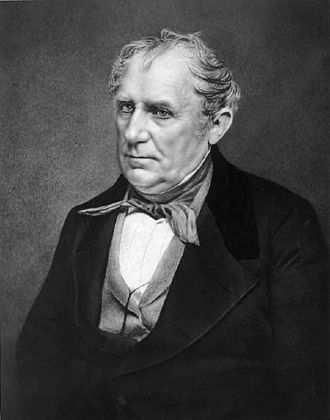
 It turns out that the American author James Fenimore Cooper (1789 – 1851), primarily known today for the novel The Last of the Mohicans, wrote in 1835 a book of political theory titled The American Democrat. The book is a rather interesting document of the political views of the “democratic” elite of his time, which are remarkably similar to the views of the “republican”, explicitly anti-democratic, elite of a generation or two before – i.e., of the American founders.
Underneath the similarity, it is clear that there are now new concerns. While the founders expended most of their efforts optimizing and justifying “checks and balances” and considered their sentiment against the rule of the mob as an easy case to make, Cooper is concerned with dispelling any misapprehensions about the equality of men – indicating that democratic ideology is gaining political power in the early 19th century. Cooper explains to his readers that if men were really thought to be equals elections would be replaced with sortition:
The absolute moral and physical equality that are inferred by the maxim, that “one man is as good as another,” would at once do away with the elections, since a lottery would be both simpler, easier and cheaper than the present mode of selecting representatives. Men, in such a case, would draw lots for office, as they are now drawn for juries. Choice supposes a preference, and preference inequality of merit, or of fitness. (p. 79)
Filed under: Books, Elections, History, Sortition, Theory | 2 Comments »
 Adam Cronkright
 Ali
Ali Ahmed R. Teleb
 avanderven
 avergne
 Alex Kovner
 azakaras
 Brett Hennig
 campbellwallace
 Simon Threlkeld
 Nick Coccoma
 codyhipskind
 Common Lot Sortitionist
 Conall Boyle
 constitutionalism
 davidschecter
 graytmatter
 gtridimas
 H.J. Hofkirchner
 Hanspeter Rosenlechner
 John Burnheim
 jgarry20151
 Jochen Krattenmacher
 johnedwardtaylor
 johnhuang865
 Jonathan Crock
 keithsutherland
 Jacob Richter
 kkoreilly
 lukewhito
 SimonPek
 Nathan El
 Nicholas Gruen
 Owen Shaffer
 Patrick Chalmers
 Paul Gölz
 peterstone
 Pierre-Etienne Vandamme
 pronfeld
 Emil
Emil rcaze
rcaze richwbrown
 Roger Knights
 roslynfuller
 Pierre-Etienne Vandamme
 shaharavin
 tbouricius
 Ted Wachtel
 Joshua Laferriere
 theodorestathis
 towardsautonomyblog
 Wayne Liebman
 Yoram Gat
 Oliver Milne
 Equality by lot