Demiocracy, Chapter 2: What’s the Solution? How

My prescription is to “de-mass-ify” democracy by downsizing and dividing the electorate into multiple, issue-specific “Demi” (small) electorates, each responsible for a single electee. At a stroke the power of the Pernicious P’s would be cut by some 80%.

The representatives must be raised to a certain number in order to guard against the cabals of a few; and … must be limited to a certain number in order to guard against the confusion of a multitude. —The Federalist #10.

Such Demi-electorates would continuously oversee and supervise their single officeholder throughout his/her term, not just during an election campaign.

These Proxy Electorates (PEs) would meet for hours every few months, primarily over a private intranet. Each PE would hear a report from its officeholder (who would have a correspondingly limited, issue-specific scope), pose questions, hear criticisms, discuss matters among themselves, and optionally make recommendations, authorize research, and launch investigations. During intervals individual electors could add comments, do research, chat, message, query the webmaster, etc.

In other words, these PEs would not be solely electors—they would be, at the least, actively involved overseers, and at most semi-legislatures, with their electee being only a functionary, depending on their charter and their mood.

Proxy Electors would be chosen as follows. Each member of the “full” (or “base,” or “mass”) electorate would be given 10 (say) “ballots” with which he/she could nominate similar everyday citizens to be his/her Proxies; no more than three ballots could be cast for any one person, including for him/herself.

All nominations would go into a virtual “bal-lottery box,” along, optionally, with some percentage of randomly selected names—say from 20% to 50%. From the box the names of pending Proxy Electors would be drawn and put into a reserve pool.

This technique is a combination, respectively, of selection (by nomination) and sortition (the technical term for random selection in politics).

There would be four (say) tiers, or levels, of Proxy Electorates: Local, County, State, and National. Bal-lotteries would be used to promote Electors from one tier to the next-higher tier, while remaining as much as possible within a similar issue-specialty (or “topical domain”) —e.g., education, law enforcement, transportation, commerce, etc. These successive bal-lotteries would tend to sift out the invincibly ignorant, improving the quality of the remaining Proxy Electors, especially at the upper levels, where noxious numbskulls would be the most damaging.

A dozen or so single-topic legislators would make up a “Demi” (i.e., small), single-topic legislature. Twelve to thirty Demi legislatures would in turn make up a full, Omni-topic legislature, whose approval would be needed before bills passed by its Demi components became law. Its members would be elected by either Demi-legislators, or Proxy Electorates, or some combination of both.

Proxy Electors would in addition freely nominate their favorite fellow electors for promotion to the electorate at the next level up (town, county, state, nation), using the random selection method already described, which I’ve dubbed a “bal-lottery.”

Demiocracy, Chapter 1b: The (Mass-Electoral) System Is the Problem

It’s been famously said that the general will cannot be represented—only a factionalizing “will of all.” And it’s been found, after man tore free, that Rousseau’s warning was correct.

Rousseau’s fears about representative institutions are everywhere confirmed within the politics of power: Leaders, players or actors become isolated from an audience. —Robert J. Pranger, The Eclipse of Citizenship, 1968, p. 27.

However, the general will can be incarnated in the State—“virtually” incarnated—by inserting a small, or “demitasse,” sample from the whole population. “Demiocracy” is the name I’ve adopted for this Demi-incarnated democracy.

It is rational to use a sample when using the whole would be impossible, awkward, or undesirable. We use a sample as juries for those reasons. Likewise, we use samples in focus groups, in surveys of TV viewership, and in opinion polling.

Demiocracy’s behavior will be revolutionary, though probably not (fortunately) as revolutionary as Rousseau hoped.

To make a revolution is a measure which, prima fronte, requires an apology. —Edmund Burke.

Fundamental progress has to do with the reinterpretation of basic ideas. —Alfred North Whitehead.

The state begins by being absolutely a work of the imagination. Imagination is the liberating power possessed by man. —Ortega y Gasset.

All great truths begin as blasphemies. —George Bernard Shaw.

A man with a new idea is a Crank, until the idea succeeds. —Mark Twain.

A really new idea affronts current agreement. —White’s Observation.

Continue reading

Demiocracy: A Demos-Dominant Democracy, Chapter 1a: The Founders’ Foundation—Neighborly Nomination

If a parliament … is the method, then certainly let us set about discerning the kind of suffrages, and rest no moment till we have got them. —Carlyle, A Carlyle Reader, p. 432.

The fact is, however, that no practical substitute for the present type of representative government, with its dependence on the system of permanent party organizations, has yet been devised…. —James Hogan, Election and Representation, 1945, p. 55.

The recruitment of the deserving by their “familiars” was the basis of the Founders’ political system. Therefore, LET US VOTE the way they intended: not for party politicians, but FOR FELLOW CITIZENS IN OUR “NEIGHBORHOODS”—physical, social, collegial, and familial—who deserve it—hopefully because they exhibit “the requisite wisdom and virtue.”

Let us no longer vote for a slate of presidential electors, whom we don’t know, but rather for people whom we DO. Some of these nominees would become, by random selection, our presidential electors—in other words, our designated political Proxies.

We would thereby select our choices, not settle for a pre-selected name on a menu—hopefully (because we don’t really know his character) the “Least Evil” one of the bunch. Our free selections, on the other hand, would be of better-known quantities, constituting our personal “Best Men” (and Women).

Our Proxy Electors (PEs) would constitute a new and very different Electoral College — a “Popular” one.

Continue reading

America Should Be Ripe for Sortition

Here are a few instances where DeMockery has badly failed us, and where Demiocracy [to be explained later] would have done a better job—and had greater legitimacy with the public, because of its Everyman composition. The priorities of common folk are not as much warped by the Pernicious P’s. (Their relative resistance to Propaganda, for instance, was portrayed by the cynicism of the “proles” in the saloon-set scenes in 1984.)

To me, as to the alienated Greeks I posted about yesterday, these outrages are not just incidental accidents, but revelations of the essential objectionable character of the political class that is nurtured and sustained by DeMockery.

There’s no such thing as a cheap politician. — Ferdinand Lundberg, Scoundrels All, 1968.

  1. The Great Depression, Part 1. I’ve read that some officials wanted the Federal Reserve to be more hawkish in 1927, because a house of cards was a-building due to its loose credit policy. But moderating the roaring Twenties then would have impinged on the wealth of Wall Streeters and dimmed the GOP’s presidential prospects in 1928, so pressure was applied to keep the party going. Even if this speculation isn’t 100% correct, it is the SORT of thing that is likely occur under DeMockery. For instance:

    Also to blame is former President Donald Trump, who repeatedly pressured and even threatened to fire Federal Reserve Chairman Jerome Powell to continue to keep the interest rates low to aid his re-election campaign. When Mr. Trump was first elected, the 2007-09 recession and its aftereffects had more or less ended. But he wanted low interest rates to artificially boost the economy at great expense. He met with the Fed chairman to remind him of his expectations. —Letter to the WSJ, April 10, 2023, by A. Salinity.

    Continue reading

Is Greece Ripe for Sortition?

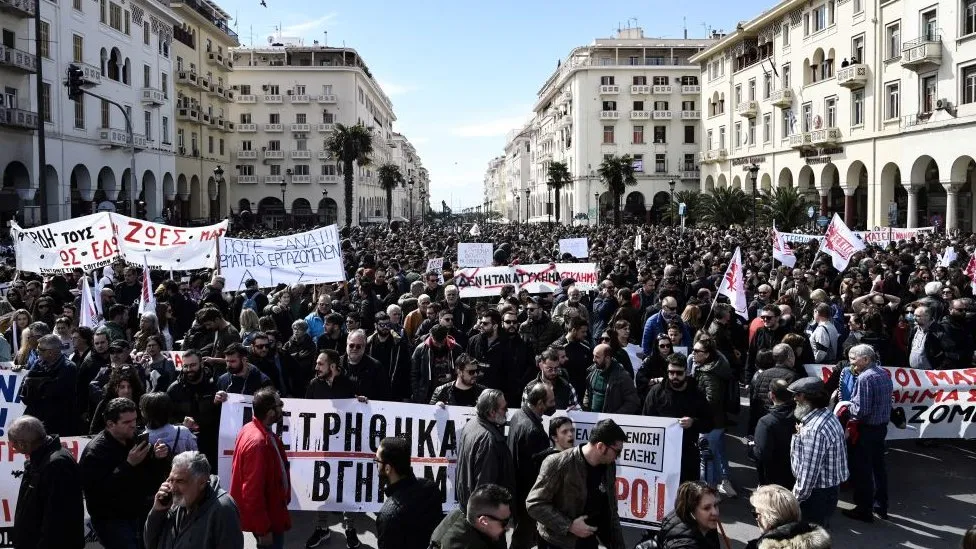
In the First World, Greece seems like the ripest country for sortition, mainly because of widespread exasperation with the entire political system in the wake of its March 2023 railway disaster.

The BBC reported on March 12, 2023:

This tragedy has shaken Greece. So many of the lives lost were young and it has unleashed a national outpouring of grief and outrage mostly directed against the country’s ruling classes. Not for the first time, Greeks feel betrayed by their politicians.

According to early polling, 87% say there are other causes beyond human error, and guilt needs to be assigned. Every day new revelations about the sordid state of Greece’s train network cause more horror, anger and distrust of the political class.

A class that neglected the rail system, privatised operations, spent millions on security systems only to let them rot and wasted vital EU funding.

Continue reading

Tom Paine’s “Common Sense” Says: “Saul Was by Lot”

Common Sense is a pamphlet written by Thomas Paine in 1775–1776 advocating independence from Great Britain to people in the Thirteen Colonies. In it he writes:

Yet I should be glad to ask how they [monarchists] suppose kings came at first? The question admits but of three answers, viz. either by lot, by election, or by usurpation. If the first king was taken by lot, it establishes a precedent for the next, which excludes hereditary succession. Saul was by lot, yet the succession was not hereditary, neither does it appear from that transaction there was any intention it ever should be. If the first king of any country was by election, that likewise establishes a precedent for the next; for to say, that the RIGHT of all future generations is taken away, by the act of the first electors, in their choice not only of a king, but of a family of kings for ever, hath no parallel in or out of scripture but the doctrine of original sin.