


 It turns out that there is a rather interesting yearly report called “Democracy Perception Index” which has been published since 2019. The report is based on opinion surveys conducted in more than 50 countries and in which people are asked about the perceptions of democracy and of the government of the country in which they live.
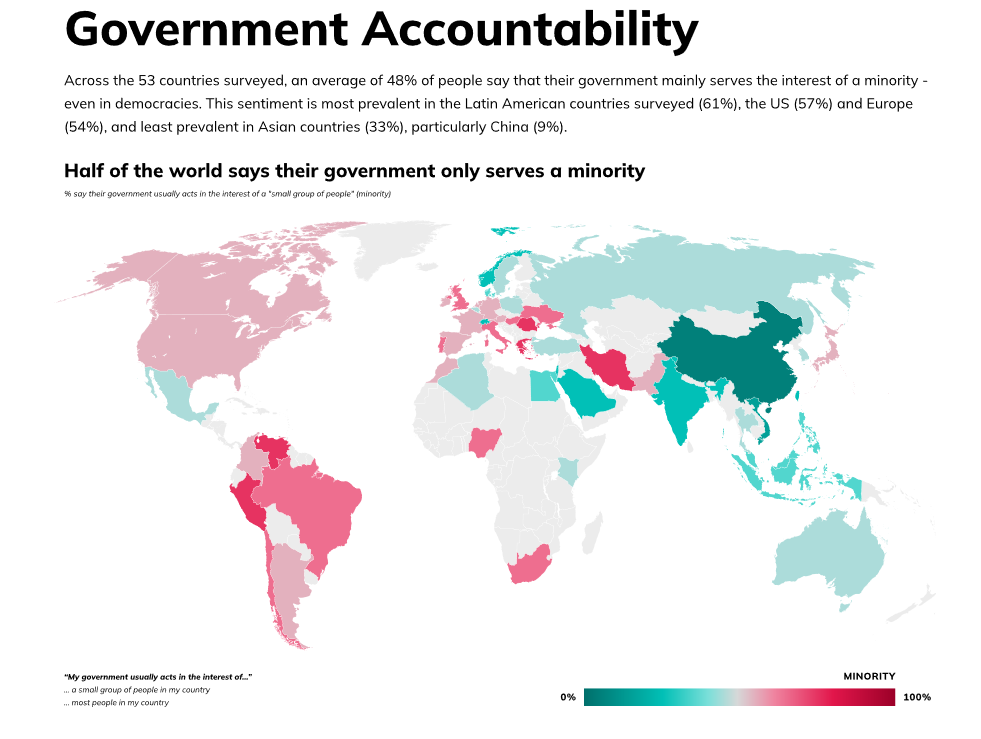
The report is contains various pieces of information of interest. One of the interesting findings in the 2024 edition is that majorities in Japan, in almost all European countries, and in all American countries with the exception of Mexico, see their governments as serving “a small group of people in my country”. In Asia, in contrast, majorities in most countries (with the notable exception of Iran) see their governments as serving “most people in my country”.
Also interestingly, some light is shed on the way people use the under-defined term “democratic”. The criterion people use for stating that their country is democratic is rather more lax than the question of whether the government serves most people. Since majorities in many countries in Europe and America say that their government is democratic, it seems that quite a few Western and South American people are willing to assert both that their government is democratic and that it serves a small group of people at the same time. In China the situation is the opposite: More people assert that the Chinese government serves most of the people in the country than assert that China is democratic, implying that quite a few of the Chinese see China as undemocratic despite asserting that its government serves most people.
Rather bemusingly, the report uses the terms “democratic”, and “free” as factual labels (as opposed to reflecting perceptions) to refer to the Freedom House classification of countries. This follows the convention of referring to [Western] expert opinions as scientific fact, while delegating people’s perceptions of their governments to mere opinion.
Filed under: Opinion polling |
 Adam Cronkright
 Ali
Ali Ahmed R. Teleb
 avanderven
 avergne
 Alex Kovner
 azakaras
 Brett Hennig
 campbellwallace
 Simon Threlkeld
 Nick Coccoma
 codyhipskind
 Common Lot Sortitionist
 Conall Boyle
 constitutionalism
 davidschecter
 graytmatter
 gtridimas
 H.J. Hofkirchner
 Hanspeter Rosenlechner
 John Burnheim
 jgarry20151
 Jochen Krattenmacher
 johnedwardtaylor
 johnhuang865
 Jonathan Crock
 keithsutherland
 Jacob Richter
 kkoreilly
 lukewhito
 SimonPek
 Nathan El
 Nicholas Gruen
 Owen Shaffer
 Patrick Chalmers
 Paul Gölz
 peterstone
 Pierre-Etienne Vandamme
 pronfeld
 Emil
Emil rcaze
rcaze richwbrown
 Roger Knights
 roslynfuller
 Pierre-Etienne Vandamme
 shaharavin
 tbouricius
 Ted Wachtel
 Joshua Laferriere
 theodorestathis
 towardsautonomyblog
 Wayne Liebman
 Yoram Gat
 Oliver Milne
 Equality by lot
Yoram:> quite a few Western and South American people are willing to assert both that their government is democratic and that it serves a small group of people at the same time. In China the situation is the opposite: More people assert that the Chinese government serves most of the people in the country than assert that China is democratic.
That’s correct. Democracy and the serving of interests are distinct concepts, so it is incorrect to suggest that autocratic systems of government are democratic because the population believes that they serve their interests. Perhaps, like Oakeshott’s adoption of the universitas/societas distinction, we need to revert to classical terminology and refer to demokratia and eudaimonia.
LikeLike
[…] are not abating. The electoralist system maintains its record of generating low approval ratings and gestures of rejection by the […]
LikeLike