


I think advocates of sortition should be pointing out the many ways it might be adapted to various different circumstances of our political life. This elides the more fundamental discussion of a preferred constitution, but rather naturalises the idea of sortition as part of the political repertoire. It shows its promise and versatility in helping to detox the current system.
Accordingly here’s something tweeted today —with the full text reproduced below the tweet.
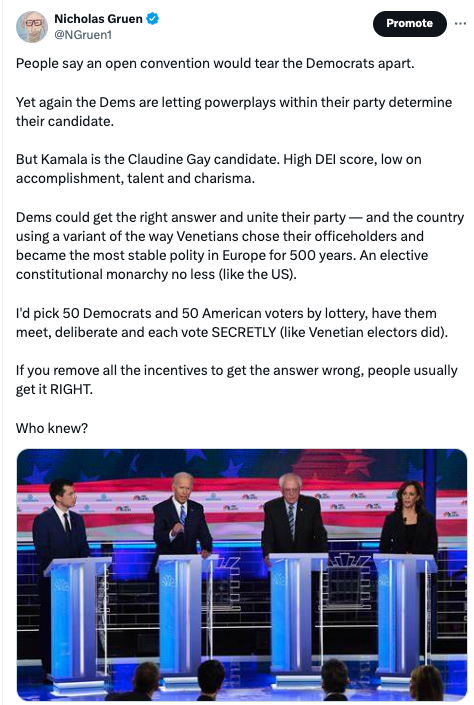
People say an open convention would tear the Democrats apart.Yet again, the Dems are letting powerplays within their party determine their candidate. But Kamala is the Claudine Gay candidate. High DEI score, low on accomplishment, talent and charisma. Dems could get the right answer and unite their party — and the country using a variant of the way Venetians chose their officeholders and became the most stable polity in Europe for 500 years. An elective constitutional monarchy no less (like the US). I’d pick 50 Democrats and 50 American voters by lottery, have them meet, deliberate and each vote SECRETLY (like Venetian electors did). If you remove all the incentives to get the answer wrong, people usually get it RIGHT. Who knew?
https://x.com/NGruen1/status/1815982404542341347
PS: the new interface is so bad, I can’t do better than this I’m afraid.
 Adam Cronkright
 Ali
Ali Ahmed R. Teleb
 avanderven
 avergne
 Alex Kovner
 azakaras
 Brett Hennig
 campbellwallace
 Simon Threlkeld
 Nick Coccoma
 codyhipskind
 Common Lot Sortitionist
 Conall Boyle
 constitutionalism
 davidschecter
 graytmatter
 gtridimas
 H.J. Hofkirchner
 Hanspeter Rosenlechner
 John Burnheim
 jgarry20151
 Jochen Krattenmacher
 johnedwardtaylor
 johnhuang865
 Jonathan Crock
 keithsutherland
 Jacob Richter
 kkoreilly
 lukewhito
 SimonPek
 Nathan El
 Nicholas Gruen
 Owen Shaffer
 Patrick Chalmers
 Paul Gölz
 peterstone
 Pierre-Etienne Vandamme
 pronfeld
 Emil
Emil rcaze
rcaze richwbrown
 Roger Knights
 roslynfuller
 Pierre-Etienne Vandamme
 shaharavin
 tbouricius
 Ted Wachtel
 Joshua Laferriere
 theodorestathis
 towardsautonomyblog
 Wayne Liebman
 Yoram Gat
 Oliver Milne
 Equality by lot
Just because someone is a DEI hire doesn’t mean they aren’t qualified? One does not automatically negate the other. The question is: should the candidate pool be made up of equally qualified candidates or candidates who meet the agreed-upon quality/standard for a given role/field? I thought the entire point of sortition was to widen the field and get more people involved; to restore faith in the system by reminding people that they have a chance to participate and to have their voices/concerns be heard. To serve at the lowest level of public office, perhaps the only qualifier should be: having passed a high school-level civics course and/or the same test which they give to aspiring citizens. At upper levels, like mayor or governor, perhaps there should be higher qualifiers, and on up the chain of command.
LikeLiked by 1 person
>I thought the entire point of sortition was to widen the field and get more people involved.
My understanding is that establishing and selecting from the candidate pool are two distinct stages. The role of sortition in the latter is to ensure that suitably qualified candidates are selected by an arational process. If DEI was felt to be an important criterion then this would need to be applied at the first stage, which has nothing to do with sortition.
LikeLiked by 1 person