


Free Webinar: Lottocracy Versus House of Citizens: Contradictory or Compatible?
The Building a New Reality Foundation is featuring Brett Hennig and Alex Guerrero on April 1 at noon EDT (UTC-4) to present and discuss their ideas, and to respond to audience questions. An optional half hour small group discussion will follow the one-hour webinar. If the time is not good for you, register anyway because we will send all registrants a link to the recording.
The following written “sketches” about the work of BANR’s webinar guests supplement my True Representation (2020) book and illustrate examples of how True Representation might be used in practice.
 Sketch 1: House of Citizens for the UK
I first saw a video of Brett Hennig delivering a brilliant 9-minute TEDx Talk entitled, “What if we replaced politicians with randomly selected people,” in which he talked about “sortition” replacing elections and bringing about the end of politicians.
There is a growing global interest in citizens’ assemblies, with members chosen randomly like a jury, who collectively study issues and provide recommendations to government.
Hennig helps organize single-issue citizens’ assemblies as a way of demonstrating the “wisdom of crowds” but his end goal is to replace elected legislators with citizens chosen by lottery, free from party politics.
He is co-director of the UK-based Sortition Foundation that in 2024 launched Project 858 — a campaign and petition drive calling for the replacement of the utterly undemocratic House of Lords with a randomly selected House of Citizens.
The 858.org.uk website explains:
858 years ago King Henry II shook things up by introducing juries. After eight centuries they’ve more than proven their worth as the backbone of the legal system and now it’s time to put ordinary people at the helm in politics too.
The Sortition Foundation claims that “the House of Lords is a hangover from our feudal past” and that “a House of Citizens would upgrade our democracy.”
Project 858 asserts that random selection ensures that the House of Citizens would be a “mirror to our society making it the first legislature in the world to be 50% women.”
Ordinary citizens are “in touch with the day-to-day reality of life in the UK.”
They would be “guided by experts, on tap but not on top” and would constitute “a counterweight to political corruption.”
The website explains that the House of Citizens would have powers equivalent to those currently held by the House of Lords and would otherwise leave the existing elected House of Commons with its role intact.
The House of Citizens would “hold government to account — shaping, challenging and, if necessary, rejecting government bills.”
It would also “have the power to initiate legislation” and “instigate citizens’ assemblies on topics of national interest and independent public inquiries into matters of significant public importance.”
According to the Sortition Foundation’s Project 858 website:
The members of the House of Citizens would be selected using a three-stage democratic lottery.
Stage 1. Official invitations are sent to 30,000 citizens, selected by democratic lottery, inviting people to register their interest in becoming a member of the House of Citizens, and inviting them to a day of information and discussion.
Stage 2. After the information day, those that accept the invitation are requested to provide some socio-economic and demographic details, such as gender, age, where they live, education level, average regular income, ethnicity and disability status.
Stage 3. An independent body, such as the Electoral Commission, in collaboration with the Office of National Statistics, would then be responsible for guaranteeing the fair selection by democratic lottery of the people from this group in such a way that it represents the make-up of people from all across the UK.
The House of Citizens would have up to 450 members who are chosen for two-year terms.
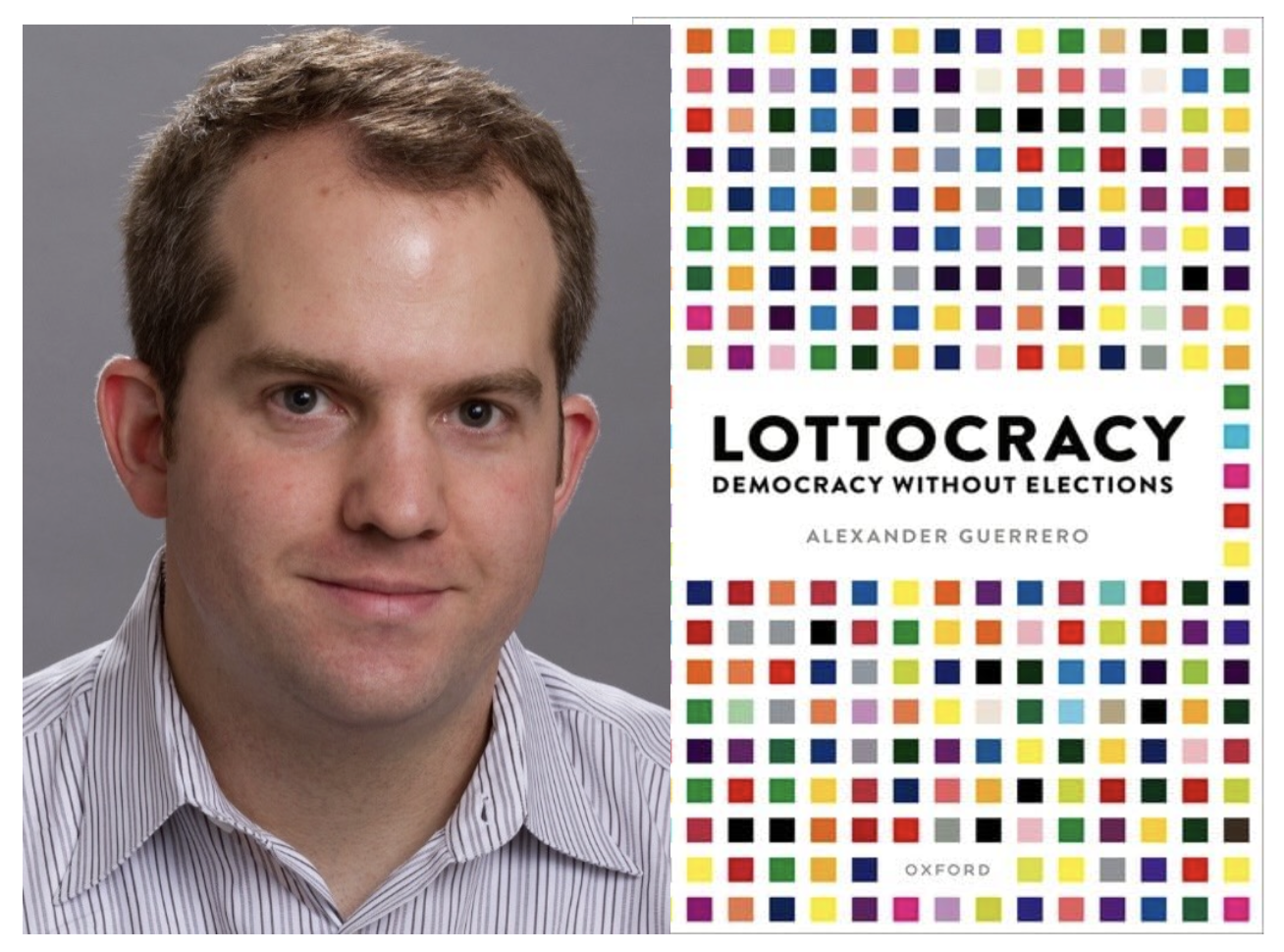 Sketch 2: Lottocracy — Democracy Without Elections
I’ve waited a decade for Alexander Guerrero’s book, Lottocracy: Democracy without Elections.
No exaggeration.
I wrote to him in 2015 after I read his brilliant 43-page journal article: Against Elections: The Lottocratic Alternative, that he published the year before.
He wrote back that he was working on a book based on the article.
I was excited because of our congruent thinking.
I too had been musing about what Guerrero calls SILLs — single-issue lottery-selected legislatures.
In his new book, while he acknowledges that “the most notable feature of the lottocratic system is the central use of randomly selected citizens,” he challenges the conventional thinking that a legislature must deal with all legislative issues.
Instead he proposes “a standing network of twenty single-issue legislative bodies, each comprised of 450 elected representatives,” covering a range of issues from agriculture and food safety to crime and punishment to health and medicine to immigration and naturalization to treasury and taxation.
With specialized legislatures it is easier for ordinary people to develop a reasonable understanding of a particular aspect of government.
His book goes into detail:
Each SILL consists of 450 people, chosen at random, to serve three-year terms, with 150 new people starting each year and 150 people finishing their term each year.
People would not be legally required to serve if selected, but the financial incentives would be considerable (perhaps a floor of $100,000 per year, with anyone whose regular income was above the floor being paid 1.1 times their normal yearly income).
Family and work responsibilities would be accommodated by subsidy and law so that individuals or their families are not penalized professionally for serving.
SILL members would not have contact with certain people or entities while serving on the SILL and would not receive money or other forms of compensation from them before or after SILL service.
There would be some mechanism for removing people for bad behavior—failing to attend meetings, speaking over others or being hostile toward others, showing up intoxicated, etc.—but this mechanism should be structured to protect those who simply are unlikable or who have divergent views.
Filed under: Academia, Books, History, meeting, Proposals, Sortition |
 Adam Cronkright
 Ali
Ali Ahmed R. Teleb
 avanderven
 avergne
 Alex Kovner
 azakaras
 Brett Hennig
 campbellwallace
 Simon Threlkeld
 Nick Coccoma
 codyhipskind
 Common Lot Sortitionist
 Conall Boyle
 constitutionalism
 davidschecter
 graytmatter
 gtridimas
 H.J. Hofkirchner
 Hanspeter Rosenlechner
 John Burnheim
 jgarry20151
 Jochen Krattenmacher
 johnedwardtaylor
 johnhuang865
 Jonathan Crock
 keithsutherland
 Jacob Richter
 kkoreilly
 lukewhito
 SimonPek
 Nathan El
 Nicholas Gruen
 Owen Shaffer
 Patrick Chalmers
 Paul Gölz
 peterstone
 Pierre-Etienne Vandamme
 pronfeld
 Emil
Emil rcaze
rcaze richwbrown
 Roger Knights
 roslynfuller
 Pierre-Etienne Vandamme
 shaharavin
 tbouricius
 Ted Wachtel
 Joshua Laferriere
 theodorestathis
 towardsautonomyblog
 Wayne Liebman
 Yoram Gat
 Oliver Milne
 Equality by lot
Thanks for this Ted, I’m looking forward to hearing it live and taking part in the 30 minutes after.
LikeLike
On Project 858’s claim that an allotted legislature would be the ‘first in the world to be 50% women’ – this is not true. The Rwandan lower house is over 60% female.
LikeLike
>Instead he proposes “a standing network of twenty single-issue legislative bodies, each comprised of 450 elected representatives,”
Is “elected” a typo or an allusion to Headlam (in the sense of “elected by lot”)?
LikeLike
I was too late to register for the webinar. Is it possible for me to see the recorded video?
LikeLike
yes. If you signup for the BANR website, in a few days it will be made available. http://Www.BANR.foundation
LikeLike