


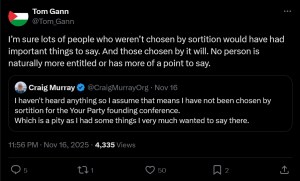
The YourParty conference is taking place Nov. 29th and Nov. 30th, featuring allotted delegates. In an interview in The New Statesman, Jeremy Corbyn, one of YourParty’s leaders, explained the use of sortition as follows:
This is the most important element of Your Party for Corbyn: it has to be representative on a grassroots level. This assessment aligns him far more with the likes of Jamie Driscoll and Andrew Feinstein (who are closer to Sultana) than with his loyal allies, Murphy and Fitzpatrick, who would rather take a more top-down approach. “I think what’s needed is empowerment of our communities,” he said, explaining his hope that the founding of Your Party will be ultra-democratic.
Hence the use of sortition at the party’s founding conference, a process under which individuals are selected to create a random yet representative sample of the population (as championed by the founder of Extinction Rebellion, Roger Hallam). “For conference, I was worried that if we just said to a group, ‘look, you form yourselves into an informal group and elect delegates to conference’, what’s going to happen is those that know each other are going to elect each other, and those that don’t know anybody will be left out,” he said.
As an explanation this is coherent, but the actual procedure does not match this rhetoric at all. While the process does indeed not involve elected delegates, it appears that the allotted delegates are not involved either other than in the demeaning role of extras. The thousands of allotted delegates who are attending during the two days of the conference (in fact, it appears that each delegate attends just one of the two days), clearly have no time to generate an agenda or even discuss a pre-set agenda. They are deprived of even the symbolic role of voting on pre-set proposals (which would not have amounted to anything anyway) since the process includes online voting by any party member.
Filed under: Applications, Sortition | 4 Comments »

 An opinion column in Le Télégramme, a regional newspaper of Brittany, France.
  Octave Larmagnac-Matheron writes in the French magazine Philosophie [
 Adam Cronkright
 Ali
Ali Ahmed R. Teleb
 avanderven
 avergne
 Alex Kovner
 azakaras
 Brett Hennig
 campbellwallace
 Simon Threlkeld
 Nick Coccoma
 codyhipskind
 Common Lot Sortitionist
 Conall Boyle
 constitutionalism
 davidschecter
 graytmatter
 gtridimas
 H.J. Hofkirchner
 Hanspeter Rosenlechner
 James Kierstead
 John Burnheim
 jgarry20151
 Jochen Krattenmacher
 johnedwardtaylor
 johnhuang865
 Jonathan Crock
 keithsutherland
 Jacob Richter
 kkoreilly
 lukewhito
 SimonPek
 Nathan El
 Nicholas Gruen
 Owen Shaffer
 Patrick Chalmers
 Paul Gölz
 peterstone
 Pierre-Etienne Vandamme
 pronfeld
 Emil
Emil rcaze
rcaze richwbrown
 Roger Knights
 roslynfuller
 Pierre-Etienne Vandamme
 shaharavin
 tbouricius
 Ted Wachtel
 Joshua Laferriere
 theodorestathis
 towardsautonomyblog
 Wayne Liebman
 Yoram Gat
 Oliver Milne
 Equality by lot