


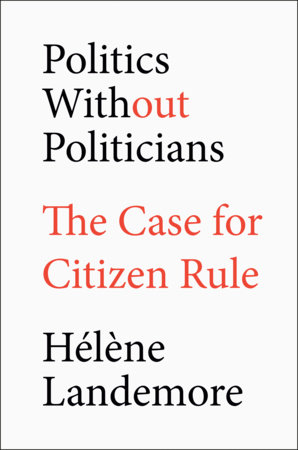
Politicians have failed us. But democracy doesn’t have to.
Bought by special interests, detached from real life, obsessed with reelection. Politicians make big promises, deliver little to nothing, and keep the game rigged in their favor. But what can we do?
In Politics Without Politicians, acclaimed political theorist Hélène Landemore asks and answers a radical question: What if we didn’t need politicians at all? What if everyday people—under the right conditions—could govern much better?
With disarming clarity and a deep sense of urgency, Landemore argues that electoral politics is broken but democracy isn’t. We’ve just been doing it wrong. Drawing on ancient Athenian practices and contemporary citizens’ assemblies, Landemore champions an alternative approach that is alive, working, and growing around the world: civic lotteries that select everyday people to govern—not as career politicians but as temporary stewards of the common good.
When regular citizens come together in this way, they make smarter, fairer, more forward-thinking decisions, often bringing out the best in one another. Witnessing this process firsthand, Landemore has learned that democracy should be like a good party where even the shyest guests feel welcome to speak, listen, and be heard.With sharp analysis and real-world examples, drawing from her experience with deliberative processes in France and elsewhere, Landemore shows us how to move beyond democracy as a spectator sport, embracing it as a shared practice—not just in the voting booth but in shaping the laws and policies that govern our lives.
This is not a book about what’s wrong—it’s a manifesto for what’s possible. If you’ve ever felt powerless, Politics Without Politicians will show you how “We the People” take back democracy.
The book’s title sounds encouragingly militant, and seems to indicate that Landemore is going farther than she did in her previous book, Open Demcoracy. At the same time it is hard not to notice even in the description above some of the familiar and less-than-useful jargon of “deliberative democracy” that undermined the more audacious parts of Open Demcoracy. Are we really supposed to believe that shyness is a major obstacle to democracy? Still, when a Yale professor goes with the title of “Politics Without Politicians”, and wins praise not only from Thomas Piketti, but from economics Nobel laureate Daron Acemoglu, the overall impression is that the idea of sortition as an alternative to electoralism, rather than a way to shore it up, is making some headway, even in academic circles.
 Adam Cronkright
 Ali
Ali Ahmed R. Teleb
 avanderven
 avergne
 Alex Kovner
 azakaras
 Brett Hennig
 campbellwallace
 Simon Threlkeld
 Nick Coccoma
 codyhipskind
 Common Lot Sortitionist
 Conall Boyle
 constitutionalism
 davidschecter
 Ethan McCutchen
 graytmatter
 gtridimas
 Henry Tuttle
 H.J. Hofkirchner
 HpR
HpR James Kierstead
 John Burnheim
 jgarry20151
 Jochen Krattenmacher
 johnedwardtaylor
 johnhuang865
 Jonathan Crock
 keithsutherland
 Jacob Richter
 kkoreilly
 lukewhito
 SimonPek
 Nathan El
 Nicholas Gruen
 Owen Shaffer
 Patrick Chalmers
 Paul Gölz
 peterstone
 Pierre-Etienne Vandamme
 pronfeld
 Emil
Emil rcaze
rcaze richwbrown
 Roger Knights
 roslynfuller
 Pierre-Etienne Vandamme
 shaharavin
 tbouricius
 Ted Wachtel
 Joshua Laferriere
 theodorestathis
 towardsautonomyblog
 Wayne Liebman
 Yoram Gat
 Oliver Milne
 Equality by lot
Landemore promoting her book on nextbigideaclub.com again presents a mix of the good, even groundbreaking (for elite academia, at least), and disappointing clichés. On the one hand, opening strong with:
On the other, Landemore is clearly still addressing the powerful and advising them how to manage the process:
LikeLike
The next issue of the Journal of Sortition is a special issue (edited by Helene Landemore) on the governance of citizens’ assemblies. The issue is, in general, highly critical of top-down management (by the organisers). The passage that Yoram cites above strikes me as no more than a realistic assessment of existing power relations. Social and political change happens in a variety of ways and softly, softly is generally a better strategy to catchee monkey than confrontation.
LikeLike
Sutherland, you are such a pathetic bootlicker.
When Brett Hennig talked about the “end of politicians” you were lecturing him about his “counterproductive (and unnecessary) hyperbole”. Now that Landemore follows Hennig and is using the same language you are falling over yourself to have her editing an issue of your journal. Your servility to authority is cringe-inducing.
LikeLike
Yoram
It’s not “my” journal (except in the narrow proprietary sense) — JoS is a forum for the study of sortition, and open to all contributors (subject to blind peer review). As for “counterproductive hyperbole”, I’ve opined (on this forum) that my own book The Party’s Over (2004) should be consigned to the bonfire, as my own views have changed over the years. And Brett appears entirely content that the services of his Sortition Foundation should be taken up by political and other elites.
Your insistence on confrontation (and monocausal doctrinal purity) puts you in a minority of one and is the reason why academic commentators have boycotted this forum (you even managed to alienate Alex Guerrero).
LikeLike
[…] review of Hélène Landemore’s Politics Without Politicians by Gaby Hinsliff in The Guardian makes the predictable points. Substance aside, the very fact that […]
LikeLike
[…] Gordon, Senior Fellow at the Mises Institute and editor of the Mises Review, wrote a review of Hélène Landemore’s Politics Without Politicians. Some […]
LikeLike