Why worry about equality

We all gain in numerous ways from the fact that we are all different to varying degrees in most respects. Strict equality in any respect can only mean uniformity in that respect. Equality as such is not generally a good thing. Certain varieties of socialist thinking that focus on eliminating inequalities inevitably turn out to be very oppressive. (Marx himself was not guilty in this respect.)

However there are many kinds of inequalities that have very detrimental effects on people’s lives. Some of these are due to natural causes, like many physical disabilities. It is to the credit of the much-maligned “nanny state” that we devote quite a lot of resources to helping people with disabilities to participate in as many areas of social life as possible.

Many other injurious inequalities are socially constructed, sometimes deliberately, but often as an unintended result of activities, some legitimate, others criminal undertaken for other reasons and causes. Some of these are remediable without recourse to compulsion, simply by dissuading the culprits from doing certain things, often just by shaming them. Those so shamed often attempt to deride this as “political correctness”. Obviously it can go too far.

Even those activists who operate principally without invoking political authority sometimes try to have the activities they want to suppress declared illegal, not so much in order to impose legal penalties on their targets as to show their opponents that the nation collectively disapproves of what they do. Obviously, that can help the activists to defend themselves from the imputation of being an idiosyncratic clique. It is a two-edged sword. Concentrating on legality invites the response that nobody has a right to criticise people who are doing what they are legally entitled to do. Usually the sorts of activity in question are mainly matter if intent in acting and notoriously difficult to prosecute. So some egregious offenders escape. Moral matter should as far as possible be left to moral suasion. Continue reading

Aspects of decision-making

1. Public affairs and rational ignorance.

The argument: It is rarely rational for anybody to vote or engage in some other political activities because the chance of influencing the outcome is so infinitesimal that it does not merit the slightest effort.

Reply. That is one consideration, but it is not only a false picture of the thinking of most people, but not the only rational consideration. Many, I think most, voters also recognise two other dimensions to their role as voters.

One is that they see voting as an expressive act and feel it is important to them to express themselves in this way. That is why opposition voters still turn out to vote in what is a safe seat for the incumbent party. Moreover, voters are concerned that in expressing their support for a candidate or a party they are ding something that reflects credit on them. So they are concerned to exercise what influence they can on that candidate or party to adopt policies that they find admirable.

Another reason why the selfish approach is not rational is that people quite rightly do not take an entirely selfish attitude to public goods. Their identity as members of a particular community is closely bound up with the quality of the public goods in which they can share as members of the community. So they do have an interest in the quality of the community’s educational institutions, even though they do not expect any particular pay-off to them from those institutions. Moreover, they are usually well aware that the sort of cost-benefit analyses that reduce benefits to measurable benefits to individuals leads to a penny-pinching approach to funding policy decisions that is often destructive and counterproductive in its effects. It is not rational.

That is not to say that it is improper in choosing to support one rather than another of competing proposals about, say, an educational program, to do so because it suits one’s own interests better. Practical decisions are rarely one-dimensional. They involve diverse, often competing, considerations in varying degrees in different contexts.
Continue reading

Demarchy and the ways of the world

1. Demarchy assumes that enough people will engage in the complex of serious activities it is supposed to work on to convince people that the outcome of those activities can claim to represent public opinion.

Looking at the way in which public opinion is in fact formed in our society that seems an absurd assumption.

Even if we go back to Habermas’s beloved 18th century coffee house it is utterly unrealistic. Public opinion emerges from a host of conversations in which what is going on or what is proposed is talked about in terms of familiar images. What is prized in conversation in all sorts of social contexts, from groups of labourers on lunch break to elite dinner parties is wit, the remark that encapsulates a way of looking at a subject in a new light that is at least in some respect plausible.

The cardinal sin in conversation is to insist on spelling out in detail just where that slant on the subject is misrepresented. People are not expected to take casual remarks seriously. That is utterly boring and destructive of conversation. Nevertheless there is overwhelming evidence that people are very strongly influenced by the cumulative effects of the caricatures that prevail in representations of ideas and states of affairs and come to be seen as expressing public opinion.

Even very sophisticated people succumb to this sort of conversation, because they are very aware that political affairs are usually so complicated that there is little chance of arriving at a rationally justified analysis and verdict on them. One just despairs or hopes that the obscure processes of social change will tend towards decisions one can live with. But there is no prospect of getting reliable decisions about political matters by discussion. So Demarchy is nonsense.

Reply: I concede there is a great deal of truth in this picture, but as a generalisation it is too sweeping. At the risk of being boring I shall try to explain why. There are several aspects to it.
Continue reading

The practicalities of demarchy

1. In order to be THE voice of public opinion the council advancing that claim would need to be unique and unchallenged. But if anybody can set up a rival council, that is impossible. If anybody takes it seriously, it will be challenged and rivals set up.

Answer. There are two stages in the proposal: a fully open public discussion and the council attempting to draw a practical policy from that discussion.

The public discussion will be unique if the Foundation sponsoring it has adequate resources to publish and render accessible on line every word that anybody thinks relevant to the problem under discussion. If anybody sets up a rival forum, all of its content will be posted on the original site, where it could have been posted at no cost. So if somebody refuses to allow certain material to be posted, they are refusing to offer it for public scrutiny.

How might they justify that refusal?

Perhaps it is copyright, and they demand to be paid for it. In a genuine case, the foundation might agree to pay whatever any other user would pay for it. In some cases a reference to sites on which it has been published might suffice.

In other cases the appeal might be to confidentiality, for example, in the case of survey documents. That sort of confidence protects the identity of contributors to the survey, not its content. When it comes to privacy about the actions of individuals and organisations, such privacy can never be invoked in a way that favours a competing open forum. It has to remain private.

Some may argue that the way in which the problem is described by the foundation in initiating discussion is subtly biased to exclude certain viewpoints. In that case they need to state their case and argue it publicly.

A completely open forum, including full documentation on the proceedings of the foundation, can be reduplicated, but the only point that could have was to try to exclude certain contributions. And that cannot be done with impunity.
Continue reading

The Demarchy Manifesto

71157100257740l

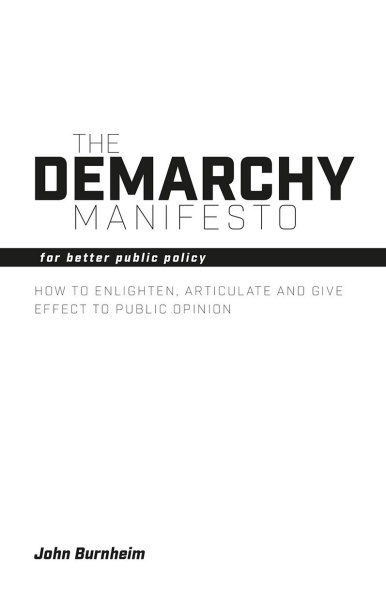
Many kleroterians are bound to be disappointed in my new book The Demarchy Manifesto, due to be release from Imprint Academic on March 1, because it makes no proposals for replacing voting in favour of sortition in existing institutions, but only in the new voluntary institutions I propose. I believe it is necessary to start this way, since it is extremely difficult to persuade people to give up their vote, but they are prepared to consider sortition where it gives them access to a chance of participating that they do not at present have. This is just an instance of a general pattern in the way that the presentation of options makes a great difference to the evaluations people make of alternatives. You might like to look at this article in the US edition of The Conversation for February 6.

The book suggests that we can snatch the initiative in discussing and formulating public policy from the political parties and produce proposals that they have to accept on pain of voter backlash. I think that there is just a chance that my proposals would consolidate the middle ground whereas the existing procedures encourage the extremes. More fundamentally I aim to move attention from “who gets what” to the sort of public goods that we all can take pride in.

An excerpt from the Introduction to the book:

What I call ‘demarchy’ is primarily a process of transferring the initiative in formulating policy options from political parties to councils representative of the people most directly affected by those policies. The task of those councils would be to distil from public discussion the most acceptable policy in a particular matter. It would be up to voters to insist that the politicians heed them. There is no question of constitutional change, no new parties or new laws, no call for a mass conversion of opinion, but a suggestion about how to initiate a change in accepted practice, starting with actions that may seem of little significance in the big picture, but are still justified by their specific purposes. My focus is on how policy is produced and adopted. I am not concerned with questions about the philosophical basis of state power, or human rights, or crime and punishment. The precise forms these things take in practice are a matter of conventions, which I do not propose to challenge. There is already much debate about these matters. I am concerned about what I see as a more important, but neglected, question.

I begin by concentrating on how to establish some new practices and initiatives in policy formation, empowering those most affected to take the initiative in formulating what they want. It is no advantage to have a choice of products if none of those on offer meets your requirements. The best situation is to be able to say exactly what you want and commission specialists to supply it. Or is that analogy anachronistic and inappropriate in the era of mass production and distribution? I try to analyse our unique problems. My ultimate aim is to transform our political culture. I intend to show how different practices of policy formation are appropriate to different problems at every level from the local to the global and how they might come to be accepted.
Continue reading

How to introduce sortition in policy-making without constitutional change

The salient feature of modern democracy is that those who wield legislative and administrative power are chosen by popular vote in open competition between candidates. In practice the candidates generally present themselves as representatives of a party with a distinct ideological emphasis. Some voters who share a particular ideological position will normally support the same party, though they may disagree on many matters of policy. Others, less ideologically committed, are “swinging voters”, taking a more pragmatic view of which party to support. In either case, voters are constrained to chose between packages of personalities, policies and promises. The processes by which the parties arrive at these packages are not very transparent and are widely distrusted. For good reason, as I shall attempt to explain.

The alternative I propose is that the policies we adopt in any specific sphere of public decision-making should be determined by bodies that are statistically representative of those most directly affected by what happens in that sphere. These bodies would have no formal constitutional status. They would depend for their authority on community recognition. We would constrain our elected representatives to activate those decisions in legislation and administration on penalty of not being elected or re-elected.

Instead of being consumers faced with a choice between packages over whose contents we have little influence, we forfeit any attempt to impose an ideological flavour on the whole range of public decisions and concentrate on getting sound decisions in those matters that affect us most. The focus of these bodies would be on specific problem areas. There would be no attempt to prescribe for every possible eventuality. The whole would be treated as an ecosystem that mostly looks after itself, as various interactions adapt to eacn other. It is far too complex and unpredictable to be planned, but its stability and development are constantly being threatened by various human activities that may need to be regulated or eliminated.
Continue reading

A proposal to solve a very urgent problem – part 2 of 2

The first part is here.

There are very many matters that need to be regulated by independent international authorities, most obviously the international movement of money. Trafficking in money is worth more than the sum of all other international trading. Money makes money without being involved in any productive process. Many economists believe that some of the worst features of this situation could be removed by imposing a very small tax on such transactions. But it is difficult for any state to do so in the absence of any international authority in the matter. Choosing the personnel of a competent, independent and recognised authority by lot from a pool of nominees, subject to appropriate conditions and safeguards, is a key element in setting up the required kind of body. However, different procedures will be needed in different contexts.

One problem with simple sortition is that in situations where a large relatively homogeneous majority is accompanied by a number of differing minorities a sample that simply reproduces their numerical distribution may lead to a decision pattern that is very unfair to the minorities. The problem is distressingly familiar. Ultimately, reducing its salience is a matter of breaking up totalizing communities, not to destroy them as communities, but to enrich them by emphasising the variety of people within any community and their multiple connections to similar people in other groups. Community is never reducible to uniformity or to any single objective.
Continue reading

A proposal to solve a very urgent problem – part 1 of 2

Global action on the global problem of human-induced climate change is stalled. In most countries action has become a victim to internal politics and also to the absence of any international authority capable of organising a concerted response. Everybody waits for others to do something.

The politics involved in the workings of the UN prevent it from providing a solution to the absence of an international authority, and attempts to get one set up by treaty seem hopeless.

In this situation even the scientific authority of the IPCC (International Panel on Climate Change) has come into question. It is alleged to be biased and complicit in the attempts of certain vested interests to exploit fear of catastrophe. Also it is not effectively answerable to anybody. There is obviously not just some plausibility but some substance in these accusations.

There is no doubt that everybody who works for the IPCC is already convinced that climate change is dangerous and that it is at least exacerbated by our use of fossil fuels. They want to find more evidence for their view. They may be nominally responsible to the UN, but in practice that is illusory.
Continue reading

Sortition and accountability

Sortition relies on the people selected being themselves affected by the consequences of their decisions in order to ensure that those decisions are in the interests of the people they affect. I think advocates of sortition often underestimate the problem of cognitive and affective distance from the specific impact of those effects when the issues are treated in terms of very general policy decisions. We have a tradition of fairness as impartiality that can be very dangerous when combined with legalistic and bureaucratic top-down approaches to solving those problems of public goods that require organised solutions. Looking to the state to provide these solutions virtually guarantees that no matter how those making the decisions are selected, they will be constrained by the system to choose ways of conceiving and dealing with them that abstract from many things that are important to various sections of the communities affected.

The closer the people who decide are to the grass roots, the more likely they are to be responsive to the specifics of the diverse needs of a community and to evolve by negotiation between diverse interests solutions that offer as much as possible to each of them. In my view sortition must start at the grass roots with very local health, education and welfare institutions and programs, on a basis of constructive deliberation, designed to lead to better recognition of needs an possibilities rather than simply react to current opinion.

People know this, but regard it as unrealistic, because the crunch question is financing and the state ultimately controls that through its monopoly of taxation. I have a suggestion for getting around that difficulty. Let the state allocate funding to specific bodies (not just local but also national and international specialised agencies that are controlled demarchically) in much the way it does at present, but allow it only a very weak say in how the money is spent by the bodies so financed. Those bodies will often want to spend more than they are granted, given the ubiquitous outcries against underfunding of public goods and services. People often express willingness to pay more for public services if only they could be assured of getting the service they want.

If an authority wants to spend more than its allocation of taxpayer funds there could be an arrangement whereby those entitled to its services paid an excess on their income tax to cover the extra expenditure. As members of that constituency, statistically representative of its needs, the committee would be in a position to make a realistic judgement about whether they were willing to pay as a community for meeting those needs. That would constitute practical accountability.