Equality by Lot 2025 statistics

Below are some statistics about the 16th year of Equality-by-Lot. Comparable numbers for last year can be found here.

2025 Visitors Posts Comments
Jan 778 7 28
Feb 708 6 22
Mar 1,249 7 41
Apr 1,639 8 48
May 1,985 7 32
June 1,739 3 13
July 2,232 4 3
Aug 5,550 6 28
Sept 10,673 4 25
Oct 11,760 4 48
Nov 16,893 9 49
Dec (to 27th) 17,363 6 14
Total 72,569 71 351

This year’s number of page views statistics as reported by the WordPress system show very large spikes that probably indicate some sort of automated activity that is not being filtered by the WordPress data gathering. The bar chart produced by the system is completely distorted by these spikes and I therefore do not post it this year. I switched to tabulating “visitors” rather than “page views”, since the former seem somewhat more stable. I am not sure how “visitors” are counted and how reliable the counting is. In any case, comparison with viewership statistics of previous years may not make sense.

Posts were made by 12 authors during 2025. (There were, of course, many other authors quoted and linked to.) This blog currently has 398 are e-mail subscribers and 152 WordPress subscribers.

Searching for “distribution by lot” (with quotes) using Google returns Equality-by-Lot as the 5th result. Equality-by-Lot is on the bottom of the first page of results (9th link) when searching for “sortition“. (Google no longer provides an estimate of the total number of results for the search terms.) Asking ChatGPT “what are good websites about sortition?” does not return (for me, at least) Equality-by-Lot as one of the recommendations.

Happy holidays and a happy new year to Equality-by-Lot readers, commenters and posters. Keep up the good fight for democracy!

Self-serving elites and the conception of the “good”

It is only to be expected, and is generally acceptable, that a person or a group with decision-making power would use that power to shape the world in ways that seem “good” to them. In this sense being self-serving – trying to shape the world in ways that please the shaper – is benign. In the context of large scale politics this translates into the elites in society running society in ways which seem “good” to them. In this sense the elites being self-serving is benign (at least to the extent that the Iron Law of Oligarchy – i.e., the existence of a powerful political elite – is considered as a given).

The question is, of course, what do the elites see as “good”. As Western political thought presents things, elites tend to be, or at least over time tend to become, corrupt and see “good” as including, or even mainly as, the control of material goods by the elite and the control of the non-elite members of society by the elite. The “good” as the elite sees it is then in conflict with the “good” as rest of society sees it. Another, more recent, component of Western political thought is that elections are, through some mechanism (that is rarely examined very closely), an effective way – indeed, the only effective way – to prevent this corruption and to align the conceptions of the good of the elite with those of the rest of society.

It turns out that elections are not a particularly good mechanism to align the conceptions of the good of the elite and the non-elite population. Continue reading

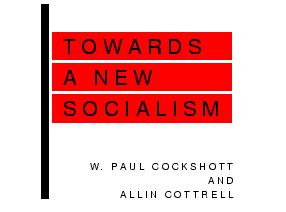
Cockshott and Cottrell: Toward a New Socialism

Back in 2010 and 2011, I wrote a couple of posts on this blog linking to writings by Paul Cockshott about sortition. Cockshott, who is a Marxist economist and a computer scientist, himself followed up in the comments.

I did not know until very recently, however, that Cockshott, together with a collaborator, Allin Cottrell, wrote in 1993 a book called Toward a New Socialism [full text PDF] which makes a case against elections and for the use of allotted bodies in government. While the book focuses mostly on economic planning, chapter 13, “On Democracy”, presents an insightful analysis of the oligarchical nature of electoralism as well as of the problems associated with two standard Marxist alternatives, soviets and communist party dictatorship. The analysis uses the historical cases of Athens and the Soviet revolution and also make mention of Burnheim’s Is Democracy Possible? (1985).

Some excerpts:

Chapter 13: On Democracy

Utopian social experiments are strongly associated in the public mind with brutal dictatorships and the suppression of civil liberties. Given our century’s history this is to be expected. Although there is a growing realisation in Britain of a need for constitutional change, visions of what this might involve are modest. Devolution of power to regions and alternative parliamentary electoral systems may be open for discussion, but the supercession of parliamentary democracy itself is almost unthinkable. Our object in this chapter is to think the unthinkable—specifically, to advocate a radically democratic constitution. We outline a modernised version of ancient Greek democracy, and defend such a system as the best political counterpart to socialist economic planning.

Democracy and parliamentarism

It is one of the great ironies of history that election by ballot, for millennia the mark of oligarchy, should now pass as the badge of democracy.
Continue reading

Sortition in 2025

Equality-by-Lot’s traditional yearly review post. For previous editions look up each year’s December posts.

The most important sortition-related development of the year was undoubtedly the decision by YourParty in the UK to allot the delegates to it founding conference. This decision created an intense discussion around sortition, a discussion that was unprecendented certainly in the UK specifically, probably in the entire Anglosphere, and possibly even in the modern world.

Many activists were horrified to find that sortition stripped them of their standard privilege associated with their established organizing and willingness to invest time and resources. The claims that the whole setup was a way for the organizers to control the process were substantiated by the setup’s details: Thousands of allotted delegates gathered into a hall for a two-day event, inevitably forcing them into the position of passive audience, eliminating any possibility of setting the agenda for the conference. Interestingly, one of the decisions adopted was a rather vague commitment to allotting some of the delegates of future YourParty conferences.

Another notable event was the posting on YouTube and TikTok of a “Subway Take” by the Academy Award winning actor Riz Ahmed in which he proposed to “stop having all elections and elect leaders through a random lottery”. On YouTube the post has now been viewed over 2.5 million times and garnered almost 200,000 likes.

Within the standard academic sortition mud stirring, one proposal stood out: using sortition to create democratic investor assemblies for controlling corporations.

Finally, the electoralist crisis in the West continues to unfold. An opposition candidate who unexpectedly won the first round of presidential elections in Romania was disqualified and the leader of the French Right was barred from participating in upcoming elections after being found guilty of illegal management of party finances.

Juries for democracy

Sam Wang tells the story of how a grand jury refused to indict a man for assault by sandwich, segues to allotted electoral districting commissions and concludes with the following

Jury-style mechanisms may be one of our best remaining tools for fair governance.

Bouricius in Jacobin

Coinciding with their interview with Alexander Guerrero, Jacobin magazine has an article by sortition advocate Terry Bouricius. The article’s title is “Sortition Can Help Cure What Ails Our Democracy”. Here is a short excerpt:

The truth is, elections are a trap. Far from a democratic process, they concentrate power in the hands of elites. This was widely understood in past eras; classical and modern political philosophers observed that elections are tools of oligarchy. The liberal theory of consent of the governed, which elections claim to achieve, is about elevating a “special” caste of rulers. That’s the opposite of self-government. And when you consider the cost of campaigns in time and money, the idea that most working people can run for office — let alone win — is a joke.

Guerrero in Jacobin

Alexander Guerrero’s book Lottocracy was published a bit more than a year ago. Guerrero discusses the book in a recent interview in Jacobin magazine. Jacobin has, by the way, offered sortition to its readers at least once before, back in 2018.

Interestingly, Guerrero’s argumentation is much more effective and to the point in the short interview format than it was in the book. While in the book supposed epistemic difficulties of well-meaning elected officials are played up in order to explain why elected government does not promote the general interest, in the interview the principal-agent problem faced by society regarding its decision makers is treated as a self-evident case of a conflict of interests where the agent is simply promoting their own interest at the expense of those of the principal. Applying to electoral systems the same straightforward understanding of the problem that is generally taken for granted when dealing with non-electoral systems makes for a much more convincing and effective argument.

Also interesting is the fact that in the short interview Guerrero finds room to mention Bernard Manin’s important book Principles of representative government, a reference which is sorely and inexplicably missing in Lottocracy. Guerrero now refers to Manin as explaining that elections were set up as a deliberately aristocratic mechanism. This is an important historical point, which (I believe) is also missing in Lottocracy. That said, Manin’s most important idea – his “pure theory of elections” – is still missing in Guerrero’s argumentation. This theory explains why elections must produce elite rule and thus can be expected to promote elite interests at the expense of the general interests, without having to resort to the standard popular ignorance argument which is problematic both as a matter of fact and as a matter of principle.

Finally, the fact that the interview skims quickly over Guerrero’s proposal for how sortition is to be used also benefits the presentation. This brevity leaves the stage for the democratic ideas behind the mechanism of sortition and does not obscure these ideas with Geurrero’s elaborate proposed set-up which aims to prevent the allotted citizens from going democratically “wild”.

More on sortition in YourParty

The YourParty conference is taking place Nov. 29th and Nov. 30th, featuring allotted delegates. In an interview in The New Statesman, Jeremy Corbyn, one of YourParty’s leaders, explained the use of sortition as follows:

This is the most important element of Your Party for Corbyn: it has to be representative on a grassroots level. This assessment aligns him far more with the likes of Jamie Driscoll and Andrew Feinstein (who are closer to Sultana) than with his loyal allies, Murphy and Fitzpatrick, who would rather take a more top-down approach. “I think what’s needed is empowerment of our communities,” he said, explaining his hope that the founding of Your Party will be ultra-democratic.

Hence the use of sortition at the party’s founding conference, a process under which individuals are selected to create a random yet representative sample of the population (as championed by the founder of Extinction Rebellion, Roger Hallam). “For conference, I was worried that if we just said to a group, ‘look, you form yourselves into an informal group and elect delegates to conference’, what’s going to happen is those that know each other are going to elect each other, and those that don’t know anybody will be left out,” he said.

As an explanation this is coherent, but the actual procedure does not match this rhetoric at all. While the process does indeed not involve elected delegates, it appears that the allotted delegates are not involved either other than in the demeaning role of extras. The thousands of allotted delegates who are attending during the two days of the conference (in fact, it appears that each delegate attends just one of the two days), clearly have no time to generate an agenda or even discuss a pre-set agenda. They are deprived of even the symbolic role of voting on pre-set proposals (which would not have amounted to anything anyway) since the process includes online voting by any party member.

Craig Murray was not allotted to the YourParty conference

District council in the UK will take steps to fulfil citizen assembly plan

An announcement on the website of the Forest of Dean District council.

Forest of Dean District councillors have agreed to act on recommendations put forward in a new citizen visioning plan developed by Coleford residents. As a result, the council will now take steps to fulfil the plan’s recommendations in partnership with others, which include improving local employment opportunities, increasing social interaction across all generations and maximising community spaces.

The visioning plan was developed by a group of Coleford residents selected through a ‘sortition’ process – a random selection from all households in the town – ensuring that participants reflected the diversity of the local community.

Councillor Jackie Dale, Cabinet Member for Thriving Communities at Forest of Dean District Council said:

“I’m delighted that we can now begin addressing the recommendations made by Coleford residents. Their priorities closely align with our own commitment to tackling the Climate, Biodiversity and Ecological Emergencies, and to building thriving, resilient communities and a strong local economy.”