Sortition in YourParty

YourParty is an attempt to create a new left-wing party in the UK. The attempt seems to be in a lot a trouble due to infighting. One of the causes, or perhaps the symptoms, of the infighting is a struggle around the idea of employing sortition for selecting delegates to the founding conference of the party. This idea may have originated in, or at least given a non-negligible push by, a proposal made by Edmund Griffiths.

The official website of YourParty says:

In November, thousands of in-person founding conference delegates will be chosen by lottery to ensure a fair balance of gender, region, and background. These delegates will have a big responsibility – to debate the founding documents, propose amendments and vote on them at the conference. The final decision will be up to all members through an online, secure, one-member-one-vote system.

This statement, it seems, represents the position of one faction of the YourParty organization. However, other elements are opposed to the idea. One of those elements is an organization called the “Alliance for Workers’ Liberty”. On its website, it has an article expressing its displeasure with the idea:

For democracy, against sortition

How and when, or even if, the “Your Party” conference will be convened is unclear as of now. But the main current proposal for it is “sortition” – that those who can attend the conference and vote will be chosen at random from the membership. We believe that this method, like the e-plebiscites proposed to supplement it, is undemocratic, and having delegates elected after deliberation in local groups is much better.

Sortition is vulnerable to people who have signed up for individual reasons and have no real day-to-day involvement in activity or discussion. Especially in a party as amorphous as this one, delegates being selected at random from the membership allows for landlords, say, or transphobes, to decide on its policy. The same person would probably not be elected by a branch.

New activists can easily be deflected by finer details of amendments, smooth speeches or technical points in meeting procedure. The best guard against that is to have experienced and capable democrats who know how to argue – and how to protest when the meeting is not being run democratically – and procedures which enable new young activists constantly to learn those skills (in a way that a randomly-selected delegate to a single conference can’t possibly learn).

Hallam: Sortition is democracy

Roger Hallam, a co-founder of Extinction Rebellion, recently released from a year-long stay in jail where he was serving a sentence for criminal political activities, has been a sortition advoacate for some time. Hallam has a new forceful article in The New Stateman (and a new book). Unlike other authors, for Hallam, sortition is not an add-on. It is democracy. If memory serves, Hallam is the most high-profile consistent advocate for sortition to date.

Hallam starts by a full frontal assault on elections.

Voting isn’t democratic. We need sortition

Randomly selecting people to rule would be a hell of a lot better than holding elections

[V]oting and elections do not, and never have, produced rule by the people. What they produce is oligarchy – rule by the few. Don’t take my word for it. This was standard political knowledge from ancient times up to the French Revolution. What you got with voting and elections was a few people in charge – obviously! Because, as everyone who observes what actually happens knows, so-called electoral “democracies” are always controlled by the few. Sure, if you like voting and elections and oligarchies that’s fine. They have their pros and cons, but don’t delude yourself and others that you are a democrat. You are not.
Continue reading

Sortition and rotation, a school of self-organization

Edmund Griffiths is a long-time advocate for sortition. Griffiths revisits the topic in the context of the new party that is in the process of formation in the UK.

The most immediate topic is the matter of a founding conference. It seems that the plan is to somehow have a procedure of mass voting: “one member one vote, it looks like having an accessible way of engaging which is both in-person and hybrid [online, presumably -YG]”. But of course the final up-or-down vote is a small part of the decision making process.

Griffiths writes:

As in most plebiscitary systems, nearly everything would come down to how the questions were worded and presented; the faceless masses, atomized and unable to suggest amendments, would vote as they were invited to. This hybrid-OMOV system would thus devolve almost all the real decision-making power on the people who hold it now—the new party’s still-invisible leadership. Naturally we don’t know all their names. But it is hardly a secret that at least some of them are (a) independent bigwigs; I would not be astonished to learn that the others include (b) leading members of left groups who have worked with the bigwigs in front organizations; and there could even be a handful of (c) mouthy individuals among them.

[I]n fairness, you could do worse. I am proud to count (a) bigwigs (well, small-time bigwigs), and (b) left group factional operators, and (c) let’s call them people who don’t hate the sound of their own voices, among my friends. But if we want something more representative, something genuinely democratic, there is only one easy and obvious way to get it: just pick the delegates at random out of the entire membership.

Griffiths then fleshes out his proposal a bit:
Continue reading

Riz Ahmed’s subway take

“Subway Takes” is a popular media series operated by Kareem Rahma with channels on TikTok, YouTube, Instagram and X, each with hundreds of thousands of subscribers. In each short video Rahma interviews a person, often a celebrity of sorts, and the interviewee lays out their “take”: an idea that they present as unusual and important. In a recent episode, Rahma interviews Riz Ahmed, a fairly known actor, whose take is

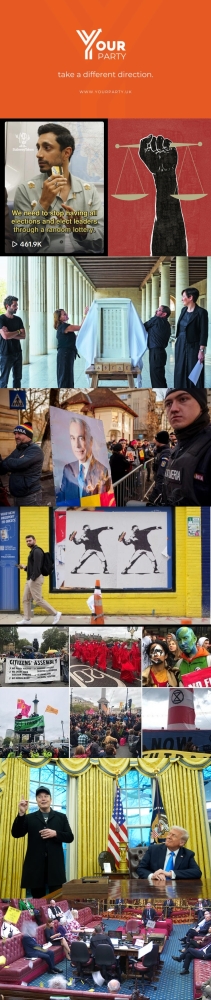
We need to stop having all elections and elect leaders through a random lottery!!

A predictable critique of Guerrero’s Lottocracy

Niko Kolodny, Professor of Philosophy at the University of California, Berkeley has a lengthy piece in the Boston Review which reviews Alexander Guerrero’s Lottocracy. Unsurprisingly, Kolodny is not sympathetic to the idea of sortition. Predictably, Kolodny finds ample opportunities to criticize Guerroro’s “relentlessly thorough”, eclectic argumentation.

In particular, Kolodny effectively exploits Guerrero’s reliance on the supposed inability of the public to represent its own interests without proper guidance. For example:

Guerrero imagines that each SILL [single-issue, lottery-selected legislatures] would be guided in its deliberation by a poll of those few citizens who somehow are able to take a week off of work and other responsibilities to pay attention to the five day-long discussions of the final five proposals. Again, if the powerful can, in effect, buy off the general public to support a particular electoral party, then why can’t the powerful mobilize a (again, presumably quite small) group to pay attention to the review of proposals for the Water Access and Water Quality SILL and support what they favor? No one but the powerful, one worries, would be minding the store.

Kolodny’s argument above, as well as his other arguments (e.g., his assertion that people cannot be expected to accept offers in an allotted body), are standard. He goes so far as to inflict on his readers the electoralist dogma about how “[b]y choosing some political programs and parties over others, [voters] shape the political/ideological space within which the elected representatives must operate until the next election”. A formula he quotes from Cristina Lafont and Nadia Urbinati’s The Lottocratic Mentality: Defending Democracy Against Lottocracy.

Such arguments are easily refuted and have been refuted many times. However, Guerrero’s book is not up to the task. Instead, the book makes it easy for the opponents of sortition – or more to the point, for the opponents of democracy – to rehash the old superficial talking points and present them as “a splendid and convincing recent counterpoint to arguments for lottocracy”.

Lenin’s theory of elections

In a short article called “‘Democracy’ and Dictatorship” published on January 3, 1919, Vladimir Lenin asserts that

[As long as] the bourgeoisie continue to keep the entire apparatus of state power in their hands, [and] a handful of exploiters continue to use the […] state machine[, e]lections held in such circumstances are lauded by the bourgeoisie […] as being “free”, “equal”, “democratic” and “universal”. These words are designed to conceal the truth, to conceal the fact that the means of production and political power remain in the hands of the exploiters, and that therefore real freedom and real equality for the exploited, that is, for the vast majority of the population, are out of the question.

It seems that for Lenin “the means of political power that remain in the hands exploiters” which render elections undemocratic are primarily the channels of mass communication:

In practice the capitalists, the exploiters, the landowners and the profiteers own 9/10 of the best meeting halls, and 9/10 of the stocks of newsprint, printing presses, etc.. The urban workers and the farm hands and day laborers are, in practice, debarred from democracy by the “sacred right of property” (guarded by the Kautskys and Renners, and now, to our regret, by Friedrich Adler as well) and by the bourgeois state apparatus, that is, bourgeois officials, bourgeois judges, and so on. The present “freedom of assembly and the press” in the “democratic” (bourgeois democratic) German republic is false and hypocritical, because in fact it is freedom for the rich to buy and bribe the press, freedom for the rich to befuddle the people with venomous lies of the bourgeois press

Thus, it is by manipulating the voters through what would today be called “misinformation” or “disinformation” (or what a few years ago was called “fake news”), that the elites manage to get majorities to vote against their own interests and maintain the situation in which they are controled by the elites. And in general, any electoralist system (whether in a capitalist system, or in a nascent socialist system, which he calls a “dictatorship of the proletariat”) is a system of oppression because the dominant class uses its control of the communication channels to get the voters to support it electorally. Therefore, the dominant class cannot be changed electorally but only by overthrowing the electoral system in one way or another.
Continue reading

Anti-sortition attitudes

It is an unfortunate state of affairs that, despite the fact that proposals of empowering allotted bodies do enjoy significant popular support, most people are not mobilized into action by the idea of sortition. Much of that can no doubt be attributed to despair. There is no point in being politically attached to radical ideas since such attachment has insignificant impact on society and is bound to end in frustration, and quite possibly to being seen by friends and acquaintances as slightly unhinged.

Still, it is rather surprising that despite the unending contempt that many people heap on the existing electoralist system, or more accurately, on its outcomes and on those who act within the system, there is still a strong attachment to the idea of elections and aversion toward proposals at eliminating them altogether in favor of a sortition-based system. Of course, a long list of arguments against sortition is available, and they are endlessly regurgitated (often as if they were brand new) to justify the suspicion toward sortition. However, since all of these arguments are easily refuted, it is quite clear that the arguments are not the cause behind the aversion toward sortition, but rather that some underlying attitudes against sortition must be common, attitudes for which the arguments merely serve as rationalizations.
Continue reading

A call for an institutional upheaval

An open letter by Eric Jourdain and the CaP Démocratie collective to the president of the parliament of Wallonia published in the Belgian newspaper Le Soir (machine translation):

Mr. President,

The crisis of democracy we have been experiencing for several decades is serious and profound. Serious because it results in the rise of populism, which reminds us of the 1930s leading up to the Second World War.

This crisis is profound because the very foundations of our political system are at stake. Today, a large portion of the population feels poorly represented, or even completely unrepresented, by political parties. An IWEPS survey indicates that 80% of Walloons no longer trust politics.

It is the quality of citizen representation, over which political parties have a monopoly, that is at stake. This monopoly has existed since 1830, but the world has changed a lot in the meantime.

Yet, with a few exceptions, the political world seems hardly concerned about this situation. Improving our system of governance and the way citizens are represented within our institutions do not seem to be a priority.

A Necessary Shock Therapy

The problem is profound, and to remedy it, we need shock therapy, an institutional upheaval. Faced with the partycracy that is plaguing our country, as Mr. Prévot put it, how can we break with this system?

We demand the establishment of a true bicameral system with a second assembly completely independent of the first, and we propose that it be composed by drawing lots. This method of representation has proven itself in ancient history but also in the 21st century. Isn’t it said that in a democracy, the people are sovereign? This sovereign should always have the power to make their voice heard and thus command respect. Voting once every five years is no longer sufficient.
Continue reading

Democracy and Truth

In a recent article in The Catholic Herald Niall Gooch discusses some objections to sortition from the book Against sortition?. As he describes sortition, “[t]he idea is that involving “normal people” in such deliberation helps to spread power more widely and obtain broader perspectives”.

The contributors to the book set out various reservations about this idea, and various objections. Many of them have procedural concerns – for example, they believe that existing approaches don’t gain a wide enough spectrum of opinion, or that they are easily captured by special interests, or that they don’t really add anything new to a conventional elected legislature.

Others highlight the problems of accountability raised by citizens’ assemblies, or the way in which they dilute the legitimacy of existing bodies. But a few contributors are clearly trying to articulate something like the more fundamental problem identified by John Paul II, which we might sum up with this question: “Does involving lots more people in political decision making actually get you closer to the truth?”

Gooch refers his readers to, Evangelium Vitae, The Gospel of Life, a 1995 essay by Pope John Paul II. In it John Paul II writes:

Democracy cannot be idolized to the point of making it a substitute for morality or a panacea for immorality. Fundamentally, democracy is a “system” and as such is a means and not an end. Its “moral” value is not automatic, but depends on conformity to the moral law to which it, like every other form of human behaviour, must be subject: in other words, its morality depends on the morality of the ends which it pursues and of the means which it employs. If today we see an almost universal consensus with regard to the value of democracy, this is to be considered a positive “sign of the times”, as the Church’s Magisterium has frequently noted. But the value of democracy stands or falls with the values which it embodies and promotes. Of course, values such as the dignity of every human person, respect for inviolable and inalienable human rights, and the adoption of the “common good” as the end and criterion regulating political life are certainly fundamental and not to be ignored.
Continue reading

The Citizen Assembly for Norway’s Future

“The Citizen Assembly for Norway’s Future” (Framtidspanelet) was a 56 member body of Norwegian citizens selected through what has become the standard “citizen assembly” process and that convened in the period Januray through May 2025. The report associated with the body describes it as being “initiated by seven civil society organizations”, those organizations being Save the Children, Norwegian Church Aid, The Norwegian Children and Youth Council (LNU), Caritas, WWF World Nature Fund, Langsikt – centre for long term policy, and Framtiden i våre hender. I was not able to find a more specific description of how the initiative for this body came about.

The body’s mandate was apparently associated with Norway’s oil fund – a national fund accumulating oil revenue which holds today almost $2 trillion.
Continue reading