Posted on June 22, 2021 by Yoram Gat
Seiki Okazaki, Professor of political theory and comparative politics at Kyushu University, Japan, has written to share a summary of his new article, “Appointment and Sortition,” pubilshed in Law and Philosophy journal, No. 7, pp. 31–56.
I have recently published an article titled “Appointment and Sortition” in Japanese. It is one of the five contributions to Law and Philosophy, No. 7 (June 2021), which discuss ‘Just Lotteries’. Here I will summarize the arguments of my article.
As is well known, sortition has been generally discussed within the framework of ‘election and/or sortition.’ While I agree that the framework is still relevant, I am concerned that it limits the potential of sortition: Sortition tends to be applied mainly to the legislature and is mainly evaluated in terms of its contribution to democracy. If we liberate the concept of sortition from the framework, we can recognize two potentialities of sortition. First, the field of application is not limited to legislature: Sortition can be applied to administration and to the judiciary. Second, we will see that it has a liberal potential as well as a democratic potential: Sortition can contribute not only to citizen participation in power, but also to the restriction of political power (Oliver Dowlen’s book is important in this respect).
Continue reading →
Filed under: Academia, Elections, Press, Proposals, Sortition | 8 Comments »
Posted on June 18, 2021 by Yoram Gat
 Back in January, the Scottish Citizens Assembly has concluded its work and published its report. One of the sections in the recommendations chapter (PDF) is called “How decisions are taken” and contains various proposals involving the use of allotted bodies for political decision making. One of those recommendations is to
set up a ‘house of citizens’ to scrutinise government proposals and give assent to parliamentary bills. Membership should be time-limited and representative of the population of Scotland, similar to the way this CA was selected.
Having a permanent allotted body with oversight powers over government and (it seems) binding veto power over legislation is, I believe, an unprecedented proposal from an official constitutional reform body. Of course, the Scottish CA itself was merely advisory, so the adoption of its recommendations by the elected government is very far from certain.
A discussion of the report was held in the Scottish parliament in February. In the discussion John Mason of the Scottish National Party responded to the proposal:
The start of the members’ introduction says:
“We, the people of Scotland, present this report” to Government and Parliament. That is a big statement, suggesting that the assembly is either more representative of, or more in touch with, the general population than elected MSPs are. We should take that kind of statement seriously. The assembly is a cross-section of society, but it is not elected, so are we questioning democracy if we follow that logic?
Continue reading →
Filed under: Applications, Proposals, Sortition | 15 Comments »
Posted on June 11, 2021 by Yoram Gat

SwissInfo reports:
Like the National Council, the Council of States has rejected the initiative that would replace the selection of judges by election to their selection by sortition.
Submitted by the entrepreneur Adrian Gasser, the initiative “Appointment of federal judges by sortition” aims to make judges more independent. The candidates have to attain their high position based solely on their qualifications, even if they do not have a political network, according to the text of the initiative.
Selected by a a commission of experts, the judges would then be allotted in a way that the official languages would be fairly represented. They would be able to serve five years beyond the normal age of retirement.
Democratic legitimacy
The senators have implicitly rejected the text. The initiative contradicts the Swiss practice where judges are elected and enjoy democratic legitimacy, a principle that is incompatible with a random process, declared Beat Rieder, a member of the judiciary committee.
The existing system has proven itself. Andrea Caroni, the president of the commission, the idea must be “voting rather than rolling the dice, democracy rather than lottery”. Sortition would in no way guaranty more independence and more fairness, added Thomas Minder.
The choices of the members of the commission of experts would not be neutral either, added Carlo Sommaruga. And it would not necessarily be the best that would be designated due to chance, concurred Karin Keller-Sutter, the Minister of Justice. According to her, the initiative introduces a “foreign element” into our institutions.
A different proposal that was also discussed would have judges elected for life rather than facing periodic re-election. In practice, however, non-re-elections are very rare. This proposal was rejected as well. According to article, Andrea Caroni thinks that “parliament knows how to protect the judiciary institution”.
Filed under: Elections, Press, Proposals, Sortition | 1 Comment »
Posted on June 6, 2021 by Yoram Gat
Prof. Alex Guerrero – a long time sortition advocate – has three lectures on sortition as part of a Coursera course called “Revolutionary Ideas: Borders, Elections, Constitutions, Prisons”. The lectures about sortition are titled:
- The Lottocracy
- The Promise of Lottocracy
- Concerns About Lottocracy
The lectures present Guerrero’s proposal which centers around single-issue-specific allotted bodies but also contain discussions that address questions that are relevant to other forms of sortition-based governance. The total length of the lectures is about 1 hour and they seem to have in mind an audience that is similar in terms of interests and attitude to political science undergraduate students.
Filed under: Academia, Proposals, Sortition | Leave a comment »
Posted on May 30, 2021 by Yoram Gat
Landemore concludes her book in chapter 9. Looking at this chapter and looking back at the entire book’s narrative, it is hard to avoid the feeling that the book’s promise was not lived up to. By this point it seems that not much remains of the book’s original radical spirit. Gone in this conclusion is the most subversive part of Landemore’s narrative – the hints that the status quo, the elections-based system produces terrible outcomes. Also gone is the radical insistence on political equality. Other than some non-committal language about “an open door” connecting representatives and society at large, in the conclusion “open democracy” seems to boil down to three institutions – allotted bodies, popular initiative processes and delegative voting. Landemore writes that “open democracy” means that ordinary citizens “have access to power”. But of course it may be argued – and conventionally it is argued – that voting is also a form of “access to power”. Why is voting in the initiative process or though vote delegation a better form of “access” than conventional voting?
The concluding chapter is mostly concerned with issues that are only tangentially related to the topics discussed in the book. A concluding chapter can be expected to contain some “future directions” – ideas that were not explored in the book but which are somehow relevant to the topics that were discussed. These future directions, however, should stem from a concise summary of the conclusions that were drawn from the preceding discussion. The conclusions should position the reader at a new vantage point from which the future directions can be pursued. Unfortunately, such a new vantage point is missing. In particular, Landemore devotes a fair amount of space in the chapter to a discussion of the role of nation-states in governance, the inclusivity of the demos, and other sites of power such as corporate power. This discussion, however, does not build on previously discussed topics and does not go beyond the standard claims and arguments made. The claim, for example, that “there seems to be a logic to democracy that is conducive to universal inclusion” and that “[t]his logic eats away at the closed borders of a nationally defined demos and cracks them open” (p. 210) is a questionable commonplace, rather than an idea that builds on the main arguments of the book.
Continue reading →
Filed under: Academia, Books, Sortition | 1 Comment »
Posted on May 19, 2021 by Yoram Gat
The final objection to “open democracy” which Landemore considers in chapter 8 of her book is that a non-electoral system would be too demanding on people’s time and effort. Landemore does not explicitly do so, but it seems useful to differentiate between the demands made on the population in total, or on average, and the demands made on specific people. A system may be problematic if it requires the average citizen to invest more time and effort than the average citizen sees fit. But even in cases where the demand on average is low, there may be problems if some citizens (even a small number) are asked to put in more time and effort than they are willing to put in.
Landemore rightly emphasizes that “it is essential to consider citizens’ time and attention as scarce resources that must be used wisely”. The notion that it makes sense, or even commendable and serves some ideal of citizenship or democracy, for citizens to show up to mass meetings or mass political events of any kind must be firmly rejected. This is not “participation” but exploitation. It is important to note, however, that the same is true for other forms of powerless “participation”, quite a few of which Landemore “makes room for” (p. 206) in her let-a-thousand-flowers-bloom approach. Spending time on a “crowdsourced platform” (p. 206), for example, or even sitting on an “agenda-setting” or “proposal review” body which is one of thousands of such bodies, meaning that its output is diluted thousands of times, is also a meaningless, exploitative anti-democratic ritual.
Continue reading →
Filed under: Academia, Books, Participation, Sortition | 1 Comment »
Posted on May 17, 2021 by Yoram Gat
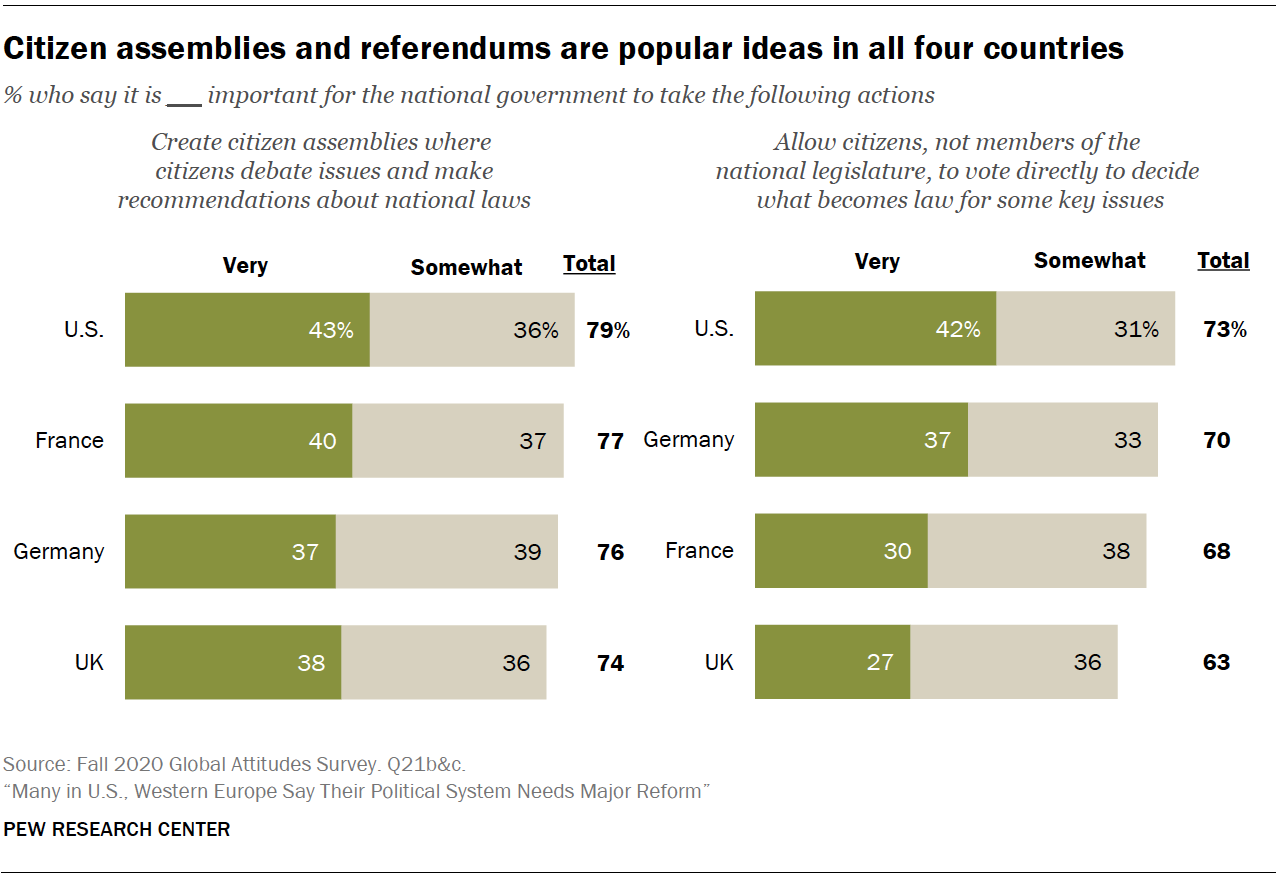
A Pew Research poll conducted in November and December 2020 asked people in France, the U.S., the U.K. and Germany about their attitudes toward the political systems in their countries. As usual, there was a lot of dissatisfaction. It turns out for example that in France and the U.S. about 20% of those polled think that the political system in their country “needs to be completely reformed”.
Interestingly, the poll had a question about “citizen assemblies”.
In all four countries, there is considerable interest in political reforms that would potentially allow ordinary citizens to have more power over policymaking. Citizen assemblies, or forums where citizens chosen at random debate issues of national importance and make recommendations about what should be done, are overwhelmingly popular. Around three-quarters or more in each country say it is very or somewhat important for the national government to create citizen assemblies. About four-in-ten say it’s very important.
Surprisingly, in my opinion, support for such advisory bodies is somewhat higher in all countries than support for binding referenda.
(Thanks Paul Gölz.)
Filed under: Initiatives, Opinion polling, Proposals, Sortition | 3 Comments »
Posted on May 16, 2021 by Yoram Gat
This continues the review of Landemore’s treatment of objections to “open democracy” which makes up the last chapter of her book.
3. Tyranny of the majority
“For some readers”, Landemore says (p. 199),
the undemocratic, or at least counter-majoritarian, aspects of electoral, liberal democracy (aka representative democracy) are intended and desirable features, not problems to be solved.
Those readers
fear that promoting a purer democratic regime against electoral democracies risks undoing the minority rights protections built into the liberal core of the latter.
Landemore sees such fears as “legitimate”, but argues that
it is also entirely possible that, by starting with a liberal rather than a democratic framework, the founders of our modern “democracies” have turned the screw too tightly on the elements of popular rule that they have also tried to incorporate (while compounding that mistake by locking the design and throwing away the key with almost impossible-to-revise constitutional entrenchments. (p. 200)
Josiah Ober is then credited with a “recent attempt at drawing a clearer distinction between democracy and liberalism” and approvingly described as having “thus begun to challenge the view that the tradition of political liberalism, and consequently representative government as its central emanation, is the only ideology or historic system that can protect at least certain individual rights and freedoms.” “Pre-liberal, non-representative democracy” – Landemore reassures her readers – “was not all that unstable or even as terribly ‘illiberal’ on the substance […] as is often feared.”
Continue reading →
Filed under: Academia, Athens, Books, Elections, History, Sortition, Theory | Leave a comment »
Posted on May 15, 2021 by Yoram Gat

Alpa Shah is Professor of Anthropology at London School of Economics and Political Science, London, UK, where she also leads a research theme at the International Inequalities Institute. Her most recent book is Nightmarch: Among India’s Revolutionary Guerrillas (Hurst, 2018).
Shah has an article in a special issue of Development and Change journal titled “What if We Selected our Leaders by Lottery? Democracy by Sortition, Liberal Elections and Communist Revolutionaries”.
Abstract:
What if we selected our leaders by lottery? Zooming out from the mud huts of indigenous communities in the forested hills of eastern India, this article compares three different models of leadership and democracy: liberal electoral democracy; Marxist‐Leninist Maoist democracy; and democracy by sortition — the random selection of rotating leaders. The significance of sortition is introduced into discussions of democracy in India (showing connections with practices in Nepal and China) as part of a broader attempt to make scholarship on South Asia more democratic. The author also re‐reads ideals of leadership among indigenous people, showing that we need a theoretical and practical vision arguing not for societies without leaders but for societies in which everyone may be a leader. In India, this compels us to push back against the critique of its indigenous communities for not producing leaders and enables a profound re‐reading of the history of subaltern anti‐colonial rebellions. The final aim of the article is to highlight the virtues of the potential of sortition in creating democratic society globally. How we think about democracy and leadership is thus turned on its head to provide a new vision for the future.
Continue reading →
Filed under: Academia, Elections, History, Sortition | 2 Comments »
Posted on May 10, 2021 by Yoram Gat
 An op-ed by Joe Mathews in The Mercury News.
We need a new way to govern the internet, here’s how to do it
Joe Mathews, May 7, 2021
Today’s methods for governing the internet do not constitute a coherent system, much less a democratic one. Instead, internet governance is a contest for power between the most powerful tech companies, who put their shareholders first, and national governments, which prioritize their own political interests.
In this contest, both sides create the pretense of democracy. Facebook, based in Menlo Park, has created its own “independent oversight” board of global experts, though it’s unelected and chosen by Facebook. The European Union touts its tougher regulation of privacy and the internet — but those regulators are also unelected, and impose their rules on people far from Europe.
Which is why the internet needs a democratic government that operates beyond the reach of tech companies or national government. Such a system must be both local — to allow people to govern the internet where they live — and transnational, just like the internet itself.
I’d suggest that the internet’s democratic government combine multiple forms of democratic governance.
The center of such a government should be a citizens’ assembly — a tool used around the world to get democratic verdicts that are independent of elites. This citizens’ assembly would consist of 1,000 people who, together, would be representative by age, gender and national origin of the global community of internet users. They would not be elected individually, but rather chosen via randomized processes that use sortition (or drawing lots).
The assembly would be supplemented by an online platform that allowed people to report problems, make suggestions, or even petition for proposals that could be voted upon in a global referendum by internet users everywhere. The models for such a platform include Rousseau, the controversial online environment through which Italy’s Five Star Movement governed itself for a time, and Decide Madrid, the online participatory framework that has spread from the Spanish capital to more than 100 cities worldwide.
National governments and tech companies would try desperately to influence this government, but they would not be in charge of it. And each citizens’ assembly would dissolve after two or three years — making it harder for the powerful to lobby it.
Filed under: Press, Proposals, Sortition | 1 Comment »


 Adam Cronkright
 Ali
Ali Ahmed R. Teleb
 avanderven
 avergne
 Alex Kovner
 azakaras
 Brett Hennig
 campbellwallace
 Simon Threlkeld
 Nick Coccoma
 codyhipskind
 Common Lot Sortitionist
 Conall Boyle
 constitutionalism
 davidschecter
 graytmatter
 gtridimas
 H.J. Hofkirchner
 Hanspeter Rosenlechner
 John Burnheim
 jgarry20151
 Jochen Krattenmacher
 johnedwardtaylor
 johnhuang865
 Jonathan Crock
 keithsutherland
 Jacob Richter
 kkoreilly
 lukewhito
 SimonPek
 Nathan El
 Nicholas Gruen
 Owen Shaffer
 Patrick Chalmers
 Paul Gölz
 peterstone
 Pierre-Etienne Vandamme
 pronfeld
 Emil
Emil rcaze
rcaze richwbrown
 Roger Knights
 roslynfuller
 Pierre-Etienne Vandamme
 shaharavin
 tbouricius
 Ted Wachtel
 Joshua Laferriere
 theodorestathis
 towardsautonomyblog
 Wayne Liebman
 Yoram Gat
 Oliver Milne
 Equality by lot