2019 review – sortition-related events

As I have done at every end-of-year of the last 9, I am offering my summary of notable sortition-related events that occurred over the last year.

As polls indicate that people continue to believe that governments do not represent them, the idea of the single-issue citizens’ assembly made strides in various European countries in 2019. In France, the Citizens’ Climate Convention is taking place, where 150 allotted people are tasked with selecting ways to address the climate crisis. This body is relatively high profile and received attention by various writers. A similar body is being demanded in the UK by the Extinction Rebellion movement.

Scotland had a citizens’ assembly for “shaping Scotland’s future”.

Participations journal devoted a special issue to sortition. 24 papers dealt with various aspects of the topic. The book Legislature by Lot, with the papers from a workshop by the same name was also published.

A citizens’ assembly on Brexit was widely discussed in the UK.

A permanent allotted body was instituted by the German speaking community in Belgium and by City Hall in Madrid.

The increasing use of allotted citizen bodies resulted in increasing scrutiny of the ways in which they are constituted and run, as well as their institutional role.

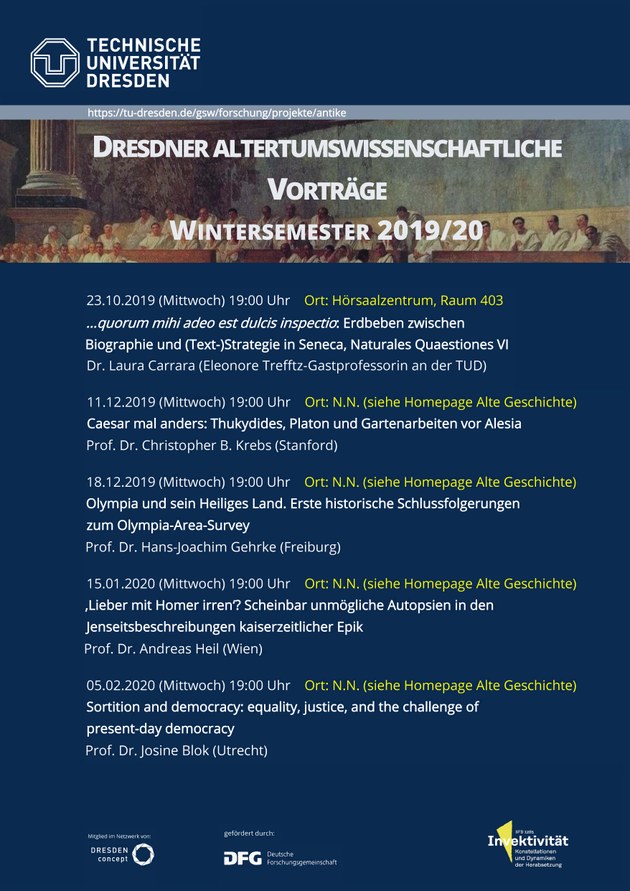
Blok: Sortition and democracy: equality, justice and the challenge of present-day democracy

Prof. Josine Blok, a classicist from the University of Utrecht, will be giving a talk titled “Sortition and democracy: equality, justice and the challenge of present-day democracy” at the University of Dresden on Feb 5th, 2020.

It turns out that Blok has been interested in sortition for some time. In 2014 she has published a paper called “Participatory Governance: The Case for Allotment” in the journal Participation. The paper is viewable and downloadable here.

In the paper, Blok hypothesizes that sortition was legitimated in Athens by the custom of using the lottery to allocate shares of inheritances among the heirs. Other parts of her discussion are interesting and original as well.

Equality by Lot‘s first decade – a call for review input

The first post on Equality by Lot was published ten years ago, on December 14th, 2009. Over a thousand posts were published since, and happily enough sortition has made great strides in the public sphere worldwide.

This year, in addition to the yearly summary of the sortition-related ongoings, I would like to publish a decennial summary. You are all invited to register your input as to what are the important sortition-related things to note – over the last year as well as over the last decade. Please either post your input as a comment to this post or send it to me via email.

For previous years’ summaries see: 2018, 2017, 2016, 2015, 2014, 2013, 2012, 2011, 2010.

Fienberg: Randomization and Social Affairs: The 1970 Draft Lottery

A 1971 Science article by Stephen E. Fienberg, professor of statistics at the University of Chicago, deals with the problematic 1970 draft lottery and places it in a wider context of randomization in social affairs.

Upcoming Sortition Foundation meeting

A note from Owen Shaffer of the Sortition Foundation:

The United States Chapter of the Sortition Foundation continues to have guest presenters at our online meeting every other month. This Sunday’s meeting features Linn Davis of Healthy Democracy! It begins at 4pm Eastern US time (3pm Central, 2pm Mountain and 1pm PCT).

Linn will explain HD’s unique form of Citizens Jury: the Citizens’ Initiative Review (CIR), which is established in Oregon state statute, and has since been replicated in five US states and two European countries. He will also explain HD’s new local government Citizens Jury (CJ) model and touch on future designs for larger-scale city, state, and national sortition-based task forces and Citizens Assemblies.

Time permitting, Linn will also explain about an exciting new initiative to synthesize several decades of CJ experience (from HD, the Jefferson Center, the newDemocracy Foundation, and others) into a mass-market CJ model that is low-cost, time-efficient, and easily replicated in cities anywhere with sticky policy questions but modest means.

Our group includes some folks you would recognize and has a healthy group of people that are new to sortition. If you would like to join the meeting, email me at dshaffer@lander.edu and I will send you the link. You can also join our group email for announcements at http://lists.sortitionfoundation.org/subscribe/usa and a Facebook group at https://www.facebook.com/groups/420337885380259/ as well.

Owen Shaffer, Convenor

Citizen Climate Convention: Become a Democratic Assembly!

An open letter to the members of the French Citizen Climate Convention from several mass-action environmental organizations was recently published in Reporterre – a French environmental daily newspaper. [Original in French.]

A Citizen Climate Convention has been convening since October 4 over the course of 6 sessions of three days each until the upcoming January. How to make sure this unprecedented test of collective democracy, which gives 150 allotted citizens the power to deliberate measures for reducing France’s CO2 emissions by at least 40% in 10 years, does not end up as a tool of self-promotion for a government whose real policy for the last two years has been so blatantly anti-environmental that it forces Nicolas Hulot, its very moderate minister of the environment, to resign? That is possible if the allotted rely on their popular legitimacy in order to change the nature and the objective of their upcoming deliberations. It is for this democratic usurpation that we are calling.

What is it that makes you legitimate, more legitimate in any case than the committee that is supposed to “govern” you? It is not that fact that you were allotted according to social-professional or geographic “representivity” criteria defined by the polling institute. This representativity has no democratic value. The fact that an allotted woman is a self-employed resident of Brittany like me does not in any way guarantee that she would faithfully represent my political convictions. It is therefore not the allotment according to social-professional categories which makes you close to your fellow citizens, but rather the fact that you share their situation of democratic dispossession. In these dying days of this deceptive regime of “representative democracy”, we are all reduced to being nothing more than private individuals, deprived of any meaningful political power.
Continue reading

Kovner: The Jurga System

A post by Alex Kovner.

In The Jurga System, I outline a complete democracy centered around citizen juries. At its core is a sharp division of democratic policy making into proposing and deciding. While this is conceptually simple, it is surprisingly difficult in practice. Doing so requires liberal use of the “blind break” to ensure that proposers cannot corrupt the decision process, and vice-versa. The book looks at this dynamic in great detail as it applies to all branches of government.

While the scheme outlined here will not be implemented anytime soon, it is a good thought experiment regarding what a complete political system based on citizen panels might look like. It also suggests a different direction from what we see today: instead of open-ended citizen assemblies tasked with generating grandiose proposals, we should prioritize citizen juries with narrower mandates but binding authority to act. Only this way will sortition become a regular, indispensable feature of democracy.

Full text available to download: https://alexkovner.com/2019/11/12/the-jurga-system/.

The Climate Convention: Technocratic illusions and pseudo-direct democracy

An article in Liberation by Salvador Juan, professor of sociology at the university of Caen and researcher at the Center for Study of Risks and Vulnerabilities. Original in French.

The Climate Convention: Technocratic illusions and pseudo-direct democracy

How are the 150 citizens who are supposed to embody the people as they face the climatic challenge supposed to reach reasoned conclusions after a few weekends of work whereas expert researchers spend years in order to understand the complexities of energetic and ecological issues?

If there is a useful concept for defining what the government is doing, it is that of technocracy. Being neither right-wing nor left-wing but promoting progress and growth, technocracy is defined by the identification of the general interest with that of the powerful organizations which manage it – the electronuclear generators, the petrochemical conglomerates, the high speed trains or the industrial agriculture of the 1970’s.

Another characteristic of this new (at the historical scale) power, in which the great state bodies are surpassed by private ones, is the requirement for legitimization by the creation of social demand and of popular support for its products. As opposed to classical economic theories, according to which supply adapts to demand, this power implies the fashioning of daily life according to the products of an industry which is unconcerned with the ecological or health consequences of its activities as long as it can make a profit, either economic or symbolic, related to its image.

Finally the last important characteristic of this new power is contempt for intermediary bodies – associations or unions. It is a quasi-royalist and popular fantasy of a direct relation between a central authority and a mass of atomised citizens, a notion whose dangers for democracy were already described by Tocqueville.[1]
Continue reading

Poole: Sorting Brexit

Steven Poole writes in The Guardian:

Jeremy Corbyn will ‘sort’ Brexit – does that mean solve it or stop it?

This week Jeremy Corbyn promised that, if elected, he would “sort Brexit”, which came as welcome variation from the twin poles of “get it done” versus “make it stop”. Sadly for many Labour voters, though, he didn’t mean he would carefully “sort” Brexit into a fire-pit of things destined for oblivion.

The verb “to sort” comes from the Latin sortīrī, to distribute by lottery, which is why “sortition” is the name for a system of democratic government, arguably superior to the one we currently enjoy, where leaders are made up of randomly chosen citizens.

But Corbyn used the demotic sense of “sort” to mean “sort out”, to solve or clear up, as in the exclamation “Sorted!”. Commuters on London’s public transport have long been irritated by its “See It. Say It. Sorted” slogan, though even “to sort out” – in the sense of to resolve rather than literally to divide – is relatively newfangled, recorded only since 1948.

Yet the sense of “to sort” as to accomplish is of much more antique vintage. As the Third Citizen in Shakespeare’s Richard III remarks: “All may be well: but if God sort it so / Tis more than we deserve or I expect.” So might we feel about the election.

The Climate Convention: the allotted don’t want to be extras

An article by Béatrice Bouniol in La Croix, September 19 [Original in French].

The allotment of citizens tasked with making proposals for handling with the climate. This unprecedented experiment arouses excitement and high expectations.

“A woman, 65 years old or older, retired, no college education”. The target of the moment is inscribed on a whiteboard. 4 days remain for the pollsters of Harris Interactive to recruit 150 citizens to the Climate Convention. For now, this means randomly selecting a sample representative of the French population.

It is in fact one of the lessons of the Grand Debate and the regional citizen conferences. Volunteers can be easily recruited in some categories of the population – college educated urban men, for example. In order to avoid bias, several criteria were added to the random generation of telephone numbers: age, gender, education, social-professional categories as well as place of residence.

“A real will to participate”

In the locations of Harris Interactive, the voices mix. The eyes are fixed on the computers, the pollsters proceed step by step. They present the objective of the convention: to come up with proposals to fight global warming. Explaining the availability required of the participants – six week-ends during six [sic] months, starting in October and ending in January. Then detailing all that is provided in order to facilitate participation: payment as for trial juries, reimbursement of expenses including childcare.
Continue reading