A British MP proposes a Brexit citizen’s assembly, a discussion follows. (A February 2019 BBC TV show.)
Filed under: Press, Proposals, Sortition | 1 Comment »
A British MP proposes a Brexit citizen’s assembly, a discussion follows. (A February 2019 BBC TV show.)
Filed under: Press, Proposals, Sortition | 1 Comment »

A post on the LSE website by Rikki Dean, John Boswell, and Graham Smith introducing a recent paper of theirs is a very useful and provocative piece.
One example of the post’s value is its ability to describe the systemic and inherent problems that are involved in the creation of a democratic process, seemingly without either using those problems manipulatively as a way to justify the oligarchical character of the existing system or falling back on the cliched feel-good formulas of leadership, participation, empowerment, etc.:
In our recent paper in Political Studies, we take a pioneering case of such a systems-oriented approach to democratic innovation – the NHS Citizen initiative – and explore how it played out in practice. Did this approach mitigate the aforementioned perennial problems of institutionalisation? And did it create new problems?
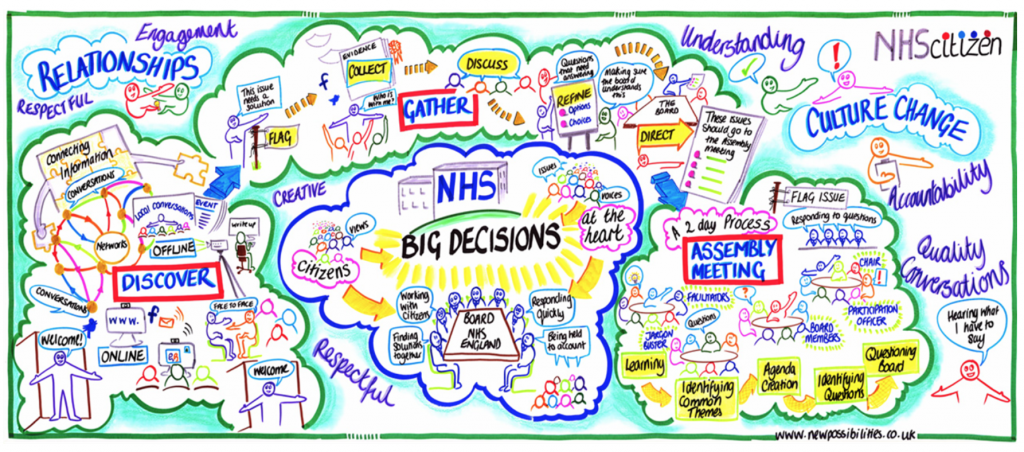
NHS Citizen was a participatory initiative launched by the appointed Executive Board of NHS England. Echoing the systemic emphasis on the distribution of functions across settings, the eventual design consisted of several interacting parts categorised into three broad stages – called Discover, Gather and Assembly – each of which had its own function.
There was initial enthusiasm both from participants and from the Board for this exciting new form of innovation. However, over time, a series of obstacles emerged, and the initiative for all intents and purposes shut down less than three years into its run. The way the process developed over the period demonstrated the ever-present difficulty for participatory organisation to connect both with public space and empowered space.
For the first Assembly, the agenda-setting process was not fully operational, meaning the Assembly dealt with issues that largely reflected the Board’s concerns. The Board were very positive about this first Assembly. Once Gather was better established, it genuinely did shift the agenda so that is was more reflective of civil society concerns. However, this culminated in the Board losing faith in NHS Citizen and choking off funding for the process. In addition, an unanticipated effect of the separation into different parts was that some of the participants in the earlier stages were unhappy about being prevented from taking part in the Assembly, which planned to use random selection. Their rebellion in the end forced a change to the selection mechanism for the Assembly. NHS Citizen thus pioneered some promising practices for better connecting deliberative assemblies to civil society, but this was at the cost of institutionalising some irresolvable tensions.
Filed under: Academia, Applications, Deliberation, Sortition | 3 Comments »
A post by Timo Rieg.
The Berlin district of Tempelhol-Schöneberg (population 301,000) has been experimenting with a new kind of citizen deliberation, where the members are chosen by lot. The method known as “Bürgerrat nach dem Vorarlberger Modell” was developed in the Austrian state of Vorarlberg and has been practised there for 13 years. It has been part of the constitution of Vorarlberg since 2013.
For such a process of deliberation the administration chooses 12 to 15 residents by lot and allows them to debate the issue for two days. The discussions are moderated by one or two facilitators. What makes the method of “Dynamic Facilitation” unique is that the participants can only speak directly to the facilitator and not with each other. This is to ensure that everyone can speak for as long as they want and to alleviate conflict. The facilitators write every idea or keyword on a flipchart so that no thought is lost.
This is being trialed in seven sub-districts of Tempelhof-Schöneberg from August 2019 to February 2020. The results of every citizens’ assembly are presented in an open civic meeting (a so-called “Bürgercafé”), to which those interested are invited by the mayor to contribute. Because it is an experiment, the process is being observed by researchers from the Institute for Advanced Sustainability Studies (IASS) in Potsdam.
The idea started with a group of five retirees who were unhappy with the political developments such as the rise of the far-right (AfD) and populist leaders (Donald Trump). They were worried about democracy and saw it as a problem of disconnection between politicans and ordinary people. So they looked for a process that would give people a voice and make the politicans pay attention to them. They discovered sortition and the David Van Reybrouck’s book Against Elections, which proposes the allotment of citizens as representatives (and what has been known in Germany since the 1970s under the name “Planungszelle”).
http://www.aleatorische-demokratie.de/planungszelle/
Continue reading
Filed under: Applications, Sortition | 6 Comments »
Gareth Jones writes in Third Force News:
A new era for democracy in Scotland is set to begin this weekend
The first meeting of the Citizens’ Assembly of Scotland is being held this weekend (26 and 27 October), with 100 people taking part in a unique project that will help shape Scotland’s constitutional future.
The assembly, convened by David Martin and Kate Wimpress, has recruited people from across Scotland who are representative of the wider public as a whole to consider three key questions for the nation.
These are: What kind of country are we seeking to build?; How can we best overcome the challenges the challenges that Scotland and the world faces, including those arising from Brexit?; and What further work should be carried out to give people the detail they need to make informed choices about the future of the country?
The members were recruited through a process of random selection to broadly reflect the adult population of Scotland in terms of geography, age, gender, ethnic group, educational qualifications, limiting long term conditions/disability and political attitudes towards Scottish independence, the UK’s membership of the EU and Scottish Parliament voting preferences.
Continue reading
Filed under: Applications, Deliberation, Press, Sortition | 44 Comments »
A short video published by CESE (Economic, Social and Environmental Council) – the body which organizes the French Citizen Convention on the Climate – provides some details on the process of sampling used for selecting the 150 citizens that serve in the convention.
The process has been sub-contracted to “Harris Interactive” – a market research company. According to the video, the company produces its sample by calling randomly generated phone numbers and inviting those who answer the phone to participate. The responses of those contacted are equally split between those who definitely accept, those who tentatively accept (pending being able to attend on the days of the convention), and those who reject the offer to participate.
As published earlier, the final sample is made by selecting from those who accept the invitation while matching the makeup of the French population in terms of gender, age groups, education attainment and place of residence.
Also on the matter of the Citizen Convention on the Climate: Loic Blondiaux, political science professor in the Sorbonne and member of the governance committee of the Convention was interviewed by FranceInter radio. He sees the Convention as a historic event. He believes that because the Convention is being organized by a body that is independent from the government it really is a democratic process despite the fact that it was initiated by the government.
Filed under: Academia, Applications, Press, Sortition | Tagged: Convention pour le climat | 3 Comments »

Benjamin Hatton of CambridgeshireLive interviewed members of the Cambridgeshire Citizens’ Assembly:
What did the assembly members think of the process?
As a condition for entry, the media was requested not to identify or speak with any assembly members, except those chosen for interview.
Lisa Eland, 45, from Haddenham, near Ely said: “It was quite interesting. I didn’t quite know what to expect.
“There was a lot of material to be covered, so you really had to focus on so many aspects that you didn’t necessarily contemplate discussing. But it gave everybody the opportunity to listen to other people’s experiences, opinions – you get very caught up in your own little bubble, how things affect you, so it was quite eye-opening listening to other people.”
Continue reading
Filed under: Applications, Press, Sortition | 4 Comments »
Gabriel Popham reports in openDemocracy:
Agora Brussels [website, Facebook page] started less than two years ago as a grassroots citizens’ movement to reboot democracy in the Belgian capital. Earlier this year Agora ran for the regional elections and managed to gain one seat at the Brussels Regional Parliament.
Agora is a unique political party, in that it doesn’t have any political programme to speak of: its only agenda is to organise a permanent citizens’ assembly, promote its institutionalisation for the region of Brussels, and defend its decisions in Parliament.
Pepijn Kennis, MP for Agora, admits that Agora’s strategy of running in elections might seem counterintuitive at first. “As a movement, we’re very much inspired by the book Against Elections by David Van Reybrouck,” he tells me from his office in the Regional Parliament. Agora shares Van Reybrouck’s view that elections nowadays tend to prioritise short-term thinking at the expense of genuine democracy.
Continue reading
Filed under: Elections, Press, Sortition | 2 Comments »
Michael Cook, editor of MercatorNet, issues a strong warning against the Extinction Rebellion movement. Here are some excerpts:
Extinction Rebellion’s loopy politics
The movement’s “Declaration of Rebellion”, a pastiche of America’s “Declaration of Independence”, states: “We hereby declare the bonds of the social contract to be null and void, which the government has rendered invalid by its continuing failure to act appropriately. We call upon every principled and peaceful citizen to rise with us.”
Declaring the “social contract” null and void is a radical step – so radical that either the author did not understand it (unlikely) or he thought that no one else would (likely). Stopping traffic? You ain’t seen nothin’ yet. This is a declaration of war on civilization.
There is but one rational, ethical, and spiritual position on climate change. None other is possible. “The ecological crises that are impacting upon this nation, and indeed this planet and its wildlife can no longer be ignored, denied nor go unanswered by any beings of sound rational thought, ethical conscience, moral concern, or spiritual belief,” the declaration says.
In a democracy, questioning an opponent’s sincerity about his convictions is the ultimate offence. Convictions are tested by rational debate, not by smearing people as venal, wicked or stupid. But this is just what XR is doing.
XR demands that countries go “beyond politics”. “Government must create and be led by the decisions of a Citizens’ Assembly on climate and ecological justice.” Why? Because “Political power in the UK is in the hands of a few elected politicians” says the “Our Demands” page on the XR website. This, of course, is true. Putting power in the hands of elected politicians is called representative democracy and it has a long and successful history of defending political and personal freedom.
Continue reading
Filed under: Athens, Mass action, Press, Sortition | 6 Comments »

Discussion and application of sortition continue to be very active in the Francophone world. Here are some recent examples:
Guyancourt: “Décidons ensemble” [“Let’s decide together”] are forming their list of candidates for the municipal elections by knocking on door number 20 in each street.
From the Popular initiative to sortition: the responses to the crisis of representation – a discussion with Yves Sintomer, Dimitri Courant, and Clément Mabi.
Random interactions in the Chamber: How allocating legislators’ seats at random affects their behavior.
Allotting candidates for the Paris municipal elections.
An allotted citizen council in Sion, Switzerland will publish positions on the propositions on the Swiss ballot.
Filed under: Academia, Press, Proposals, Sortition | 2 Comments »