Posted on April 9, 2019 by Yoram Gat
Le Monde reports that 500,000 people have participated in the French “Grand Debate” by submitting an online form. Of those, 55% indicated that they would support “involving citizens in public decisions using sortition”.
Filed under: Participation, Press, Sortition | Leave a comment »
Posted on April 9, 2019 by Yoram Gat

The 2019 ECPR General Conference will be held at the University of Wrocław, Poland in September. It will feature hundreds of panels and thousands of papers. One of those papers will deal with sortition:
Sortition as a Finalite Politique for EU Democracy
Paweł Glogowski, University of Wrocław
Abstract: The issue of democratic deficit in the European Union has been present in the academic and political debate for many years now. The first natural reaction to that complex and multilevel problem was to strengthen democracy known as a representative system. The cure was supposed to come primarily through better representation of citizens’ in the European Parliament. As we know, this has not helped the EU in solving the issue. In fact, together with the dynamic increase of EP powers, the voters turn out in European elections has dropped. In consequence, the Union proposed to fight the democratic deficit with participatory democracy, and such innovative tool like European Citizens’ Initiative. Seven years of experience show that this instruments has also failed to empower and engage EU citizens. Hence, this article will try to answer the question whether deliberative democracy is the last chance to solve the issue of EU’s democratic deficit. The author will examine the pros and cons of sortition on a transnational level, and if this kind of democratic innovation has any chance to heal democracy in the European Union.
Filed under: Academia, Sortition | 2 Comments »
Posted on April 5, 2019 by Yoram Gat
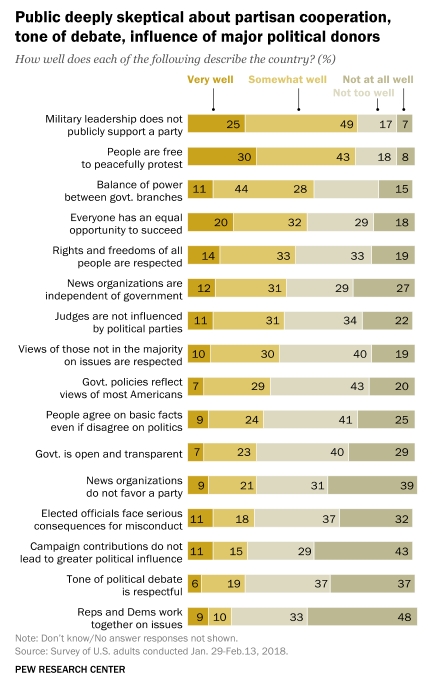
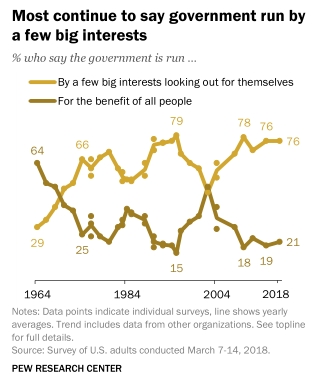
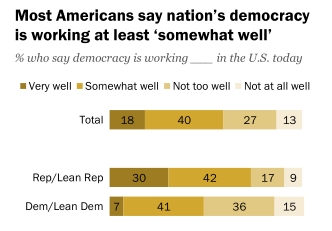
A 2018 opinion poll by the Pew Research Center has quite a few useful findings about the perceptions of government and political parties by American citizens. Some highlights:
Democracy: Most Americans do not believe that government policies reflect the views of most Americans and most say that government is run by a few big interests. Yet most say that American democracy works very or somewhat well.
Continue reading →
Filed under: Elections, Opinion polling | 9 Comments »
Posted on March 28, 2019 by Yoram Gat
“Risks that Matter 2019”, a new OECD report [PDF], shows a familiar public opinion pattern. Most people in most countries (in this case OECD countries) feel government does not serve their needs and does not take their opinions into account when formulating policy.

Filed under: Elections, Opinion polling | 1 Comment »
Posted on March 28, 2019 by Yoram Gat
 A call for papers has been issued for a colloquium in Lyon, France titled “Le retour du tirage au sort en politique: État des lieux et prospectives critiques entre sciences politiques et philosophie” (The return of sortition to politics: the lay of the land and critical perspectives between political science and philosophy).
The colloquium is organized by MAAD (Mutations et Approches Actuelles de la Démocratie) at the ENS in Lyon and will take place on October 10th and 11th, 2019. The call for papers mentions that, in addition to French, submissions in English and Spanish would be accepted as well.
The call for papers has a useful bibliography which contains a number of interesting recent sortition-related academic publications.
Filed under: Academia, Sortition | Leave a comment »
Posted on March 22, 2019 by Yoram Gat
“Against Lottocracy” (PDF) is a 2018 paper by Lachlan Montgomery Umbers from the department of philosophy at the University of Western Australia.
Abstract
Dissatisfaction with democratic institutions has run high in recent years. Perhaps as a result, political theorists have begun to turn their attention to possible alternative modes of political decision-making. Many of the most interesting among these involve reliance on lotteries in one way or another – as a means of distributing the franchise, selecting representatives, or making social choices. Advocates of these ‘lottocratic’ systems contend that they retain the egalitarian appeal of democracy, while promising improved political outcomes. The aim of this article is to defend democracy (or, at least, universal suffrage and majority rule) against the challenge posed by these proposals. I argue, firstly, that lottocratic systems necessarily involve the establishment of objectionable social and political inequalities in a way that democracies do not. Secondly, I raise a number of doubts with respect to the purported instrumental benefits of these proposals.
The paper is an attempt to formulate a reasoned (negative) response to proposals for instituting sortition-based government as a substitute to elections-based government, and specifically (as its name indicates) to Alexander Guerrero’s proposals. By doing so, the paper represents a significant step forward in the Anglophone academic discussion of sortition. In English-speaking academia proposals for setting up “citizen juries” – i.e., allotted, one-time, limited-purview decision making or (more often) advisory bodies – are discussed at length. So far, however, proposals for setting up sortition-based government were either ignored or summarily dismissed (“Nobody is going to support replacing Congress or Parliament with a randomly selected assembly,” as Helen Landemore put it). As it turns out, Umbers argues for the same reformist academic position. Umbers, however, does break some new ground by devoting his energies to making a detailed argument rather than simply taking sortition-based government off the table at the outset.
Continue reading →
Filed under: Academia, Elections, Sortition | 4 Comments »
Posted on March 17, 2019 by Yoram Gat
Dan Hind and Tom Mills write in openDemocracy:
Entering the secret castle: A small step towards democratic public media?
Last week the BBC gave a representative audience panel control of its Brexit output for one day. Could this ‘citizens juries’ type approach begin to transform our media?
It didn’t receive much attention, but last week the BBC tried something interesting. For one day, Friday 1st March, its Brexit-related output was overseen by a representative audience panel that would, as the BBC put it, ‘control’ coverage ‘across a range of BBC News outlets’. The initiative, branded Brexit: Your Stories, was intended, the BBC said, to reflect ‘how Britain really feels about Brexit’. Kamal Ahmed, the editorial director of BBC News, was quoted as saying:
Not only will it be a very different and thought-provoking way of reporting the news that day, but it will help inform how we shape our news coverage in the future. We want our news rooms across the UK to be less a set of secret castles where, to the public, mysterious things happen. We want to open up the process and this first day is just the start.
Does this unusual step from the BBC signal a genuine interest in organisational change? Will it be a first step in democratising its output, as the statement put it? Or was Friday’s experiment more an exercise in PR?
Time will tell. But the rather narrow focus suggests a significant motivation was to help the BBC navigate the choppy waters of Brexit reporting, which has presented enormous challenges for the broadcaster.
[…]
Filed under: Applications, Press, Sortition | Leave a comment »
Posted on March 12, 2019 by Yoram Gat

NJ.com presents “5 ideas to upgrade democracy” by 5 “of America’s leading political philosophers”. One of those is Alexander Guerrero, professor of philosophy at Rutgers University-New Brunswick’s School of Arts and Science, who offers the readers his ‘lottocracy‘:
Maybe America’s problem stems not from the fact that we aren’t picking the right people, but from the fact that we aren’t picking them in the right way.
Maybe — bear with me here — we should get rid of elections. I believe that you — that each of us — has something to offer, and that we can find ways to work together.
I propose we use a new system that uses random selection, rather than elections, to select political representatives.
I call it lottocracy.
For it to work, we must agree that having an elected, generalist legislature has run its course.
We should instead have randomly-chosen citizens selected to serve on single-issue legislatures, each covering specific areas such as immigration, transportation, education, agriculture and so on.
Each of the proposals was evaluated by 3 political scholars from Rutgers’ Eagleton Institute of Politics: Ashley Koning, Elizabeth C. Matto and John Weingart. Here is what they wrote about lottocracy:
Why won’t this work?
Continue reading →
Filed under: Academia, Press, Proposals, Sortition | 8 Comments »
Posted on March 9, 2019 by Yoram Gat
 Bard Institute for the Revival of Democracy through Sortition (BIRDS) was recently founded by Jonas Kunz and Hans Kern.
Kunz and Kern have now published a lengthy article in which they offer sortition as a tool for taking action on climate change:
Sortition: The Key to Globally Coordinated Climate Change Action?
Climate change by human industry (anthropogenic warming) has been known to scientists at the highest levels within the U.S. government, at least since 1979. That year, the ‘Charney Report’ — Carbon Dioxide and Climate: A Scientific Assessment — presented the research of nine atmospheric, meteorological and oceanographic scientists convened at Woods Hole Institute, to the National Research Council. The introduction to this report by Werner E. Suomi pronounces: “If carbon dioxide continues to increase, the study group finds no reason to doubt that climate changes will result and no reason to believe that these changes will be negligible. The conclusions of prior studies have been generally reaffirmed. …[“]
 [Natheniel Rich writes in a New York Times article:] “in the decade that ran from 1979 to 1989, we had an excellent opportunity to solve the climate crisis. The world’s major powers came within several signatures of endorsing a binding, global framework to reduce carbon emissions.” To arrive at a clear understanding of what went wrong, we must first do away with the common misconception that big industry is and always has been the main culprit. In fact, as the article reveals, the oil industry was the first, to take due diligence measures, on the dangers of climate change and was preparing to adapt to policy changes. The policy changes, however, never came. Resistance did not come from the outside, it came from within the political structures themselves.
Continue reading →
Filed under: Academia, Athens, Deliberation, Elections, History, Sortition | 33 Comments »
Posted on February 26, 2019 by Yoram Gat





 Adam Cronkright
 Ali
Ali Ahmed R. Teleb
 avanderven
 avergne
 Alex Kovner
 azakaras
 Brett Hennig
 campbellwallace
 Simon Threlkeld
 Nick Coccoma
 codyhipskind
 Common Lot Sortitionist
 Conall Boyle
 constitutionalism
 davidschecter
 graytmatter
 gtridimas
 H.J. Hofkirchner
 Hanspeter Rosenlechner
 James Kierstead
 John Burnheim
 jgarry20151
 Jochen Krattenmacher
 johnedwardtaylor
 johnhuang865
 Jonathan Crock
 keithsutherland
 Jacob Richter
 kkoreilly
 lukewhito
 SimonPek
 Nathan El
 Nicholas Gruen
 Owen Shaffer
 Patrick Chalmers
 Paul Gölz
 peterstone
 Pierre-Etienne Vandamme
 pronfeld
 Emil
Emil rcaze
rcaze richwbrown
 Roger Knights
 roslynfuller
 Pierre-Etienne Vandamme
 shaharavin
 tbouricius
 Ted Wachtel
 Joshua Laferriere
 theodorestathis
 towardsautonomyblog
 Wayne Liebman
 Yoram Gat
 Oliver Milne
 Equality by lot