Foa and Mounk: The democratic disconnect

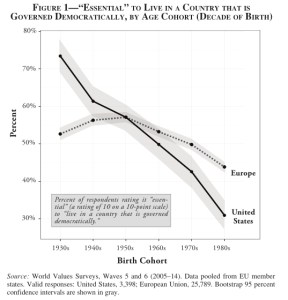
A paper in the Journal of Democracy by Roberto Stefan Foa and Yascha Mounk explores trends in the tremendously valuable World Values Survey database.

Drawing on data from Waves 3 through 6 of the World Values Surveys (1995–2014), we look at four important types of measures that are clear indicators of regime legitimacy as opposed to government legitimacy: citizens’ express support for the system as a whole; the degree to which they support key institutions of liberal democracy, such as civil rights; their willingness to advance their political causes within the existing political system; and their openness to authoritarian alternatives such as military rule.

What we find is deeply concerning. Citizens in a number of supposedly consolidated democracies in North America and Western Europe have not only grown more critical of their political leaders. Rather, they have also become more cynical about the value of democracy as a political system, less hopeful that anything they do might influence public policy, and more willing to express support for authoritarian alternatives. The crisis of democratic legitimacy extends across a much wider set of indicators than previously appreciated.

Continue reading

Senior French politicians propose allotted institutions

Back in June Arnaud Montebourg, who had served as Minister of the Economy in the years 2012-2014 and who is considered a potential presidential candidate in 2017, proposed, among other reforms of the French system aiming to “rebuild the trust” between the French people their political class, to have the Senate re-purposed to serve as a supervisory body and have its members selected by lot:

Could not the Senate, instead of being an end-of-the-career institution, be an allotted assembly, without legislative power because it is not representative, but with a supervisory role?

[My translation here and below.]

Now Emmanuel Macron, Montebourg’s successor as Minister of the Economy and possibly a presidential candidate in 2017 as well, has his own proposal for creating an allotted supervisory body:

The creation of a citizens’ commission

Each year, the president of the Republic has to appear before a citizens’ commission to be held to account, possibly supported by the Court of Audit. The former minister envisages the possibility of using allotment. This would allow the recreation of a little “political hygiene” in the system. For creating a democratic debate “which does not exist today”.

Graham Smith: The problem with politicians and democracy…

I would complete the headline of Alex Sakalis’s interview with Graham Smith on openDemocracy with “… is that they are mutually exclusive” (at least if by “politicians” it is meant “elected politicians”). Smith, however, strikes a more tentative note:

Citizens’ priorities are not necessarily the same as those of their political representatives. […] What is clear is that citizens are willing and able to deliberate on complex and contested political issues. The question is whether they will be listened to by local and national political leaders. The evidence is not promising.
Continue reading

Democracy talk – Episode 4

Patrick and I discuss the upcoming U.S. elections, diminishing candidate favorability, electoral crisis, the principle of distinction and other matters.

“[W]e usually end up where we need to be.”

Hillary Clinton, from the recent Wikileaks release:

You just have to sort of figure out how to — getting back to that word, “balance” — how to balance the public and the private efforts that are necessary to be successful, politically, and that’s not just a comment about today. That, I think, has probably been true for all of our history, and if you saw the Spielberg movie, Lincoln, and how he was maneuvering and working to get the 13th Amendment passed, and he called one of my favorite predecessors, Secretary Seward, who had been the governor and senator from New York, ran against Lincoln for president, and he told Seward, I need your help to get this done. And Seward called some of his lobbyist friends who knew how to make a deal, and they just kept going at it. I mean, politics is like sausage being made. It is unsavory, and it always has been that way, but we usually end up where we need to be. But if everybody’s watching, you know, all of the back room discussions and the deals, you know, then people get a little nervous, to say the least. So, you need both a public and a private position. And finally, I think — I believe in evidence-based decision making. I want to know what the facts are. I mean, it’s like when you guys go into some kind of a deal, you know, are you going to do that development or not, are you going to do that renovation or not, you know, you look at the numbers. You try to figure out what’s going to work and what’s not going to work. [Clinton Speech For National Multi-Housing Council, 4/24/13]

Vincent Azoulay: An electoral campaign in reverse

An article by Vincent Azoulay, professor of ancient history in the University of Paris-Est/Marne-la-Vallée, in france culture (original in French, my translation [corrections welcome]):

An electoral campaign in reverse: the ostracism

Let us start from a finding that is at first surprising. We possess no detailed record of an electoral campaign in Athens – despite it being history’s first democracy! There are multiple reasons for this: first, elections may not have necessarily been important events, being considered an aristocratic selection mechanism, being the opposite of the more egalitarian mechanism of sortition. Most importantly, when elections were held – when selecting generals, for example – they were most often if not unanimous then at least less-contentious: because it was never for selecting a single individual, a bitterly competitive affair, but a board of ten magistrates, which made the competition not as harsh.


To find the real electoral campaigns in Athens, with their maneuvers and intrigue, we have to turn to a celebrated institution, the ostracism, which may be considered as an election in reverse, as it was for politicians who would definitely not be elected!
Continue reading

Against elections, the video

A surprisingly militant video from David Van Reybrouck.

Crowdfunding Anthony Barnett’s WHAT NEXT: Britain after Brexit

unboundAnthony Barnett’s new book WHAT NEXT: Britain after Brexit is available for pre-order on Unbound. He writes:

Dear Fellow Kleroterians!

Thank you for permitting me to join you on this blog. I’m writing with a shameless request, but in this post-Brexit world being polite and submissive and deferential in a British way seems to be for the birds. Towards the end of the last century I wrote a paper suggesting that a section of the upper chamber should be selected by lot. Peter Carty got in touch with me, as he had been writing a paper on similar lines. We developed it into a publication for Demos, then directed by Ian Christie, published in 1998. Ten years later we turned it into a book, The Athenian Option: radical reform of the House of Lords, published by Imprint.

There was a moment I’ll never forget – which we write about in the book. In order to put replacing the Lords into the long grass, Tony Blair created a Royal Commission in 1999 to take evidence across the country. Because our Demos paper had caused a stir we were invited to give evidence. On the way into the session I found myself in a small lift with one of its senior members, Douglas Hurd, at that point Baron Hurd of Westwell. He had been close to Edward Heath, had been Foreign Secretary under John Major, who he had failed to beat for the Tory leadership. A grandee, I think, was the term at the time. the very opposite of the kind of regular person who would have been chosen had the Commission been selected by lot.
Continue reading

Democracy talk – Episode 3: Brexit

Patrick Chalmers and I are offering our conversation regarding Brexit and related issues.

Initiative in Switzerland calls for a referendum on “elections by sortiton”

generation-nomination-636x310

Harald K. calls attention to an interview with Charly Pache, a Swiss political activist, in the Pirate Times. Pache is one of the founders of the group “Génération Nomination” which aims to introduce sortition to the Swiss government. In the interview he makes an explicit proposal: replace elections with sortition as the mechanism for selecting the Swiss legislature.

Excerpt:

Pirate Times: What is “Generation Nomination” initiative?

Charly Pache: Generation Nomination is a Swiss based movement that wants to empower every citizen to be an active element of democracy, by introducing a system called ‘sortition’ in which members of the legislative are no more elected but randomly selected among all citizens, hence to give equal chances to all to be a player in the political decisions, no matter how rich or connected the citizen is. We are active on local, regional and national levels, with good connection with direct democracy NGO’s, academics and activists around the world.

Pirate Times: When did it start and what are its aims?

Charly Pache: We launched Generation Nomination publicly in 2015 after two years of preparation. The European Convention on Human Rights (ECHR) does not ensure the right to democracy but barely to ‘free elections’, what in fact shrinks the exercise of democracy to only elections… this is a very poor definition, as democracy is a lot more than ‘elections’: it’s about participation of all citizen, debating, informing, building political competences among the population. Furthermore, elections are of aristocratic nature, not of democratic essence. We want to broaden the ECHR with the right to democracy.

Continue reading