


Filed under: Elections | Tagged: drawing, image, screws | 1 Comment »

Filed under: Elections | Tagged: drawing, image, screws | 1 Comment »
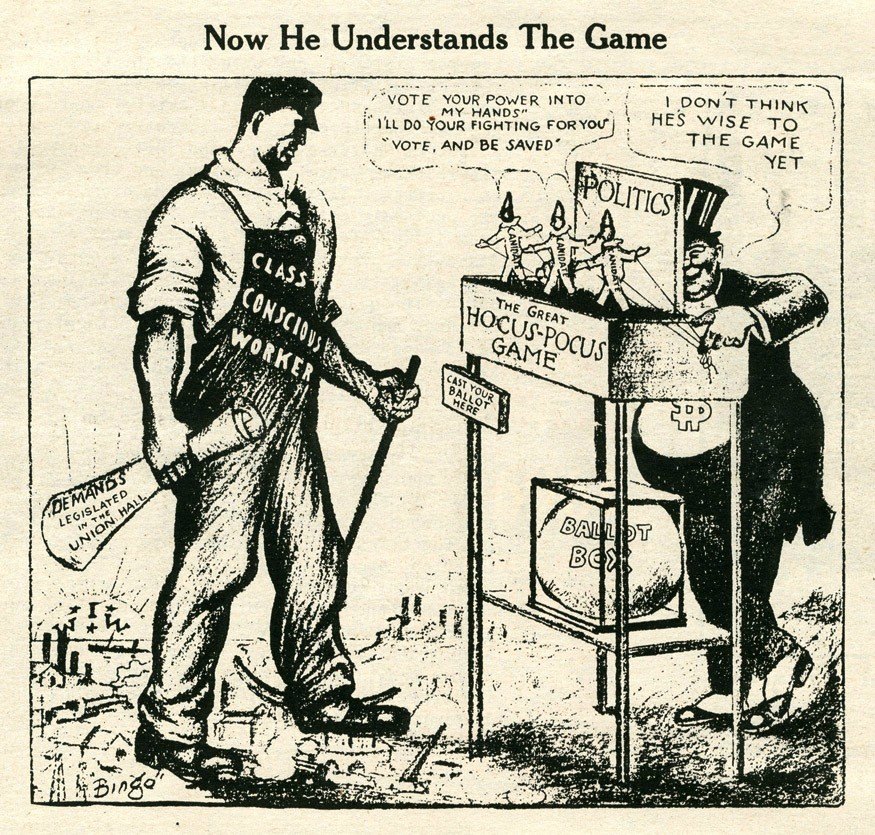
Electoralist dogma accords voting with significant ethical importance. If elections are the centerpiece of democracy, a legitimization of government, an expression of the “consent of the governed” then seeing voting as anything less than a pledge of allegiance would be cynical. By casting a vote for a candidate the voter makes a declaration of support for the record and agenda of the candidate and to some extent takes on responsibility for policy the candidate implements if elected. The more extreme versions of this romanticized view apply these implications of support and responsibility to each and every act or position of the candidate. Other versions apply them only to the record and policy in total.
An alternative, less exalted view would be that voting in a mass election is a specific act with specific practical implications. It is no more than a political expedient. According to this view, when considering who to vote for – and indeed whether to vote at all – citizens simply need to consider which alternative can be expected to yield better policy. Voting is then not an assertion about the record or agenda of the candidate in isolation but the expression of a comparison between the anticipated outcomes of the available courses of action.
Continue reading
Filed under: Elections | Tagged: Bernie Sanders, electoralist dillema, electoralist ideology, Leftist critique | 13 Comments »
From an interview with investigative reporter Lee Fang about the recent retirement of Eric Holder from his job as Attorney General of the US and his resumption of his job at the law firm Covington & Burling:
Lee Fang: One of the perhaps most cynical and and most prevalent ways that you can legally bribe a government official or an elected official is to wait to give them a multi-million dollar check, not while they’re in office, but as soon as they retire. So if a politician helps a bank or an oil company, that oil company can’t directly buy them a boat or give them a million-dollar check. But if they wait until that official retires from office, as soon as they step out the door of Congress and find an employment contract with a lobbying firm or a big bank, then they can accept a multi-million-dollar payday; and so it’s simply delayed bribery, in my perspective.
Filed under: Elections, Juries, Press, Proposals, Sortition | Tagged: Corruption, Eric Holder, FAIR, Lee Fang, legal corruption, revolving door | 4 Comments »
Nicholas Ross Smith and Zbigniew Dumienski of the Politics and International Relations Department at the University of Auckland write at the New Zealand Herald, New Zealand’s largest circulation newspaper, arguing that using randomly selected juries to make some council-level policy suggestions may be a good starting point for organically growing a more democratic governance system:
A report by Bernard Orsman published in the New Zealand Herald on the state of Auckland City Council found that 88 of the 99 positions in the council’s boardrooms and executive teams were filled by “white men from wealthy suburbs.”
The reported demographic composition of the decision-making bodies in Auckland Council suggests that we are facing a potentially harmful democratic deficit. Yet, before anyone suggests quotas or other bureaucratic mechanisms aimed at diversifying the Council’s management structure, it would be good to consider a very different and far more democratic approach currently tried by our friends across the ditch: citizens’ juries as bodies that could breathe new, more democratic and vibrant spirit into our city’s old structures.
The democratic deficit evident in Auckland City Council is part of a broader trend in democracies worldwide, both at the local and national levels, which are increasingly seen as departing from the core democratic principles that they are supposed to uphold. Meaningful deliberations and political equality are the soul of democracy.
Increasingly, our electoral system is virtually devoid of the former and its outcomes suggest the erosion of the latter. Interestingly, such an outcome would have perhaps been predicted by the founders of democracy in classical Athens who were concerned that elections and campaigning contains in themselves anti-democratic and oligarchic seeds.
Continue reading
Filed under: Academia, Athens, Elections, Juries, Press, Sortition | Tagged: Australia, City council, Melbourne, New Zealand | 2 Comments »
Damon Linker’s argument against compulsory voting weaves in Plato and the Socratic argument for aristocracy. His reasoning is an interesting modernization of the classical aristocratic mindset. His point about the contestability of excellence is good, and he makes use of it as a justification of electoralism.
A democracy gives every adult citizen a very small say in who rules. An individual doesn’t have to prove that he’s thoughtful or informed to exercise that right. As Plato argued 2,300 years ago, this makes democratic politics exceedingly peculiar. We don’t take a vote to determine the medical treatments that doctors prescribe, and neither do we ask for a show of hands about how to construct a bridge or a building. And yet we think it’s perfectly reasonable to ask for everyone’s opinion about what policies our country should pursue at home and abroad.
That’s because in politics, unlike in medicine and engineering, the act of determining who does and does not possess knowledge and wisdom is exceedingly contentious. (One might say it’s a political act in itself.) So we solve — or rather, we sidestep — the problem by letting everyone have a say.
Continue reading
Filed under: Athens, Elections, History, Participation, Press, Proposals, Sortition | Tagged: compulsory voting, Damon Linker, Plato | 14 Comments »
The persuasive juror who manages to sway the majority through his passion, eloquence and irresistible logic is part of Western cultural lore. It appears that one commenter on this blog even perceives himself as having played that very role.

The following exchange raises the possibility that the ability of a single juror to sway a whole jury is attributable to much more mundane dynamics – dynamics that are put in place by the unanimity rule. The key paragraph is the last one.
Continue reading
Filed under: Juries, Press, Sortition | Tagged: Unanimity | 4 Comments »
An English version of an op-ed piece I wrote recently. I am still looking for an Israeli mass media venue that would publish it.
Another round in the long struggle over the way Israel’s gas fields are to be exploited is upon us. Like most of Israel’s citizens, my understanding of the technical and economic details associated with this matter is sketchy. It is clear to me that a very lucrative resource is involved and that there are various proposals about how to deal with it – proposals which will see the value of this resource divided in different ways among different groups. Beyond that things are rather murky as far as I know. It seems that politically powerful people are exerting political pressure to obtain parts of the value of the gas wealth and that at least some of these people have personal, business or political connections to government officials. Like a large majority in the Israeli public I suspect that the balance of powers in the government serves primarily narrow interests (“the tycoons”) rather than serving the general public. Having said that, I have not followed the details and I cannot confidently say who is associated with whom and whose interests are served by each proposal.
Continue reading
Filed under: Opinion polling, Proposals, Sortition | Tagged: citizens' jury, Gas | Leave a comment »

Filed under: Elections | 48 Comments »
Nicholas Reece writes in The Age:
Experiment pays off: Melbourne People’s Panel produces quality policy
Citizen juries are one of the most promising innovations to emerge in the conversation about democratic renewal.
Melbourne’s radical experiment in democracy has reached a momentous conclusion, with the City Council announcing on Friday it will accept nearly all the recommendations of a 10-year financial plan developed by a citizens’ jury. That a group of 43 randomly selected Melburnians meeting over six weekends developed sound policy that is now being implemented is a profound result for anyone despairing at the state of our democracy. And it invites the exciting question, what’s next?
It turns out that having a plan “developed” over 6 weekends to guide the expenditure of billions of dollars over 10 years is considered a momentous success of radical democracy. What’s next, indeed.
Filed under: Applications, Elections, Press, Proposals, Sortition | Tagged: Australia, budget, citizens' jury | 44 Comments »
16. Why not use direct democracy?
“Direct democracy” is not a democratic mechanism – it suffers from much of the same fundamental problems of electoral systems.
Much in the same way that an electoral candidate has to have the backing of powerful people or organizations in order to become well-known enough to have a chance to be elected, so a proposition has to have powerful backing in order to become well-known enough to have a chance to appear on the ballot. Just like people have no real way to know how well a particular elected official represents their views and interests, so it is difficult to know what the effects of a particular proposition will turn out to be.
In addition, there is too much for government to handle for the cumbersome proposition mechanism to handle. Much of the business of government will necessarily be handled by professionals. “Direct democracy” offers no mechanism for controlling those professionals as they carry out the day-to-day workings of the government.
17. An electoral career provides training for statesmanship.
That is a very questionable assertion. An electoral career provides training for manipulation and self-promotion. A person habituated in such ways of thinking is not likely to pursue policy which serves the public.
Continue reading
Filed under: Elections, Sortition | Tagged: direct democracy | 2 Comments »
 Adam Cronkright
 Ali
Ali Ahmed R. Teleb
 avanderven
 avergne
 Alex Kovner
 azakaras
 Brett Hennig
 campbellwallace
 Simon Threlkeld
 Nick Coccoma
 codyhipskind
 Common Lot Sortitionist
 Conall Boyle
 constitutionalism
 davidschecter
 graytmatter
 gtridimas
 H.J. Hofkirchner
 Hanspeter Rosenlechner
 James Kierstead
 John Burnheim
 jgarry20151
 Jochen Krattenmacher
 johnedwardtaylor
 johnhuang865
 Jonathan Crock
 keithsutherland
 Jacob Richter
 kkoreilly
 lukewhito
 SimonPek
 Nathan El
 Nicholas Gruen
 Owen Shaffer
 Patrick Chalmers
 Paul Gölz
 peterstone
 Pierre-Etienne Vandamme
 pronfeld
 Emil
Emil rcaze
rcaze richwbrown
 Roger Knights
 roslynfuller
 Pierre-Etienne Vandamme
 shaharavin
 tbouricius
 Ted Wachtel
 Joshua Laferriere
 theodorestathis
 towardsautonomyblog
 Wayne Liebman
 Yoram Gat
 Oliver Milne

 Equality by lot