No government responsiveness on economic inequality and minimum wage

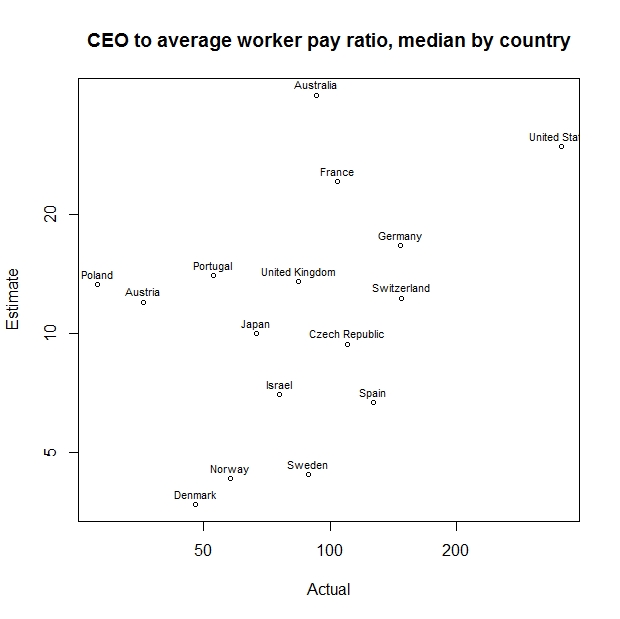
A recent international study of inequality by Michael Norton and Sorapop Kiatpongsan was already mentioned here for its findings about how uninformed the public was about matters of public policy. The study collected the opinion of people about what the CEO-to-average-worker pay ratio should be, and their best guess of what it actually was. A summary of the findings are shown in the table at the bottom.

Interestingly, not only do median estimates of the pay ratio in all countries grossly underestimate the true values, but there is essentially not correlation between the two (R2 = 14%, 3.5% after dropping the U.S. outlier):

estimate-vs-actual
Continue reading

Citizen initiative review panels debut in Colorado and Arizona

Arizona:

Morrison Institute hosts citizen’s initiative review to help inform Arizona voters
By Emi Kamezaki, September 21, 2014

ASU’s Morrison Institute for Public Policy partnered with Healthy Democracy to host Arizona’s inaugural citizens’ initiative review, which discussed pension reform among a small group of residents Sept. 18-21.

Arizonans will vote on Proposition 487, which favors a shift from public direct benefit systems, to private defined benefit pension systems, at the Nov. 4 election. The CIR brought together 20 randomly selected Phoenix voters of various backgrounds to learn about the different sides of the issue and create an unbiased resource for voters.

Colorado:

First Citizens’ Initiative Review delivers guidance for voters
By Clarissa Arellano, September 30, 2014

The Colorado initiative process is a powerful one that allows voters to be their own lawmakers but also puts voter education at a premium for a fair and effective election.
Continue reading

Stokes, Dromi and democracy

Susan C. Stokes, a professor of political science at Yale university, is the author of a book called Mandates and Democracy: Neoliberalism by Surprise in Latin America.

I find the following excerpts from a chapter called “Explaining policy switches” generally amusing and rather illuminating about the practice of political science (I introduced some light editing to improve readability of the excerpts):

[B]oth qualitative evidence from campaigns and statistical analysis of cross-sectional data offer evidence that fear of losing elections induced politicians to hide their policy intentions.

Yet evidence of this belief structure does not adjudicate between the representative and the rent-seeking model of policy switches. Both kinds of politicians are expected to hide their true intetions to win office. The critical question is, Did they dissimulate and switch because they thought efficiency policies were in the best interest of voters or because they found efficiency policies advantageous for themselves, whether or not they would be good for voters?
Continue reading

A letter to The Newfoundland and Labrador Independent

Democracy and elections

Dear Justin,

I am writing in response to the recent column by Raymond Critch “Why should every vote count?” (Sept. 29th). Mr. Critch describes his feeling of disenfranchisement due to the process that led to the selection of a new Premier of Newfoundland and Labrador – a process not involving public elections.

However, as Mr. Critch himself alludes by quoting John Kenneth Galbraith, elections are in fact not a tool of democracy but rather a way to inoculate the population against the feeling that the government is not theirs.

Mr. Critch also points out that democracy originally did not rely on elections to select political decision makers. In ancient Greece everybody knew that elections are typical to oligarchies, like Sparta, while democracies, like Athens, used sortition. Sortition is the mechanism of selecting decision makers by drawing lots – generating a decision making body that is statistically representative of the entire population.

Modern society is trapped in a situation where we have an elections-based elite-dominated political system and yet we call it “a democracy”. We are unhappy with it, and yet we keep venerating it. Until we free ourselves from identifying elections with democracy we will not be able to start working our way toward what can properly described as democracy.

Only rule by a statistically representative body – a portrait of the people in miniature – can produce a democracy: rule by the people for the people.

Best regards,

Yoram Gat
https://equalitybylot.wordpress.com

Not so wise: median estimates around the globe underestimate income inequality

A recent study by Michael Norton and Sorapop Kiatpongsan finds that for all countries studied median estimate of income inequality is much lower than reality:

In their study, Norton and Kiatpongsan asked about 55,000 people around the globe, including 1,581 participants in the U.S., how much money they thought corporate CEOs made compared with unskilled factory workers. Then they asked how much more pay they thought CEOs should make. The median American guessed that executives out-earned factory workers roughly 30-to-1 — exponentially lower than the highest actual estimate of 354-to-1. They believed the ideal ratio would be about 7-to-1.

“In sum, respondents underestimate actual pay gaps, and their ideal pay gaps are even further from reality than those underestimates,” the authors write.

Americans didn’t answer the survey much differently from participants in other countries. Australians believed that roughly 8-to-1 would be a good ratio; the French settled on about 7-to-1; and the Germans settled on around 6-to-1. In every country, the CEO pay-gap ratio was far greater than people assumed. And though they didn’t concur on precisely what would be fair, both conservatives and liberals around the world also concurred that the pay gap should be smaller. People agreed across income and education levels, as well as across age groups.

Voters’ demands for lobbying regulation are unmet by elected officials

Voters don’t trust elected officials. One of the ways this phenomenon manifests itself is by popular support for various forms of regulation of the officials’ political activity. The fact that this sentiment doesn’t get reflected in policy – just like public opinion regarding the salaries of elected officials – is a blunt failure of the electoral responsiveness dogma.

Rhetoric being cheaper than policy, some promises to regulate lobbying do get made:

I am in this race to tell the corporate lobbyists that their days of setting the agenda in Washington are over. I have done more than any other candidate in this race to take on lobbyists — and won. They have not funded my campaign, they will not run my White House, and they will not drown out the voices of the American people when I am president. Barack Obama, 2007

This promise was not, of course, translated to policy. But that aside, even as rhetoric this is rather tepid. Hammering lobbyists publicly – one of the only groups of people more widely distrusted than elected officials themselves – should have been an easy way for candidates and incumbents to win votes. But doing so would involve not only offending benefactors who finance the politicians’ campaigns but also offending former and future colleagues who happen to currently be on the other side of the revolving door.

A policy jury is “innovative, genuine democracy”

Noosa Council, Queensland, Australia:

A Noosa Community Jury of 24 randomly selected citizens will be used to consider certain complex and weighty local issues. Council could either ask for a recommendation, or in some circumstances Council may agree beforehand to implement the jury’s decision.

Mayor Noel Playford says the Community Jury will not take over the Councillors’ role, but will complement their work when everyday citizens, given time and access to all the information they need, in independently facilitated forums, can make an informed decision that earns community trust.

A citizens’ jury statistically reflecting the whole community will be randomly selected by an independent agency, not by the Council.

“These are the vital ingredients” Mr Playford said, “random selection, time and access to information and facilitated forums, independent of the Council.”

The Mayor described the jury as “innovative, genuine democracy”.

“In the de-amalgamation battle, our community was not just fighting for the return of their council, but also for a bigger say in local decision-making.”

The new democratic structure in Noosa will be organised in partnership with the newDemocracy Foundation, a respected, national research foundation made up of former leading politicians and academic experts in the field.
Continue reading

‏‎J’ai pas voté

J’ai pas voté is a documentary by Moise Courilleau and Morgan Zahnd. It is “an autopsy of French democracy aiming to create a new opportunity for growth of a new era of political organization”. Among those featured are Loic Blondiaux, Yves Sintomer, Jean-Paul Jouary, Jacques testard, Bernard Manin, Etienne Chouard, and Hervé Kempf.

The film is English subtitled.

The tired democracy

A discussion with Etienne Chouard and David Van Reybrouck under the title “The tired democracy – what are the solutions?” was held in Brussels in April. A video of part of the meeting is available. Unfortunately, the audio quality is rather poor.

Below is Ahmed Teleb’s English summary of the talk (Thanks!).
Continue reading

Impact of money raising considerations on campaign rhetoric

The virtue-based justification of electoralism implies an indirect connection between public opinion and policy. According to this justification, the public identifies people it trusts and puts them in office. Those people then determine policy as they see fit. According to this theory, then, the connection between policy and popular opinion is mediated by character judgments.

The rewards-based justification, on the other hand, implies a direct connection: elected officials wish to please the public in order to be re-elected and thus pursue policy that matches public opinion (in the sense that if they pursue policy X, then there exists no alternative policy which would win higher approval ratings).

The rewards-based theory suffers from two fundamental defects:

  1. It ignores the epistemic difficulties facing voters. In reality voters’ ability to determine the effects of government policy is very limited. They are therefore unable to tell whether government policy matches their world view and promotes their interests.
  2. It assumes that politicians lack policy preferences of their own. The theory assumes that politicians want to be elected simply and solely for pleasure of being in office rather than to promote any specific policy.

Those defects indicate why the rewards-based theory cannot be expected to explain policy setting by elected government. However, those defects do not apply to the rewards-based theory in the limited context of campaign rhetoric. Continue reading