Jurriaan Kamp: Juries can save America’s eroding democracy

Jurriaan Kamp writes in the Huffington Post:

America proudly sees herself as the leader of the democratic world. Democracy is on the rise around the globe. Forty years ago, think tank Freedom House published its first annual report ranking the world based on democratic freedoms. A mere 40 countries had free elections. Back then, Spain and Portugal were military dictatorships. Today, Freedom House counts 87 nations as “free countries,” a doubling in less than four decades. An additional 60 countries are “partly free,” leaving 48 countries still labeled “not free.”

Good news. However over the same forty years America’s own democracy has been eroded. First politics became a terrible money game with candidates having to spend ridiculous amounts of money to get elected based on sound bite simplifications of all important issues. And ultimately that money game has ended in a stalemate on Capitol Hill where two parties now only agree on one strict rule: If they want “yes” we will certainly and clearly say “no” — no matter the arguments.

Somewhere at the core of the idea of democracy is the notion that the people — or their representatives — get together for a dialogue out of which insight and vision may emerge. Continue reading

A short sortition debate

A short online discussion of sortition yields familiar arguments:

[S]ortition is a form of government based upon the drawing of officials by lottery. It was used in Ancient Greece and is rarely used now. To me, it seems a lot less corruptible than a regular democracy, it seems to me that it represents the people better, by literally selecting by random, rather than certain people picking certain people because he looks cool or “my dad met him”.

If you do it with a large enough pool of people it should represent the larger public well. It works with polling science I dont see why it wouldnt work there.

Most people are incompetent at their chosen profession. Why should we assume that if they are selected randomly they will behave anymore rationally than they do in other areas of their life?

Continue reading

Tim Dunlop: What if voting actually hampers democratic governance?

Tim Dunlop has been reading David van Reybrouk:

A ‘lottery’ electoral system could break our malaise

Perhaps it’s time to overhaul our voting system and instigate a form of “lottery” whereby our MPs are elected on the basis of random sampling. It may not be perfect, but neither is our current system, writes Tim Dunlop.

The basic logic of voting is that it is the method by which we determine the will of the people. Free elections are therefore understood to be the cornerstone – the defining characteristic – of democratic governance.

No vote, no democracy is just about a truism.

But what if that’s wrong? What if voting actually hampers democratic governance and is leading to undemocratic outcomes?

What if all the stuff we complain about in regard to our politicians – that they are unrepresentative, that they are out of touch, that they are in the pocket of various vested interests, that all they are really interested in is getting re-elected – what if all those problems are actually a by-product of voting itself?

In fact, Dunlop does a better job of presenting the idea of sortition than van Reybrouk himself. van Raybrouk never quite manages to point out what is wrong with elections. He spins a convoluted story in which elections were supposedly once democratic but are now no longer sufficiently so. This story may provide van Reybrouk with some sort of cover for his anti-electoralist heresy, but it makes his point incoherent. Dunlop, on the other hand, drops this supposedly historical argument and his introductory paragraphs above make the argument for sortition clearly and succinctly.

Two items by Equality-by-Lot regulars

Arthur D. Robbins:

To quote Sean O’Casey, “Th’ whole worl’s in a terrible state o’ chassis.” Why is it that way? Does it have to be that way? What can be done to set it straight? These are the questions the intellectual should be asking.

There are many factors creating the “state o’ chassis.” Most of them can be traced to a combination of action and inaction on the part of government. Government promotes the exploitation of fossil fuels. It favors the private car over public transportation. It diverts to war critical resources that could be used to develop alternative sources of energy. All of these policies are humankind’s contribution to global warming. These policies can be reversed, but not without transforming government. And I am afraid yet another election will not do the job.

Currently, there is considerable discussion and some experimentation exploring the possibilities of using sortition as a means of restructuring government. In ancient Athens, sortition was used as a means of selecting magistrates. We could substitute sortition for elections as a means of selecting our representatives and senators.
Continue reading

British public wrong about nearly everything, survey shows

This is the clever headline of an article in The Independent about a survey by the Royal Statistical Society and King’s College London measuring public perceptions of various public policy related facts:

A new [2013] survey by Ipsos MORI for the Royal Statistical Society and King’s College London highlights how wrong the British public can be on the make-up of the population and the scale of key social policy issues. The top ten misperceptions are:

1. Teenage pregnancy: on average, we think teenage pregnancy is 25 times higher than official estimates: we think that 15 per cent of girls under 16 get pregnant each year, when official figures suggest it is around 0.6 per cent.

2. Crime: 58 per cent do not believe that crime is falling, when the Crime Survey for England and Wales shows that incidents of crime were 19 per cent lower in 2012 than in 2006-7 and 53 per cent lower than in 1995. 51 per cent think violent crime is rising, when it has fallen from almost 2.5 million incidents in 2006-7 to under 2 million in 2012.

3. Job-seekers allowance: 29 per cent of people think we spend more on JSA than pensions, when in fact we spend 15 times more on pensions (£4.9bn vs £74.2bn).
Continue reading

No government responsiveness on economic inequality and minimum wage

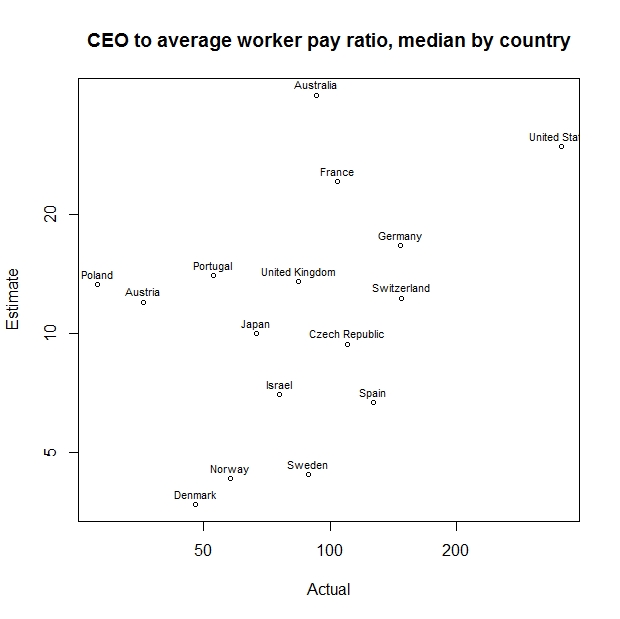
A recent international study of inequality by Michael Norton and Sorapop Kiatpongsan was already mentioned here for its findings about how uninformed the public was about matters of public policy. The study collected the opinion of people about what the CEO-to-average-worker pay ratio should be, and their best guess of what it actually was. A summary of the findings are shown in the table at the bottom.

Interestingly, not only do median estimates of the pay ratio in all countries grossly underestimate the true values, but there is essentially not correlation between the two (R2 = 14%, 3.5% after dropping the U.S. outlier):

estimate-vs-actual
Continue reading

Citizen initiative review panels debut in Colorado and Arizona

Arizona:

Morrison Institute hosts citizen’s initiative review to help inform Arizona voters
By Emi Kamezaki, September 21, 2014

ASU’s Morrison Institute for Public Policy partnered with Healthy Democracy to host Arizona’s inaugural citizens’ initiative review, which discussed pension reform among a small group of residents Sept. 18-21.

Arizonans will vote on Proposition 487, which favors a shift from public direct benefit systems, to private defined benefit pension systems, at the Nov. 4 election. The CIR brought together 20 randomly selected Phoenix voters of various backgrounds to learn about the different sides of the issue and create an unbiased resource for voters.

Colorado:

First Citizens’ Initiative Review delivers guidance for voters
By Clarissa Arellano, September 30, 2014

The Colorado initiative process is a powerful one that allows voters to be their own lawmakers but also puts voter education at a premium for a fair and effective election.
Continue reading

Stokes, Dromi and democracy

Susan C. Stokes, a professor of political science at Yale university, is the author of a book called Mandates and Democracy: Neoliberalism by Surprise in Latin America.

I find the following excerpts from a chapter called “Explaining policy switches” generally amusing and rather illuminating about the practice of political science (I introduced some light editing to improve readability of the excerpts):

[B]oth qualitative evidence from campaigns and statistical analysis of cross-sectional data offer evidence that fear of losing elections induced politicians to hide their policy intentions.

Yet evidence of this belief structure does not adjudicate between the representative and the rent-seeking model of policy switches. Both kinds of politicians are expected to hide their true intetions to win office. The critical question is, Did they dissimulate and switch because they thought efficiency policies were in the best interest of voters or because they found efficiency policies advantageous for themselves, whether or not they would be good for voters?
Continue reading

A letter to The Newfoundland and Labrador Independent

Democracy and elections

Dear Justin,

I am writing in response to the recent column by Raymond Critch “Why should every vote count?” (Sept. 29th). Mr. Critch describes his feeling of disenfranchisement due to the process that led to the selection of a new Premier of Newfoundland and Labrador – a process not involving public elections.

However, as Mr. Critch himself alludes by quoting John Kenneth Galbraith, elections are in fact not a tool of democracy but rather a way to inoculate the population against the feeling that the government is not theirs.

Mr. Critch also points out that democracy originally did not rely on elections to select political decision makers. In ancient Greece everybody knew that elections are typical to oligarchies, like Sparta, while democracies, like Athens, used sortition. Sortition is the mechanism of selecting decision makers by drawing lots – generating a decision making body that is statistically representative of the entire population.

Modern society is trapped in a situation where we have an elections-based elite-dominated political system and yet we call it “a democracy”. We are unhappy with it, and yet we keep venerating it. Until we free ourselves from identifying elections with democracy we will not be able to start working our way toward what can properly described as democracy.

Only rule by a statistically representative body – a portrait of the people in miniature – can produce a democracy: rule by the people for the people.

Best regards,

Yoram Gat
https://equalitybylot.wordpress.com

Not so wise: median estimates around the globe underestimate income inequality

A recent study by Michael Norton and Sorapop Kiatpongsan finds that for all countries studied median estimate of income inequality is much lower than reality:

In their study, Norton and Kiatpongsan asked about 55,000 people around the globe, including 1,581 participants in the U.S., how much money they thought corporate CEOs made compared with unskilled factory workers. Then they asked how much more pay they thought CEOs should make. The median American guessed that executives out-earned factory workers roughly 30-to-1 — exponentially lower than the highest actual estimate of 354-to-1. They believed the ideal ratio would be about 7-to-1.

“In sum, respondents underestimate actual pay gaps, and their ideal pay gaps are even further from reality than those underestimates,” the authors write.

Americans didn’t answer the survey much differently from participants in other countries. Australians believed that roughly 8-to-1 would be a good ratio; the French settled on about 7-to-1; and the Germans settled on around 6-to-1. In every country, the CEO pay-gap ratio was far greater than people assumed. And though they didn’t concur on precisely what would be fair, both conservatives and liberals around the world also concurred that the pay gap should be smaller. People agreed across income and education levels, as well as across age groups.