As was mentioned here before, some time ago Prof. Alexander Guerrero and his ideas about the use of sortition in government were the subject of an article in The Boston Globe.
I thank Prof. Guerrero for alerting me to a recently published essay of his about sortition in the online magazine Aeon. The essay presents Guerrero’s proposal, but starts with an interesting analysis of the failure of elections and follows the proposal with an analysis of the promise of sortition.
The lottocracy Elections are flawed and can’t be redeemed – it’s time to start choosing our representatives by lottery
[…]
The celebrity comic Russell Brand is gesticulating wildly, urgently, in a hotel room, under the bright lights of a television interview. ‘Stop voting, stop pretending, wake up. Be in reality now. Why vote? We know it’s not going to make any difference. We know that already.’ He is responding to his interviewer, Jeremy Paxman, who is taking him to task for never having voted.
We are brought up to think that voting is important, that it is a necessary condition of being a politically serious person, that we can’t complain about politics if we don’t vote. This last principle has echoes of the more reasonable parental admonition, said of lima beans or cauliflower: don’t knock it until you’ve tried it. But that principle is based on sound epistemological grounds: you might, for all you know, like cauliflower or lima beans. The voting thing is, as Brand argues, stupid. There are ways of participating in public affairs other than voting. For example, one can become a celebrity and call for revolution in a television interview.
Bob Moore wrote to call attention to the website of Democracy for the USA – a new organization that advocates replacing elections with sortition. Democracy for the USA is based in Chicago and bills itself as an outgrowth of the Occupy Chicago movement aiming to rectify the deficiency of Occupy’s platform – the lack of a workable alternative to the electoral system.
THE BIG IDEA
The heart of democracy is the community meeting. Of course there are already neighborhood meetings, but these do not determine government policy; they are not effective instruments of popular power. In a democratic USA, by contrast, the people will exercise sovereign rule collectively through regular and frequent community meetings across the country. Unlike the political system now in place, there will be no bodies of politicians–a Congress, state legislatures, city councils–drafting our laws. There will be no lobbyists, no groups such as ALEC, usurping the process. Neither will there be a president, governors, or mayors directing the government. Instead, through Community Assemblies and Executive Councils staffed by ordinary citizens selected by lot, everyone will truly have an equal voice in policy-making and an equal opportunity of serving in government.
In essence it is really this simple. We will not get anywhere flailing away within the confines of the current political structures. We will be like rats running around in a maze, succeeding perhaps in making life a little less unbearable for some people in spots, but ultimately getting nowhere fast. In the meantime the earth will be consumed and we will find ourselves in a condition of serfdom or worse. We have no option: we have to make the necessary change from the current system to democracy.
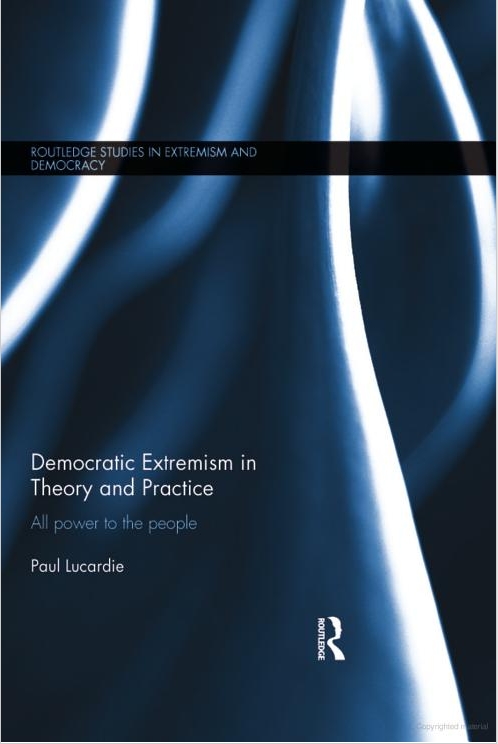
Paul Lucardie sent the following excerpts from his new book ‘Democratic Extremism in Theory and Practice. All power to the people’ (London: Routledge, 2014).
Author’s comment: Democratic extremism may appear to be an oxymoron, as ‘democracy’ is usually associated with moderation, pluralism and tolerance. Yet one could also regard democratic extremism as the opposite of autocratic and aristocratic extremism: whereas the latter imply that all decisions are taken by a dictator, a class of landowners or perhaps (in a more modern variety) the Central Committee of a ruling Communist Party, the former means that all decisions are taken by the people and that a political elite does not play any significant role. Examples of extreme democracy are rare, as far as I could find out. More common are cases of what I would call radical democracy: not all decisions but most important decisions are taken by the people, some are left to a political elite. Even more common, however, are mixed regimes where most decisions are taken by an elected aristocracy (professional politicians) and some by the people. In fact most so-called representative democracies are, in my opinion, mixed regimes, if not elective aristocracies. Continue reading →
The Youth Parliament of Belgium is a yearly conference of French-speaking youth in Belgium which is organized by the Parliament of the French Community in Belgium. Every year the Youth Parliament discusses four decrees that are proposed by four “ministers”. The Parliament decides whether to adopt or reject each of the decrees.
The 2013 Youth Parliament adopted a decree titled “Décret visant à réformer l’exercice du pouvoir des citoyens, de leurs assemblées et de leur gouvernement” (“Decree to reform the exercise of power of citizens, their assemblies and their government”), which, if I understand correctly, was authored by Pierre-Yves Ryckaert, a political activist.
The decree opens so (automated translation with my touch-ups):
After more than two hundred years of the representative parliamentary system, one thing is clear: this system which is supposed to derive its legitimacy from the consent of voters appears to create a structural and insidious monopolization of power by a class of professional politicians. The elite politician created by elections is bound to be limited to short-term policies, in a context where they are no longer sufficient to cope with the challenges of tomorrow. This led some citizens and elected officials to question the foundations of this system. Continue reading →
Most of the sounder proposals to refresh faith in democracy invoke some kind of “deliberative” process. Informed citizens should, in this model, have the opportunity to take part in every link of the decision-making chain rather than simply issue a yes/no verdict at its finale. In practice, how might this noble notion work? Well, here’s one idea that has even less chance of rapid realisation than an 11 per cent pay hike for MPs. We should fill at least some public offices by lottery.
“Sortition”, or the allocation of civic duties by lot, has a distinguished history. If ancient Athens practised it to supply most rotating city offices, then everyone in modern Britain understands it – and almost all respect it. The jury system still commands near-universal consent. People know that jury service modifies the risks of pure “sortition”. It makes provision for reasonable refusal or deferment, for challenges on the grounds of competence or conduct, and above all for guidance from a corps of impartial professionals – in this case, judges. If qualified random selection allows us to send someone down (or not) for life, then why not to decide on speed bumps and swimming pools? Continue reading →
Commenter ee points to a couple of videos in which Brandon Joyce makes a presentation about sortition on Channel 9 WPDN Public Distribution Network in Kensington, Philadelphia, PA.
Joyce got to the idea of sortition by reading Rancière. He starts out by pointing out the aristocratic or oligarchical nature of elections. He then puts out up a list of advantages of sortition over elections:
Dispenses with elections, campaigns, campaign finance
Partially free us from “particratic” polarization, ideologies, loyalties
Results in a far more accurate representation of “We, the People.” (“Get politicians out of politics!”)
Engages and empowers populace
Mitigates the corruption of long-entrenched power an d political class (for a time, at least)
While the bulk of the material rewards of high political office is not in the form of the officials’ pay, the salaries, allowances and benefits of the typical national legislator are quite generous. The report linked to below provides some data about the benefits of elected officials in the European Union. According to the report, the benefits of members of the national legislatures in the EU are on average about 3 times the average income of the citizens of their respective countries, while EU legislators make about 10 times the average income in EU countries.
The following survey results show the huge income disparities between the EU citizens battered by the economic crisis and their EU parliamentarians, concluding with one thesis only: We are dealing in Brussels and some national parliaments of the EU countries with conditions similar to ancient Rome because just like in the former Roman Senate none of these “new class EU senators” are controlled in any way. For example, MEPs of France have a salary of around 740 percent higher than the salary level of the average French (25,469 Euros annually). Continue reading →
Ahmed Teleb suggested the following as the most noteworthy sortition-related events of 2013:
the publication of Hélène Landemore’s book, Democratic Reason: Politics, Collective Intelligence, and the Rule of the Many, which has a section called “Elections versus Random Selection”:
Random lotteries would indeed produce what is known as ‘descriptive representation’ of the people […] ensuring statistical similarity of thoughts and preferences of the rulers and the ruled.” (p. 108),
We’ve all heard of the “wisdom of crowds” especially after James Surowiecki’s 2004 best-selling book by that name and Scott Page’s 2007 “The Difference.” […]
So why does the US Congress, a crowd of 535, seem so remarkably un-wise? Continue reading →
Below are some statistics about the fourth year of Equality-by-Lot. Comparable numbers for last year can be found here.
2013
Page views
Posts
Comments
Jan
1,665
9
118
Feb
1,273
3
17
Mar
1,329
5
111
Apr
1,783
12
163
May
1,628
11
84
June
1,499
11
118
July
1,801
9
148
Aug
1,578
5
82
Sept
1,730
10
182
Oct
2,518
12
234
Nov
1,629
9
147
Dec (to 20th)
950
4
34
Total
19,383
100
1,438
Note that page views do not include visits by logged-in contributors – the wordpress system does not count those visits.
Posts were made by 10 authors during 2013. (There were, of course, many other authors quoted and linked to.)
There are currently 116 email and WordPress followers of this blog. In addition there are 24 Twitter followers (@Klerotarian) and 43 Facebook followers.
Searching for “distribution by lot” (with quotes) using Google returns Equality-by-Lot as the second result (out of “about 109,000 results”), as well as the third and fourth results. Searching for “sortition” returns Equality-by-Lot as the 9th result (out of “about 60,800 results”).


 Adam Cronkright
 Ali
Ali Ahmed R. Teleb
 avanderven
 avergne
 Alex Kovner
 azakaras
 Brett Hennig
 campbellwallace
 Simon Threlkeld
 Nick Coccoma
 codyhipskind
 Common Lot Sortitionist
 Conall Boyle
 constitutionalism
 davidschecter
 graytmatter
 gtridimas
 H.J. Hofkirchner
 HpR
HpR James Kierstead
 John Burnheim
 jgarry20151
 Jochen Krattenmacher
 johnedwardtaylor
 johnhuang865
 Jonathan Crock
 keithsutherland
 Jacob Richter
 kkoreilly
 lukewhito
 SimonPek
 Nathan El
 Nicholas Gruen
 Owen Shaffer
 Patrick Chalmers
 Paul Gölz
 peterstone
 Pierre-Etienne Vandamme
 pronfeld
 Emil
Emil rcaze
rcaze richwbrown
 Roger Knights
 roslynfuller
 Pierre-Etienne Vandamme
 shaharavin
 tbouricius
 Ted Wachtel
 Joshua Laferriere
 theodorestathis
 towardsautonomyblog
 Wayne Liebman
 Yoram Gat
 Oliver Milne
 Equality by lot