Lafont: Democracy without shortcuts

Cristina Lafont is a professor of philosophy at Northwestern University whose research is about normative questions in political philosophy concerning democracy and citizen participation, global governance, human rights, religion and politics.

Lafont is the author a new book, Democracy without shortcuts, devoting a fair amount of attention to allotted citizen juries.

This book articulates a participatory conception of deliberative democracy that takes the democratic ideal of self-government seriously. It aims to improve citizens’ democratic control and vindicate the value of citizens’ participation against conceptions that threaten to undermine it. The book critically analyzes deep pluralist, epistocratic, and lottocratic conceptions of democracy. Their defenders propose various institutional “shortcuts” to help solve problems of democratic governance such as overcoming disagreements, citizens’ political ignorance, or poor-quality deliberation. However, it turns out that these shortcut proposals all require citizens to blindly defer to actors over whose decisions they cannot exercise control. Implementing such proposals would therefore undermine democracy. Moreover, it seems naïve to assume that a community can reach better outcomes “faster” if it bypasses the beliefs and attitudes of its citizens. Unfortunately, there are no “shortcuts” to making a community better than its members. The only road to better outcomes is the long, participatory road that is taken when citizens forge a collective will by changing one another’s hearts and minds. However difficult the process of justifying political decisions to one another may be, skipping it cannot get us any closer to the democratic ideal. Starting from this conviction, the author defends a conception of democracy “without shortcuts.” This conception sheds new light on long-standing debates about the proper scope of public reason, the role of religion in politics, and the democratic legitimacy of judicial review. It also proposes new ways to unleash the democratic potential of institutional innovations such as deliberative minipublics.

Continue reading

Grandjean: Sortition is apolitical and in-egalitarian

An op-ed in LaLibre.be by Geoffrey Grandjean, teaching fellow at the University of Liège and director of the Institut de la Décision publique. Original in French. Published 03/12/2019.
Forming a citizen assembly using sortition in order to reinvigorate democracy is a fashionable idea. Nevertheless, it appears to me to be erroneous. There are preferable alternatives.

Sortition has come back into fashion. Political representatives, swayed by a series of experts, are now seeing sortition as a way to reinvigorate democracy and maybe, for some, to finally realize the democratic dream through statistical sampling. Instrumental reasoning will win over ideological debates because an allotted assembly – or even a partially allotted assembly – is synonymous with democracy.

However, recourse to sortition as a method for selecting assembly members is profoundly apolitical and in-egalitarian idea. There are three reasons for this.

More than a link of trust

First, behind sortition there are mistaken, and even dangerous, assumptions about the functioning of democracy. On the one hand, in critiquing the existing representative system, the advocates of sortition respond to a sentiment of general distrust by proposing a mechanism that does not rely on trust. The electoral link of trust between represented and representatives is replaced by a probabilistic selection technique of cold calculation. In this regard, in Les @nalyses du CRISP en ligne, Vincent de Coorebyter asserts that the tendency to create citizen parliaments consists of “an abandonment, pure and simple, of sovereignty in favor of an assembly selected without us”.

On the other hand, when we look at the different proposals for allotted assemblies, they are often designed as having short terms. In fact, citizens are convened for a single day, or a week at most. This type of proposal translates to short-termism and the ephemerality, unless the allotted citizens become full-fledged parliamentarians. Taking a public decision takes time, even in our digital societies. Fundamentally, the advocates of sortition drain away, through the procedure of selection of assemblies, what is the heart of political decisions – the depth and intensity of debate of ideas which requires trust and requires time. Therefore, sortition reveals itself as apolitical.
Continue reading

Berkowitz: Democratic Revival and Using Lottery in Citizen Juries

On Saturday, April 18, 2020, at 4:00 pm – 5:00 pm EDT/GMT-4 the Hannah Arendt Center at Bard College will hold an online discussion by Dr. Roger Berkowitz under the title “Democratic Revival and Using Lottery in Citizen Juries presented”. The event will be accessible through the following link: https://zoom.us/j/182088949.

We require intensive efforts to rebuild faith in democracy. An increasingly talked about idea is citizen assemblies or Citizen Juries that bring together everyday people chosen by lottery to discuss, learn about, and make recommendations upon political questions.

These Citizen Assemblies are based on the old Athenian idea of choosing representatives in a democracy by lottery rather than by election. Around the world, such Citizen juries are being used to foster greater involvement of citizens in policy making which complement representative and direct democracy. These deliberative institutions are not mere focus groups. By bringing non-expert citizens into political institutions, Citizen Juries both breathe energy into representative democracy and nurture virtue amongst citizens. It is one way to address the deficit of democratic participation that plagues modern democracy. Dr. Berkowitz will lead a discussion about Citizen Juries and how they can reinvigorate democracy.

Schnapper: Extreme democracy and democratic extremists

Dominique Schnapper is the director of studies at the School for Advanced Studies in the Social Sciences (EHESS) (retired) and a former member of the French Constitutional Council. This is a translation of Schnapper’s articleExtrême et extrémistes de la démocratie” published in April 2019 on the Telos website.
The Gilets Jaunes movement fights under the banner of “real” democracy and it risks contributing to the destruction of the only democratic regime that has ever existed, namely representative democracy.

Democracy always had two dimensions: a democratic one and an aristocratic one. Democratic because the rulers submit to elections by the ruled and are rewarded or punished through the vote.

The dream of direct democracy

The aristocratic dimension was always a source of disagreement. The dream of direct or total democracy has accompanied the history of democracy. But it is today all the more present in the idea that entrusting decision making to others is contradictory to the conception of the sovereign democratic individual doing things himself, and being the source of all legitimacy and competence. He brings his own legitimacy. He feels fully qualified to express himself directly by himself without the intervention of a representative.

Democrats like neither mediation nor distinctions. Every type of distinction – and in particular the distinction between voters and elected – every hierarchy is perceived as discriminatory. The elites are easily denounced as responsible for all our failures. For there the ideas of direct democracy and ideas inspired by direct democracy regain their power. Protesting activists become actors of a “counter-democracy” [Pierre Rosanvallon, La contre démocratie, 2006], they speak about the foundational principles of democracy and the liberation from electoral rhythm in order to exercise daily surveillance on the actions of the rulers.
Continue reading

Sortition in the New Yorker, again

For the second time in less than a year, sortition is mentioned in the New Yorker. Last time, it was merely an off-handed comment. This time, sortition is front and center. Nathan Heller’s article is built around an interview with Hélène Landemore. Alexander Guerrero also gets quoted.

Landemore’s ideal is participative, but she seems to be working with a rather loose concept for her proposals:

What distinguishes Landemore’s ideal from other lottocratic models, such as Guerrero’s, is the breadth of her funnel: the goal is to involve as much of the public organically in as many decisions as possible. Her open-democratic process also builds in crowdsourced feedback loops and occasional referendums (direct public votes on choices) so that people who aren’t currently governing don’t feel shut out.

As evidence that open democracy can work in large[…,] culturally diverse societies, Landemore points to France’s Great National Debate—a vast undertaking involving a vibrant online forum, twenty-one citizens’ assemblies, and more than ten thousand public meetings, held in the wake of the gilets jaunes protests, in 2019—and, this year, to the country’s Citizens’ Convention on Climate Change.

Continue reading

Costa Delgado and Moreno Pestaña: Democracy and sortition: Reasons for using randomness

A new book, The Routledge Handbook of Contemporary European Social Movements, has a chapter by Jorge Costa Delgado and José Luis Moreno Pestaña named “Democracy and sortition: Reasons for using randomness”. The authors summarize their chapter as follows:

The use of sortition accompanies the renewal of debates on democracy. In this chapter, following a brief overview of a few general traits pertaining to the political use of sortition, we will study its fundamental contributions on three levels. First of all, we will analyze how random selection can contribute to renewing the debate about the knowledge necessary to participate politically. For that we will develop four logical possibilities following the discussion between Socrates and Protagoras in Plato’s homonymous dialogue, and, subsequently, they will be exemplified through the debate regarding sortition in the Spanish political party Podemos as context for reference. Secondly, we will address the problem of sortition and its double potential to motivate participation and demotivate unwanted behaviour and profiles. In this case, illustrative examples will be taken stemming from the authors’ own ethnographic experience. Lastly, it will be argued that sortition serves to produce a particular moral content within political participation, based on the idea that politics are a civic virtue, essential to the development of human capabilities, that must be stimulated and distributed en masse. This perspective contrasts with logics deeply rooted in activist environments that, often hinder the declared objectives of those who are members of them, specially the alternation, when we think of political participation, between the ideology of the gift and the professional one.

Van Reybrouck’s Against Elections translated to Japanese

Prof. Seiki Okazaki of Kyushu University, Japan, wrote to draw attention to the publication of a translation of David Van Reybrouck’s book Against Elections to Japanese. It seems the book has generated significant interest in Japan. Prof. Okazaki attributes the positive reception to some extent to the fact that sortition-based judicial institutions have been part of the Japanese system for a decade.

The Japanese translation of David Van Reybrouck’s Against Elections (Tegen Verkiezingen) appeared in April 2019 […] Three of the four national newspapers published a book review: the Yomiuri Shimbun on May 19, the Asahi Shimbun on June 1, and the Nikkei on August 10. Many regional newspapers printed a book review transmitted by Kyodo News. Other newspapers and magazines also reviewed the book favourably. Supported by these reviews, the book was reprinted as early as September 2019.

2019 marked the 10th anniversary of the the lay judge trial system and of the mandatory prosecution through citizen review of non-charge decisions. These are both reforms related to the criminal justice system in Japan enhancing the participation of citizens using sortition in a procedure that was until then exclusive territory of professionals. As the Supreme Court noted, the lay judge system has become well accepted and acquired legitimacy in Japanese society. Japanese citizens have become familiar with sortition in the judicial system and realize how this enhances quality and democracy in the courts. This is probably one of the reasons that Japanese citizens are interested in the central arguments developed in Against Elections and why sortition was not immediately rejected a proposal unfeasible for Japanese society.

However, the most important factor for the book’s success is the wide and deep distrust of party politics. Opinion polls show that about 40 percent of Japanese voters support no political party.

OKAZAKI Seiki, one of the translators of Against Elections, proposed to replace the elected House of Councillors with the sorted House of Citizens. He suggests that the sorted House can exercise veto power over the decisions of the elected House (Okazaki Seiki, “Election and Sortition,” Kenpo-kenkyu (Review of Constitutional Law), No. 5, November 2019, pp. 87-96. Written in Japanese).

The Democratic Diarchy

Alex Kovner and myself have been banging on for some time about the ongoing necessity for political parties (albeit in a heavily-modified form) for policy proposal and advocacy in a well-functioning democracy (the disposal role being reserved for randomly-selected juries) and this has not gone down particularly well on this forum. We’re presenting a short paper on it at the Association for Political Thought conference at Oxford in January and would greatly appreciate feedback before we go. It’s very short and we’ve put a lot of effort into refining and clarifying the necessary distinctions. The full paper is on Academia.edu, here’s the abstract:

Isegoria (equal speech) and isonomia (equal law), the two norms that constituted classical Athenian democracy, were implemented respectively by the right of every citizen to propose (or argue against) new laws (isegoria), and equal voting rights over their implementation (isonomia). In the fourth century the latter (disposal) function was entrusted to large, randomly-selected juries (nomothetai) that could be viewed as descriptively-representative microcosms of the citizen body. Isegoria rights were restricted to the five citizens elected by the assembly.

Most current models for ‘citizens’ assemblies’, although claiming Athenian provenance, more closely resemble modern parliaments in that the proposal and disposal functions are conflated, the only difference being that citizens’ assemblies are not constituted by preference election. This paper argues that such models result from a conceptual confusion, have no historical precedent and are vulnerable to corruption and domination by the very hegemonic forces that they seek to counter. The paper argues that, whilst the democratic argument for legislative decision-making (disposal) by a large ad hoc representative jury is persuasive, sortition can have no role to play in the proposal function and such sortition-based bodies can only be part of a mixed constitution in which political parties (albeit of a radically different form to their current incarnation) are required in order to implement ‘representative isegoria’.

And here’s details of the conference panel:

‘The Circumstances of Sortition’

  • David Owen (University of Southampton), ‘The Uses of Sortition’
  • Yves Sintomer (Université de Paris 8), ‘The Contrasted Models of Democracy in Sortition-Based Innovations’
  • Alex Kovner; and Keith Sutherland (University of Exeter), ‘Isegoria and Isonomia: Election by Lot and the Democratic Diarchy’
  • Peter Stone (Trinity College Dublin), ‘The Paradox of Sortition’

2019 review – sortition-related events

As I have done at every end-of-year of the last 9, I am offering my summary of notable sortition-related events that occurred over the last year.

As polls indicate that people continue to believe that governments do not represent them, the idea of the single-issue citizens’ assembly made strides in various European countries in 2019. In France, the Citizens’ Climate Convention is taking place, where 150 allotted people are tasked with selecting ways to address the climate crisis. This body is relatively high profile and received attention by various writers. A similar body is being demanded in the UK by the Extinction Rebellion movement.

Scotland had a citizens’ assembly for “shaping Scotland’s future”.

Participations journal devoted a special issue to sortition. 24 papers dealt with various aspects of the topic. The book Legislature by Lot, with the papers from a workshop by the same name was also published.

A citizens’ assembly on Brexit was widely discussed in the UK.

A permanent allotted body was instituted by the German speaking community in Belgium and by City Hall in Madrid.

The increasing use of allotted citizen bodies resulted in increasing scrutiny of the ways in which they are constituted and run, as well as their institutional role.

Blok: Sortition and democracy: equality, justice and the challenge of present-day democracy

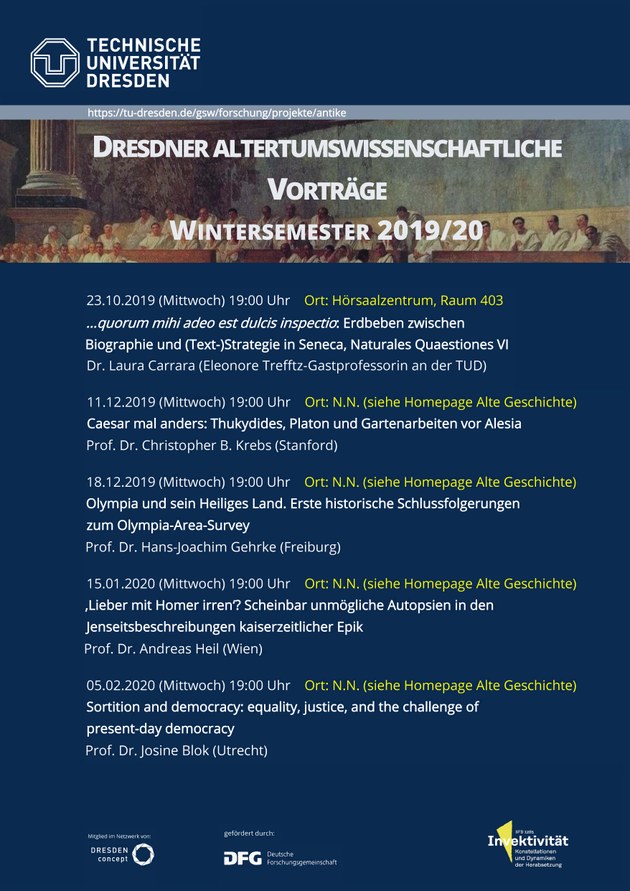
Prof. Josine Blok, a classicist from the University of Utrecht, will be giving a talk titled “Sortition and democracy: equality, justice and the challenge of present-day democracy” at the University of Dresden on Feb 5th, 2020.

It turns out that Blok has been interested in sortition for some time. In 2014 she has published a paper called “Participatory Governance: The Case for Allotment” in the journal Participation. The paper is viewable and downloadable here.

In the paper, Blok hypothesizes that sortition was legitimated in Athens by the custom of using the lottery to allocate shares of inheritances among the heirs. Other parts of her discussion are interesting and original as well.