Posted on January 28, 2015 by campbellwallace
DOWN WITH ELECTIONS!
Part 1 Part 2 Part 3 Part 4 Part 5 Part 6
PART 3
Examples of the Legislation in Action
How might all this work in practice? Let us consider some examples.
Example 1: The Passage of a Proposal by a Private Citizen
Suppose Bill Brown decides that Watchamacallit Bay is over-fished. He writes a letter to the Assembly:
Dear Sirs and Madams,
Watchamacallit Bay is hopelessly overfished, when I was a kid there was fish everywhere, now its DEAD!!! Theres no fish left!
Fishing should be banned in Watchamacallit Bay.
Yours etc, Bill Brown
He receives a reply in warm, friendly, bureaucratic style from the Proposals Committee:
Dear Sir/Madam,
Re: Proposal to ban fishing in Watchamacallit Bay.
The Proposals Committee has received your proposal, and thanks you for it.
Proposal Number: 2050/456789 (please quote this reference in correspondence)
Status of proposal: Pending. (You will be informed of changes to the status.)
Current Regulations in force concerning this matter, or which may be affected:
Continue reading →
Filed under: Academia, Elections, Sortition | 105 Comments »
Posted on January 18, 2015 by Yoram Gat
A new post by Ahmed Teleb:
Citizens’ Initiative Reviews: Democracy via Vicarious Deliberation?
Although there has been much discussion in deliberative democracy circles on both the potential and possible drawbacks of “intensive” citizen deliberation–especially on Equality by Lot–there has been less awareness and discussion of deliberative forums in practice. Below is a video interview (first 16 minutes only) of two panelists from last fall’s Citizens’ Initiative Review pilot in Colorado. Further below, you will find links to two peer-reviewed articles evaluating the 2010 CIR in Oregon. Oregon is, to my knowledge, the unique contemporary example of a permanent incorporation of citizen deliberation into its political system. The link at the end of the post is to Oregon’s CIR Commission and to the Oregon Statutes that govern it.

Filed under: Academia, Applications, Ballot measures, Press | Tagged: Citizens’ Initiative, deliberative democracy | 5 Comments »
Posted on December 29, 2014 by Yoram Gat
Tomas Mancebo highlighted the proposals for using sortition that were part of the constitutional process at Podemos – a party which emerged this year as a highly popular alternative to the established parties in Spain.
Adam Cronkright wrote about his work with Democracy In Practice in Bolivia applying sortition to student governments.
Together with Tomas, I find the fact that sortition was relatively prominently proposed and discussed (although ultimately rejected) as part of the power structure within Podemos as the most significant sortition-related event of 2014.
Other 2014 sortition-related events of significance were:
- Russell Brand’s anti-electoral message, although originally announced in 2013, continued to resonate and generate largely outraged responses throughout 2014.
- The idea of sortition continued to be actively discussed in French. A new French movie – J’ai pas voté – featured a string of critics of electoralism and sortition advocates. Etienne Chouard and David Van Reybrouck joined forces in April for a conference called “The Tired Democracy”.
- While Chouard’s more militant message seems to be limited to French media, Van Reybrouck’s softer message made it through the language barrier and was featured on the BBC.
- An empirical study by Gilens and Page indicating that median (as measure by income) public opinion has very little effect on policy in the U.S. got significant media attention. Another study, by Norton and Kiatpongsan, showing that there is little association between people’s expectations (and perceptions) about inequality and reality was widely discussed as well.
- Ever eager to find ways to legitimize itself, established power made exploratory maneuvers to exploit the idea of sortition.
Happy new year and best wishes to all!
Filed under: Academia, Elections, Opinion polling, Press, Sortition | 21 Comments »
Posted on December 13, 2014 by Yoram Gat
Elections in Israel are in the offing again. Prof. Irad Malkin, a professor of Ancient History in Tel Aviv University and winner of the 2014 Israel Prize for history, again offers sortition to the readers of the Israeli newspaper Haaretz:
Lottery instead of voting, like in Athens
In these days, in which parties are preparing for elections, especially in view of the increase of the electoral threshold, an exhausting process of political fighting, deals, backstabbing and ideological infighting can be expected. Even if a new party is formed and wins seats in the Knesset, residues of bitterness and animosity that have accumulated during the formation struggle will remain. This problem can be solved – greatly shortening the process and dissolving the conflicts in advance – by adopting a mechanism that was used in ancient Athens, the city that gave us democracy.
In the Athenian democracy people were selected by lottery to most positions in the executive, religious and judicial organization. […] The difference between oligrachy and democracy, say Aristotle, is that oligarchy has elections while democracy has the lottery.
Continue reading →
Filed under: Academia, Athens, Elections, History, Participation, Press, Proposals, Sortition | Tagged: Electoral threshold, Israel, Malkin | 6 Comments »
Posted on December 2, 2014 by Yoram Gat
A new Spanish political party called “Podemos” (“we can”) has seen meteoric growth in public support according to opinion polls. According to some polls, it has now surpassed in popularity the two major Spanish parties.
Its founding manifesto (a somewhat awkward translation here) presents Podemos as an outgrowth of the 2011 “Indignados” protests and the unrepresentative nature of the existing system:
Turning outrage into political change
Just as with other moments in history, we see today a European continent submerged in perplexity. Whilst the majorities look back with nostalgia on the past that is lost, certain powerful minorities, with no criterion other than their own survival, show that enrichment is their flag and impunity their horizon. Never in Europe have there been so many people discontented with their loss of rights, and, at the same time, so few prospects for channeling this outrage through a voting option that excites while at the same time, shows the capacity to represent the majorities under attack and a capacity for committed and efficient administration that makes the best possible options become real. Many find it intolerable that in the greatest crisis in the system since the crash of 1929, those forces that claim to be progressive are at their weakest point, thereby condemning the majorities in our countries to a kind of melancholy that leads to resignation and political depression. [Excerpted from the translation linked above with my touch ups.]
Continue reading →
Filed under: Academia, Applications, Ballot measures, Elections, Opinion polling, Participation, Press, Proposals, Sortition | Tagged: Pablo Iglesias | 6 Comments »
Posted on October 24, 2014 by keithsutherland
There has been a lot of debate on this blog recently as to whether or not political outcomes are unduly influenced by the rich; in this post I want to consider the influence of other nondemocratic agents – activists, civil society pressure groups, non-corporate lobbyists and academics in the social sciences and humanities. The reason for the inclusion of the last category is because most political leaders are educated in these disciplines – unlike, say, in China, it’s hard to identify political leaders who studied the natural sciences or engineering – so academics in these fields will have had a powerful influence in their formative years. There are more Oxford PPE (politics, philosophy and economics) graduates in the House of Commons than Old Etonians (35 to 20) and 50% of ministers and 28 percent of MPs were educated at Oxbridge, the vast majority in the above-mentioned subjects. Jeremy Waldron, in his inaugural lecture for his (Oxford) chair of social and political theory argued against the focus of the PPE syllabus on the ’57 varieties of luck egalitarianism’ as opposed to ‘political’ issues like representation, sovereignty and the rule of law, and it’s the resulting influence of the equality lobby that I want to address in this post. Some of the material is anecdotal, and some evidence of partisan influences in the formulation of a UN convention on disabilities equality.
The primary school in my village (pop. c.300) has recently constructed, at considerable expense, a ‘sensory room’ to meet the needs of one part-time disabled pupil. (Bear in mind this is happening at a time when local authority budgets are squeezed to the extent that rural residents are being told that they will need to grit their own roads this winter (and pay for the materials) as the council does not have the funds.) This is the result of government policy that insists that the disabled must be fully integrated in regular society, and has closed down most of the special schools that accommodated the specific needs of disabled children. Speaking to two parents of disabled children (one Aspergers and one cerebral palsy), they both volunteered that this politically-motivated policy has been disastrous for their children because, unlike their peers in special schools, their everyday growing-up experience provided a constant reminder of their neediness.
Continue reading →
Filed under: Academia, Initiatives, meta | Tagged: advocacy group, civil society, Jeremy Waldron, pressure group, pressure groups | 9 Comments »
Posted on October 19, 2014 by Yoram Gat
This is the clever headline of an article in The Independent about a survey by the Royal Statistical Society and King’s College London measuring public perceptions of various public policy related facts:
A new [2013] survey by Ipsos MORI for the Royal Statistical Society and King’s College London highlights how wrong the British public can be on the make-up of the population and the scale of key social policy issues. The top ten misperceptions are:
1. Teenage pregnancy: on average, we think teenage pregnancy is 25 times higher than official estimates: we think that 15 per cent of girls under 16 get pregnant each year, when official figures suggest it is around 0.6 per cent.
2. Crime: 58 per cent do not believe that crime is falling, when the Crime Survey for England and Wales shows that incidents of crime were 19 per cent lower in 2012 than in 2006-7 and 53 per cent lower than in 1995. 51 per cent think violent crime is rising, when it has fallen from almost 2.5 million incidents in 2006-7 to under 2 million in 2012.
3. Job-seekers allowance: 29 per cent of people think we spend more on JSA than pensions, when in fact we spend 15 times more on pensions (£4.9bn vs £74.2bn).
Continue reading →
Filed under: Academia, Elections, Opinion polling, Press | Tagged: Ipsos MORI, King’s College London, public perceptions, Royal Statistical Society | 14 Comments »
Posted on October 17, 2014 by Yoram Gat
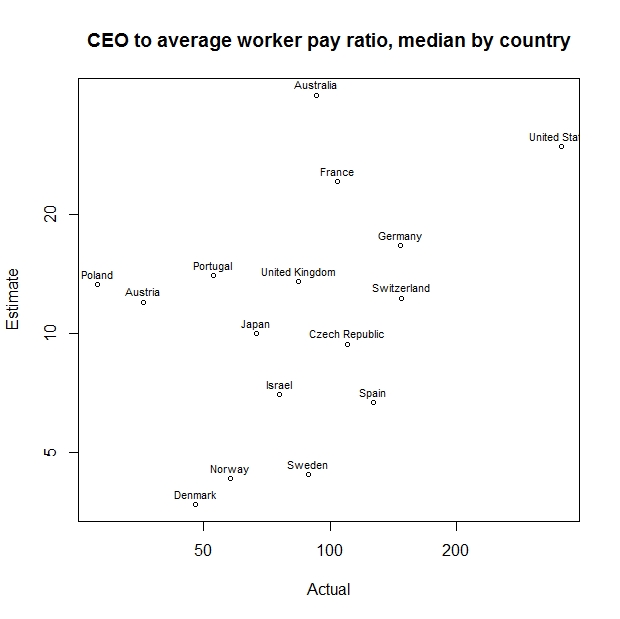
A recent international study of inequality by Michael Norton and Sorapop Kiatpongsan was already mentioned here for its findings about how uninformed the public was about matters of public policy. The study collected the opinion of people about what the CEO-to-average-worker pay ratio should be, and their best guess of what it actually was. A summary of the findings are shown in the table at the bottom.
Interestingly, not only do median estimates of the pay ratio in all countries grossly underestimate the true values, but there is essentially not correlation between the two (R2 = 14%, 3.5% after dropping the U.S. outlier):

Continue reading →
Filed under: Academia, Elections, Opinion polling | Tagged: economic inequality, income inequality, inequality, Michael Norton, Sorapop Kiatpongsan | 1 Comment »
Posted on October 8, 2014 by Yoram Gat
Susan C. Stokes, a professor of political science at Yale university, is the author of a book called Mandates and Democracy: Neoliberalism by Surprise in Latin America.
I find the following excerpts from a chapter called “Explaining policy switches” generally amusing and rather illuminating about the practice of political science (I introduced some light editing to improve readability of the excerpts):
[B]oth qualitative evidence from campaigns and statistical analysis of cross-sectional data offer evidence that fear of losing elections induced politicians to hide their policy intentions.
Yet evidence of this belief structure does not adjudicate between the representative and the rent-seeking model of policy switches. Both kinds of politicians are expected to hide their true intetions to win office. The critical question is, Did they dissimulate and switch because they thought efficiency policies were in the best interest of voters or because they found efficiency policies advantageous for themselves, whether or not they would be good for voters?
Continue reading →
Filed under: Academia, Books, Elections, History | 5 Comments »
Posted on September 28, 2014 by Yoram Gat
A recent study by Michael Norton and Sorapop Kiatpongsan finds that for all countries studied median estimate of income inequality is much lower than reality:
In their study, Norton and Kiatpongsan asked about 55,000 people around the globe, including 1,581 participants in the U.S., how much money they thought corporate CEOs made compared with unskilled factory workers. Then they asked how much more pay they thought CEOs should make. The median American guessed that executives out-earned factory workers roughly 30-to-1 — exponentially lower than the highest actual estimate of 354-to-1. They believed the ideal ratio would be about 7-to-1.
“In sum, respondents underestimate actual pay gaps, and their ideal pay gaps are even further from reality than those underestimates,” the authors write.
Americans didn’t answer the survey much differently from participants in other countries. Australians believed that roughly 8-to-1 would be a good ratio; the French settled on about 7-to-1; and the Germans settled on around 6-to-1. In every country, the CEO pay-gap ratio was far greater than people assumed. And though they didn’t concur on precisely what would be fair, both conservatives and liberals around the world also concurred that the pay gap should be smaller. People agreed across income and education levels, as well as across age groups.
Filed under: Academia, Opinion polling | Tagged: income inequality, Michael Norton, Sorapop Kiatpongsan, wisdom of the crowds | 8 Comments »


 Adam Cronkright
 Ali
Ali Ahmed R. Teleb
 avanderven
 avergne
 Alex Kovner
 azakaras
 Brett Hennig
 campbellwallace
 Simon Threlkeld
 Nick Coccoma
 codyhipskind
 Common Lot Sortitionist
 Conall Boyle
 constitutionalism
 davidschecter
 graytmatter
 gtridimas
 H.J. Hofkirchner
 Hanspeter Rosenlechner
 John Burnheim
 jgarry20151
 Jochen Krattenmacher
 johnedwardtaylor
 johnhuang865
 Jonathan Crock
 keithsutherland
 Jacob Richter
 kkoreilly
 lukewhito
 SimonPek
 Nathan El
 Nicholas Gruen
 Owen Shaffer
 Patrick Chalmers
 Paul Gölz
 peterstone
 Pierre-Etienne Vandamme
 pronfeld
 Emil
Emil rcaze
rcaze richwbrown
 Roger Knights
 roslynfuller
 Pierre-Etienne Vandamme
 shaharavin
 tbouricius
 Ted Wachtel
 Joshua Laferriere
 theodorestathis
 towardsautonomyblog
 Wayne Liebman
 Yoram Gat
 Oliver Milne
 Equality by lot