Posted on October 2, 2015 by peterstone
I just wanted to recommend a working paper by Daniela Cammack entitled “Deliberation in Classical Athens: Not Talking, But Thinking (and Voting).” It’s available online here. It’s not directly about sortition, but it deals with a number of themes discussed on this blog. The paper argues that the Athenians maintained a careful distinction between the function of presenting arguments and the function of evaluating those arguments, and assigned the latter, but not the former, to the assembly. This distinction, Cammack argues, is conflated by those who use the term “deliberation” for both functions.
I found this passage particularly relevant to contemporary politics:
In Athens, then, as in modern democracies, an overwhelming majority of non-speaking voters attempted to control a minority of prominent political actors who took primary responsibility for advocating and carrying policies. The key difference between Athenian and modern democracy was not that all or even many Athenians took part in political discussion, but first, that large samples of ordinary citizens had the opportunity to vote on every political decision, and second, that the barriers to becoming politically influential were relatively low, while the risks associated with this position were high. This is the reverse of the situation today, where a high barrier to entry as a politician–largely financial–is combined with a low risk of losing one’s position once established. To be sure, one can fail to be reelected, but this pales in comparison to the mechanisms of accountability available in Athens, such as routine annual audits (euthynai) covering both moral and financial issues. In many modern systems, by contrast, a feedback loop is set up in which corruption becomes endemic, since the high costs of running for election are in large part met by supporters whose opportunity to shape policy then becomes significantly greater than that of ordinary voters, with very little way for those ordinary voters to hold the politician in question to account, either before or after the next election.
Worth a look.
Filed under: Academia, Athens, History, Participation | 12 Comments »
Posted on September 28, 2015 by Ahmed R. Teleb

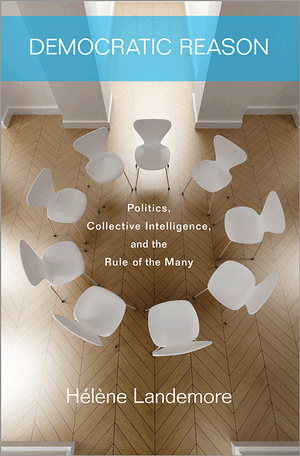
Hélène Landemore’s book Democratic Reason won the 2015 Spitz Prize for work in democratic theory.
That makes the second Spitz (for outstanding work in democratic theory) to a Sortinista in three years, following John McCormick’s Machiavellian Democracy in 2013.
Filed under: Academia, Books, Sortition | Comments Off on News: Democratic Reason wins 2015 Spitz Prize for work in democratic theory
Posted on September 22, 2015 by Yoram Gat
Ray Fisman, a Boston University economist, and Daniel Markovits from Yale Law School write in Slate about “The distributional preferences of an elite”, a study they recently published in Science magazine. In the final paragraphs they say:
Elites’ preferences matter. The American elite overwhelmingly dominates both campaign finance and political lobbying, and American policymakers themselves come overwhelmingly from elite circles—the powerbroker Yale Law alumni mentioned above represent just the tip of a vast iceberg.
Our results thus shine a revealing light on American politics and policy. They suggest that the policy response to rising economic inequality lags so far behind the preferences of ordinary Americans for the simple reason that the elites who make policy—regardless of political party—just don’t care much about equality. Hemingway’s illusory but widely shared view that the only thing that separates the rich from the rest is their money thus disguises a central pathology of American public life. When American government undemocratically underdelivers economic equality, the cause is less party than caste.
Democracy gives the mass of citizens a path for protest when the gap between ordinary views and a closed rank of elite opinion grows too great. The populist insurgencies that increasingly dominate the contests to select both the Republican and Democratic candidates in the upcoming presidential election show the protest path in action. Elites—in both parties—remain baffled by Donald Trump and Bernie Sanders’ appeal; and they prayerfully insist that both campaigns will soon fade away. Our study suggests a different interpretation, however. These bipartisan disruptions of elite political control are no flash in the pan, or flings born of summer silliness. They are early skirmishes in a coming class war.
Filed under: Academia, Elections, Experiments, Press | 5 Comments »
Posted on September 7, 2015 by Yoram Gat
The corrupting effects of “money in politics” – campaign finance and lobbying – are a frequent target for political reform. The underlying idea for this agenda seems to be that elected officials promote particular interests because they expect monetary reward, either as contribution for their re-election campaigns or, through some other channel, to their personal pockets.
Lawrence Lessig, law professor at Harvard, has now announced a presidential campaign that he presents as being based solely on the notion of tackling the corrupting influence of money in politics. Lessig seems to believe that a wide consensus among US voters can be created around this issue and that this issue would be compelling enough for voters to de-prioritize other issues to support this one since – as Lessig presents things – the issue of money in politics is preliminary to all other issues because until it is dealt with the corrupting influence of money makes progress on other issues unfeasible.
Lessig’s presents three items in his reform agenda. Two of those items – changing the way electoral districts are created, and reducing obstacles to voting – are commonplace electoral reform items and seem not to have much to do with money in particular. The third item is about pouring more money into electoral campaign – either by using public-funded matching or by using campaign funds vouchers. Those are presumably supposed to decrease the corrupting influence of money because the additional campaign funds are not a-priori unequally distributed.
Lessig seems to believe that with his activism and with this campaign he is striking at the root of the problem of modern politics. There are several reasons to infer that he is misguided.
Continue reading →
Filed under: Academia, Elections, Press, Proposals | Tagged: campaign finance, Lawrence Lessig | Leave a comment »
Posted on August 13, 2015 by Common Lot Sortitionist
“Lottery Voting: A Thought Experiment” is a 1995 article by Akhil Reed Amar, perhaps the most influential Constitutional Law theorist in the US.
In the article Amar proposes using the lottery to determine representation only after a standard election campaign has determined the percentage of support each candidate has received.
In this case then, the ‘statistical representation’ (which he champions) would be only of those citizens willing to go through the process of standing for election.
This is much less representative — and less attractive to me — than eliminating campaigning altogether… and using only two parameters to enter the lot: 1.) registration for it, indicating a willingness to serve if chosen; 2.) a simple civics test (such as the Naturalization Test in the U.S.).
Filed under: Academia, Elections, Proposals, Sortition | Tagged: Akhil Reed Amar | 35 Comments »
Posted on July 31, 2015 by Yoram Gat
Nicholas Ross Smith and Zbigniew Dumienski of the Politics and International Relations Department at the University of Auckland write at the New Zealand Herald, New Zealand’s largest circulation newspaper, arguing that using randomly selected juries to make some council-level policy suggestions may be a good starting point for organically growing a more democratic governance system:

A report by Bernard Orsman published in the New Zealand Herald on the state of Auckland City Council found that 88 of the 99 positions in the council’s boardrooms and executive teams were filled by “white men from wealthy suburbs.”
The reported demographic composition of the decision-making bodies in Auckland Council suggests that we are facing a potentially harmful democratic deficit. Yet, before anyone suggests quotas or other bureaucratic mechanisms aimed at diversifying the Council’s management structure, it would be good to consider a very different and far more democratic approach currently tried by our friends across the ditch: citizens’ juries as bodies that could breathe new, more democratic and vibrant spirit into our city’s old structures.
The democratic deficit evident in Auckland City Council is part of a broader trend in democracies worldwide, both at the local and national levels, which are increasingly seen as departing from the core democratic principles that they are supposed to uphold. Meaningful deliberations and political equality are the soul of democracy.
Increasingly, our electoral system is virtually devoid of the former and its outcomes suggest the erosion of the latter. Interestingly, such an outcome would have perhaps been predicted by the founders of democracy in classical Athens who were concerned that elections and campaigning contains in themselves anti-democratic and oligarchic seeds.
Continue reading →
Filed under: Academia, Athens, Elections, Juries, Press, Sortition | Tagged: Australia, City council, Melbourne, New Zealand | 2 Comments »
Posted on June 9, 2015 by Common Lot Sortitionist
Three Irish political scientists, David Farrell, Clodagh Harris and Jane Suiter, write in the Washington Post:

On May 22, Ireland became the first country in the world to introduce marriage equality through a national referendum to change the country’s constitution.
The vote was a world first in one other sense: Never before has a country changed its constitution as a result of deliberation involving a random selection of ordinary citizens. The government’s decision to call the referendum came because of a recommendation from the Irish Constitutional Convention, which had been asked to consider a range of possible constitutional reform questions.
Continue reading →
Filed under: Academia, Applications, Ballot measures, Press, Sortition | Tagged: Irish Constitutional Convention, Marriage equality | 4 Comments »
Posted on June 5, 2015 by Yoram Gat
Part 1 Part 2
11. Elections are a mechanism of accountability. It allows the electorate to reward or punish those with power. There is no way to hold government accountable using sortition.
Using elections as an accountability mechanism is like a bank’s board of directors appointing a new bank manager for a 4-year term and telling him that if he steals the depositors’ money then there is some chance that he will not be re-appointed to run the bank for another term (but he will get to keep the money he took). A manager who sees his job as a means for self-enrichment is clearly better off simply taking the money. No matter how many years of service he can secure if he stays honest, his salary will never amount to what he can steal in a single term.
Besides, if the replacement managers are all as greedy as the current manager, what good would replacing the manager do?
In short, seeing elections as providing an effective means of incentivizing a government to promote the interests of the average citizen is hopelessly unrealistic. It is remarkable that this view is standard in both popular discourse and professional political science literature.
12. The training and service experiences would likely cause people to change their minds about various issues and in this way become unrepresentative.
As the allotted delegates study issues it is indeed to be expected that they will adopt views on matters that they were not aware of before, and occasionally will even come to have opinions that contradict previously held ones. In this sense the allotted become unrepresentative – they are better informed and have spent more time and effort considering various matters of policy than the average citizen does.
Continue reading →
Filed under: Academia, Elections, Religion, Sortition | 112 Comments »
Posted on April 1, 2015 by jgarry20151
What should randomly selected citizens actually do when they are deliberating? Should the deliberation occur in their heads or should it be talk-based? This internal-versus-external deliberation question is core to any discussion of the legitimacy of decisions reached by randomly selected citizens. In the attached paper, presented at a conference in Dublin last Friday, we suggest, to put it bluntly, that talking is bad and imagining is good. We further suggest, and operationalise, distinct ways of facilitating imagined deliberation and present tentative experimental findings as to their relative effectiveness. This draft paper is very much a work in progress but we would welcome any thoughts (including robust disagreement).
Imaginative Randomocracy: A General Model of Citizen Decision Making Applied to Northern Ireland (and the UK)
Filed under: Academia, Proposals, Sortition | 23 Comments »
Posted on March 30, 2015 by Ahmed R. Teleb
In an address called “What is Political Science For?” at the 2013 American Political Science Association’s Annual Meeting, APSA President Jane Mansbridge mentioned sortition as one of the new areas being studied for grounding legitimacy. She referenced Fishkin & Ober in her footnote to the statement. The thrust of her talk is that political scientists (democratic theorists especially) should turn their focus away from preventing tyranny and towards creating “legitimate coercion” because the world is facing rather formidable collective action problems that cannot be solved otherwise. Together with Waldron’s “Political Political Theory” article it leads me to believe that there is some movement in the field towards the questions that we often discuss here on Equality by Lot. Below are some excerpts from the full article found here.
This address advances three ideas. First, political science as a discipline has a mandate to help human beings govern themselves. Second, within this mandate we should be focusing, more than we do now, on creating legitimate coercion. In a world of increasing interdependence we now face an almost infinite number of collective action problems created when something we need or want involves a “free-access good.” We need coercion to solve these collective action problems. The best coercion is normatively legitimate coercion. Democratic theory, however, has focused more on preventing tyranny than on how to legitimate coercion. Finally, our discipline has neglected an important source of legitimate coercion: negotiation to agreement. Recognizing the central role of negotiation in politics would shed a different light on our relatively unexamined democratic commitments to transparency in process and contested elections. This analysis is overall both descriptive and aspirational, arguing that helping human beings to govern themselves has been in the DNA of our profession since its inception.
Continue reading →
Filed under: Academia, Sortition, Theory | Tagged: American Political Science Association, collective action problems, legitimacy, legitimate coercion, Political Science | 9 Comments »


 Adam Cronkright
 Ali
Ali Ahmed R. Teleb
 avanderven
 avergne
 Alex Kovner
 azakaras
 Brett Hennig
 campbellwallace
 Simon Threlkeld
 Nick Coccoma
 codyhipskind
 Common Lot Sortitionist
 Conall Boyle
 constitutionalism
 davidschecter
 Ethan McCutchen
 graytmatter
 gtridimas
 Henry Tuttle
 H.J. Hofkirchner
 HpR
HpR James Kierstead
 John Burnheim
 jgarry20151
 Jochen Krattenmacher
 johnedwardtaylor
 johnhuang865
 Jonathan Crock
 keithsutherland
 Jacob Richter
 kkoreilly
 lukewhito
 SimonPek
 Nathan El
 Nicholas Gruen
 Owen Shaffer
 Patrick Chalmers
 Paul Gölz
 peterstone
 Pierre-Etienne Vandamme
 pronfeld
 Emil
Emil rcaze
rcaze richwbrown
 Roger Knights
 roslynfuller
 Pierre-Etienne Vandamme
 shaharavin
 tbouricius
 Ted Wachtel
 Joshua Laferriere
 theodorestathis
 towardsautonomyblog
 Wayne Liebman
 Yoram Gat
 Oliver Milne
