There has been a lot of debate on this blog recently as to whether or not political outcomes are unduly influenced by the rich; in this post I want to consider the influence of other nondemocratic agents – activists, civil society pressure groups, non-corporate lobbyists and academics in the social sciences and humanities. The reason for the inclusion of the last category is because most political leaders are educated in these disciplines – unlike, say, in China, it’s hard to identify political leaders who studied the natural sciences or engineering – so academics in these fields will have had a powerful influence in their formative years. There are more Oxford PPE (politics, philosophy and economics) graduates in the House of Commons than Old Etonians (35 to 20) and 50% of ministers and 28 percent of MPs were educated at Oxbridge, the vast majority in the above-mentioned subjects. Jeremy Waldron, in his inaugural lecture for his (Oxford) chair of social and political theory argued against the focus of the PPE syllabus on the ’57 varieties of luck egalitarianism’ as opposed to ‘political’ issues like representation, sovereignty and the rule of law, and it’s the resulting influence of the equality lobby that I want to address in this post. Some of the material is anecdotal, and some evidence of partisan influences in the formulation of a UN convention on disabilities equality.
The primary school in my village (pop. c.300) has recently constructed, at considerable expense, a ‘sensory room’ to meet the needs of one part-time disabled pupil. (Bear in mind this is happening at a time when local authority budgets are squeezed to the extent that rural residents are being told that they will need to grit their own roads this winter (and pay for the materials) as the council does not have the funds.) This is the result of government policy that insists that the disabled must be fully integrated in regular society, and has closed down most of the special schools that accommodated the specific needs of disabled children. Speaking to two parents of disabled children (one Aspergers and one cerebral palsy), they both volunteered that this politically-motivated policy has been disastrous for their children because, unlike their peers in special schools, their everyday growing-up experience provided a constant reminder of their neediness. Continue reading →
This is the clever headline of an article in The Independent about a survey by the Royal Statistical Society and King’s College London measuring public perceptions of various public policy related facts:
A new [2013] survey by Ipsos MORI for the Royal Statistical Society and King’s College London highlights how wrong the British public can be on the make-up of the population and the scale of key social policy issues. The top ten misperceptions are:
1. Teenage pregnancy: on average, we think teenage pregnancy is 25 times higher than official estimates: we think that 15 per cent of girls under 16 get pregnant each year, when official figures suggest it is around 0.6 per cent.
2. Crime: 58 per cent do not believe that crime is falling, when the Crime Survey for England and Wales shows that incidents of crime were 19 per cent lower in 2012 than in 2006-7 and 53 per cent lower than in 1995. 51 per cent think violent crime is rising, when it has fallen from almost 2.5 million incidents in 2006-7 to under 2 million in 2012.
3. Job-seekers allowance: 29 per cent of people think we spend more on JSA than pensions, when in fact we spend 15 times more on pensions (£4.9bn vs £74.2bn). Continue reading →
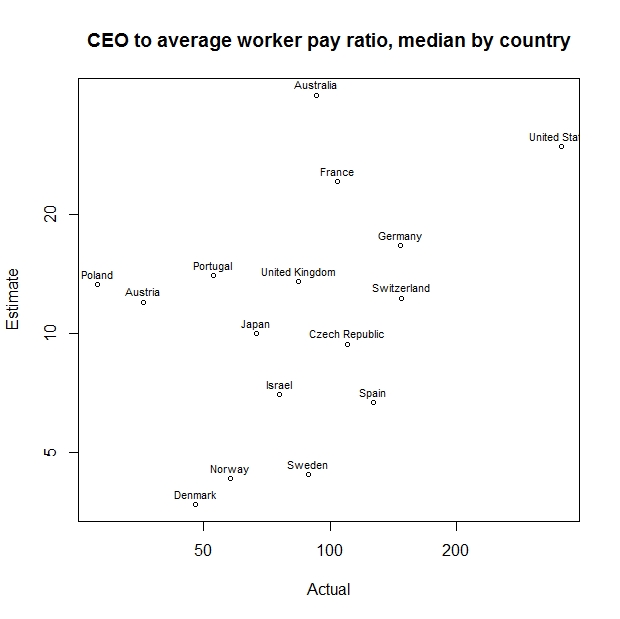
A recent international study of inequality by Michael Norton and Sorapop Kiatpongsan was already mentioned here for its findings about how uninformed the public was about matters of public policy. The study collected the opinion of people about what the CEO-to-average-worker pay ratio should be, and their best guess of what it actually was. A summary of the findings are shown in the table at the bottom.
Interestingly, not only do median estimates of the pay ratio in all countries grossly underestimate the true values, but there is essentially not correlation between the two (R2 = 14%, 3.5% after dropping the U.S. outlier):
I find the following excerpts from a chapter called “Explaining policy switches” generally amusing and rather illuminating about the practice of political science (I introduced some light editing to improve readability of the excerpts):
[B]oth qualitative evidence from campaigns and statistical analysis of cross-sectional data offer evidence that fear of losing elections induced politicians to hide their policy intentions.
Yet evidence of this belief structure does not adjudicate between the representative and the rent-seeking model of policy switches. Both kinds of politicians are expected to hide their true intetions to win office. The critical question is, Did they dissimulate and switch because they thought efficiency policies were in the best interest of voters or because they found efficiency policies advantageous for themselves, whether or not they would be good for voters? Continue reading →
A recent study by Michael Norton and Sorapop Kiatpongsan finds that for all countries studied median estimate of income inequality is much lower than reality:
In their study, Norton and Kiatpongsan asked about 55,000 people around the globe, including 1,581 participants in the U.S., how much money they thought corporate CEOs made compared with unskilled factory workers. Then they asked how much more pay they thought CEOs should make. The median American guessed that executives out-earned factory workers roughly 30-to-1 — exponentially lower than the highest actual estimate of 354-to-1. They believed the ideal ratio would be about 7-to-1.
“In sum, respondents underestimate actual pay gaps, and their ideal pay gaps are even further from reality than those underestimates,” the authors write.
Americans didn’t answer the survey much differently from participants in other countries. Australians believed that roughly 8-to-1 would be a good ratio; the French settled on about 7-to-1; and the Germans settled on around 6-to-1. In every country, the CEO pay-gap ratio was far greater than people assumed. And though they didn’t concur on precisely what would be fair, both conservatives and liberals around the world also concurred that the pay gap should be smaller. People agreed across income and education levels, as well as across age groups.
[Update: Commenting was accidentally initially off, enabled now.]
Draft paper:
Abstract: Following (Waldron, 2013), this paper draws a distinction between ‘social’ and ‘political’ variants of sortition, focusing principally on the latter. The two leading theories – the ‘blind break’ and the ‘invisible hand’ of descriptive representation – rely on different principles, focus on different levels of analysis (individual and collective) and have little in common. The attempt by epistemic democrats to bridge the gap via small-group face-to-face deliberation fails on account of the lack of concern for statistical representativity and the lack of distinction between the different roles of advocacy and judgment (proposing and disposing) in political decision-making, sortition only being relevant to the latter function.
This is derived from the paper that I presented at the recent IPSA Montreal conference, where I was encouraged to write it up and submit to a journal. I’d really appreciate comments and criticisms via this forum. Here’s the full draft (click the download button on the right).
J’ai pas voté is a documentary by Moise Courilleau and Morgan Zahnd. It is “an autopsy of French democracy aiming to create a new opportunity for growth of a new era of political organization”. Among those featured are Loic Blondiaux, Yves Sintomer, Jean-Paul Jouary, Jacques testard, Bernard Manin, Etienne Chouard, and Hervé Kempf.
Global action on the global problem of human-induced climate change is stalled. In most countries action has become a victim to internal politics and also to the absence of any international authority capable of organising a concerted response. Everybody waits for others to do something.
The politics involved in the workings of the UN prevent it from providing a solution to the absence of an international authority, and attempts to get one set up by treaty seem hopeless.
In this situation even the scientific authority of the IPCC (International Panel on Climate Change) has come into question. It is alleged to be biased and complicit in the attempts of certain vested interests to exploit fear of catastrophe. Also it is not effectively answerable to anybody. There is obviously not just some plausibility but some substance in these accusations.
There is no doubt that everybody who works for the IPCC is already convinced that climate change is dangerous and that it is at least exacerbated by our use of fossil fuels. They want to find more evidence for their view. They may be nominally responsible to the UN, but in practice that is illusory. Continue reading →
In “Expanded Congress Would Help Women” (letter, Feb. 24), Prof. Wilma Rule suggests a complicated scheme for the selection of members of the House of Representatives so that women and minorities may be fairly represented. As I understand the methods she recommends, however, there is no guarantee of any such effect. In any case, she ignores a simple means of choosing Representatives that would have the desirable results she wants, as well as others.
If members of the House were chosen by lot, instead of being elected (with still only one member for each district), the laws of statistics would assure that every part of our population would be represented very nearly proportionally. In addition, veto power over legislation would belong to a body that was not composed of professional politicians, who would have no interest in being re-elected and would therefore be subject to limited influence. Continue reading →
Antoine Vergne has shared his database of lotteries related literature. The database currently contain 365 items touching on a variety of topics related to distribution-by-lot and sortition, covering theory, practice, history and advocacy, and ranging in time from antiquity to the present.
The database is managed as a Zotero library. Readers who wish to help manage and extend the database are invited to leave contact information below or to email me (the address is here).


 Adam Cronkright
 Ali
Ali Ahmed R. Teleb
 avanderven
 avergne
 Alex Kovner
 azakaras
 Brett Hennig
 campbellwallace
 Simon Threlkeld
 Nick Coccoma
 codyhipskind
 Common Lot Sortitionist
 Conall Boyle
 constitutionalism
 davidschecter
 Ethan McCutchen
 graytmatter
 gtridimas
 Henry Tuttle
 H.J. Hofkirchner
 HpR
HpR James Kierstead
 John Burnheim
 jgarry20151
 Jochen Krattenmacher
 johnedwardtaylor
 johnhuang865
 Jonathan Crock
 keithsutherland
 Jacob Richter
 kkoreilly
 lukewhito
 SimonPek
 Nathan El
 Nicholas Gruen
 Owen Shaffer
 Patrick Chalmers
 Paul Gölz
 peterstone
 Pierre-Etienne Vandamme
 pronfeld
 Emil
Emil rcaze
rcaze richwbrown
 Roger Knights
 roslynfuller
 Pierre-Etienne Vandamme
 shaharavin
 tbouricius
 Ted Wachtel
 Joshua Laferriere
 theodorestathis
 towardsautonomyblog
 Wayne Liebman
 Yoram Gat
 Oliver Milne
