Posted on January 19, 2014 by Yoram Gat
Bob Moore wrote to call attention to the website of Democracy for the USA – a new organization that advocates replacing elections with sortition. Democracy for the USA is based in Chicago and bills itself as an outgrowth of the Occupy Chicago movement aiming to rectify the deficiency of Occupy’s platform – the lack of a workable alternative to the electoral system.
THE BIG IDEA
The heart of democracy is the community meeting. Of course there are already neighborhood meetings, but these do not determine government policy; they are not effective instruments of popular power. In a democratic USA, by contrast, the people will exercise sovereign rule collectively through regular and frequent community meetings across the country. Unlike the political system now in place, there will be no bodies of politicians–a Congress, state legislatures, city councils–drafting our laws. There will be no lobbyists, no groups such as ALEC, usurping the process. Neither will there be a president, governors, or mayors directing the government. Instead, through Community Assemblies and Executive Councils staffed by ordinary citizens selected by lot, everyone will truly have an equal voice in policy-making and an equal opportunity of serving in government.
In essence it is really this simple. We will not get anywhere flailing away within the confines of the current political structures. We will be like rats running around in a maze, succeeding perhaps in making life a little less unbearable for some people in spots, but ultimately getting nowhere fast. In the meantime the earth will be consumed and we will find ourselves in a condition of serfdom or worse. We have no option: we have to make the necessary change from the current system to democracy.
The website links to Ted Aranda’s The Racket and the Answer, that is apparently based on his 2008 Ph.D. thesis.
Filed under: Academia, Sortition | 10 Comments »
Posted on January 10, 2014 by Yoram Gat
Paul Lucardie sent the following excerpts from his new book ‘Democratic Extremism in Theory and Practice. All power to the people’ (London: Routledge, 2014).
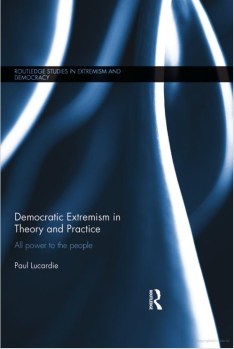
Author’s comment: Democratic extremism may appear to be an oxymoron, as ‘democracy’ is usually associated with moderation, pluralism and tolerance. Yet one could also regard democratic extremism as the opposite of autocratic and aristocratic extremism: whereas the latter imply that all decisions are taken by a dictator, a class of landowners or perhaps (in a more modern variety) the Central Committee of a ruling Communist Party, the former means that all decisions are taken by the people and that a political elite does not play any significant role. Examples of extreme democracy are rare, as far as I could find out. More common are cases of what I would call radical democracy: not all decisions but most important decisions are taken by the people, some are left to a political elite. Even more common, however, are mixed regimes where most decisions are taken by an elected aristocracy (professional politicians) and some by the people. In fact most so-called representative democracies are, in my opinion, mixed regimes, if not elective aristocracies.
Continue reading →
Filed under: Academia, Books, Elections, Sortition | Tagged: Democratic extremism, Paul Lucardie, radical democracy | 45 Comments »
Posted on December 30, 2013 by Common Lot Sortitionist
Does anyone know of organizations, publications or websites that discuss sortitional selection of legislatures in German?
Filed under: Academia, Books, Experiments, Proposals, Sortition | Tagged: Austria, Citizen Legislature, German, Germany, politics, random selection, representative democracy, selection by lot, sortition, Switzerland | 9 Comments »
Posted on November 8, 2013 by peterstone
The call for papers has gone out for the 4th Annual General Conference of the European Political Science Association. It will be held in Edinburgh, Scotland, on June 19-21, 2014. This is the first year that the conference has had a political theory category for proposals. I have been asked to serve as head of the political theory section, and so I am anxious to see political theory make a big splash at the conference. Obviously, I don’t think the conference will be amenable to ten sortition-related panels, but one sortition-related panel is a different matter…
The proposal submission deadline is December 13, 2013. For further details, or to propose a paper and/or panel, please visit http://epsanet.org/conferences/general-conference-2014.html. And if you have any questions, please do not hesitate to ask. Let’s talk.
Filed under: Academia, Theory | Leave a comment »
Posted on October 14, 2013 by avanderven
In chapter 16 of his 1988 book The World Solution for World Problems, A Concept for Government, L. Leòn presented a protocol for mondial lottocracy.
At the moment, this blog, Equality by Lot, is all about an endless stream of opinions, opinions, …, and discussions, discussions… Would it not be an idea to start with a rules based protocol, such as L. Leòn’s protocol, and to ask people to add rules or to eliminate rules (with a short explanation of why)? It would make things much more down-to-earth and much more exciting.
Filed under: Academia, Action, Applications, Athens, education | Tagged: democracy, Government BY the people, sortition | 18 Comments »
Posted on September 29, 2013 by Yoram Gat
Part 1 is here.
Extension of self-representation
Like many other authors discussing sortition (Dahl, Leib, Zakaras, Fishkin, and others), Stone and Dowlen choose, then, to drastically downgrade sortition from a tool of radical democratic reform (as presented by C&P, or earlier by C.L.R. James) to an add-on to the electoral system. Such a retreat is certainly not warranted by the theoretical considerations discussed in the first part of the article. The claim that sortition can be expected to produce good government can be put on a much more solid theoretical foundation than the faulty intuitive argument provides. An alternative argument works by employing the properties of sampling in order to extend self-representation of the decision-making group into representation of the entire population. It goes as follows:
- A small group of people, under reasonably favorable conditions, is able to represent its own interests. This claim is not directly associated with sortition, but is rather a claim about the political dynamics of small groups of people in general. The claim is that when a small group of people, meeting on an a-priori egalitarian basis, has the opportunity to make collective decisions that would promote the interests of the members as they perceive them, then it will tend to do so. This is a situation which most people would be familiar with – group decision making in the family, within a group of friends or with colleagues. “A small group” is taken to be a group in which all-to-all communication is possible. The upper size limit of such a group would depend on the circumstances, but even under the most favorable circumstances a few hundred people seems like the most that would fit the description.
- Policy that promotes the interests of a small group of people which are selected as a sample of a larger group will tend to promote the interests of the larger group as well. Since the interests of a group selected as a sample of a larger group are typical of those of the entire group, policy that promotes the interests of the sample would tend to promote the interests of the group. In particular, if a certain policy promotes the interests of a majority of the members of the sample then that policy is likely to promote the interests of a majority in the population. There would be some obvious exceptions to this extension from sample to population. Policy that applies directly to the members of the sample in their role as members – their salaries for example – affects interests for which the sample members are very atypical. In a government by sortition such exceptions would have to be treated separately.
Continue reading →
Filed under: Academia, Books, Elections, Proposals, Sortition, Theory | Tagged: c l r james, collective decisions, fishkin, group decision, self representation | 93 Comments »
Posted on September 28, 2013 by Yoram Gat
Mirroring
In his Introduction to A Citizen Legislature by Ernest Callenbach and Michael Phillips, Peter Stone commends the authors for doing “an excellent job of presenting the idea of a representative House — a House that will truly be “of the people” — as an inspiring piece of democratic reform.” On the other hand, such inspiring presentation does not meet the philosopher’s standard of a good argument: “Their [C&P’s] efforts to defend their proposal, however, have a number of shortcomings.”
Stone rejects the implied argument that descriptive representation is a desirable end. Descriptive representation is a means, not an end, Stone argues: “descriptive representation is desirable because — and only to the extent that — it contributes to the goal of good lawmaking.” And while some may reject this point of view, and argue that the symbolism of microcosm is indeed an end in itself, I think that would be an evasion of the main point. The essential function of government is to generate good policy – i.e., policy that promotes the interests of the population – and, as Stone asserts, sortition is a useful tool if and only if it can be expected to produce a government that generates good policy. (By “interests” I mean to encompass whatever a person, or a group of people, perceive, upon informed and considered reflection, as important or desirable.)
Continue reading →
Filed under: Academia, Books, Elections, Sortition, Theory | 35 Comments »
Posted on September 8, 2013 by Conall Boyle
Perhaps this provides part of the explanation of random promotion policies (equivalent to random wages) used by some universities.
Is this true? Do some US universities really promote faculty staff at random?
Continue reading →
Filed under: Academia, Distribution by lot, Theory | Tagged: Promotion, Random, random selection | 12 Comments »
Posted on September 6, 2013 by Conall Boyle
Further to Terry Bouricius’s query below, I have managed a rough translation, in MS Word .docx format.
(It’s in large font which I find easier to read on-screen!)
To read it click: Vergne 2013 engl trans
Filed under: Academia, Sortition | Leave a comment »
Posted on September 2, 2013 by peterstone
I’ve recently published two articles that might prove of interest. First, I wrote a review essay dealing with the Imprint Academic series on Sortition and Public Policy. It’s just appeared in the latest issue of Redescriptions: Yearbook of Political Thought, Conceptual History and Feminist Theory (volume 16, 2012/2013). It’s been in the pipeline for a while, and so regrettably does not cover the latest offerings in the series (such as Conall Boyle’s interesting book on educational lotteries). The issue is at https://jyx.jyu.fi/dspace/handle/123456789/42047
Second, Comparative Education Review just published a symposium on “Fair Access to Higher Education: A Comparative Perspective” (volume 57, no. 3, August 2013). It contains a paper of mine entitled “Access to Higher Education by the Luck of the Draw.” The paper deals with university admissions in general and the Irish case in particular. It’s available on JSTOR at http://www.jstor.org/stable/10.1086/669235, but only if your library/university subscribes.
Sorry to be incommunicado. I’ve been away for much of the summer, and have a very busy term ahead of me, but I hope to rejoin the conversation soon.
Filed under: Academia, Books, Distribution by lot, House of Lords, Proposals, schools, Sortition, Theory | 13 Comments »


 Adam Cronkright
 Ali
Ali Ahmed R. Teleb
 avanderven
 avergne
 Alex Kovner
 azakaras
 Brett Hennig
 campbellwallace
 Simon Threlkeld
 Nick Coccoma
 codyhipskind
 Common Lot Sortitionist
 Conall Boyle
 constitutionalism
 davidschecter
 Ethan McCutchen
 graytmatter
 gtridimas
 Henry Tuttle
 H.J. Hofkirchner
 HpR
HpR James Kierstead
 John Burnheim
 jgarry20151
 Jochen Krattenmacher
 johnedwardtaylor
 johnhuang865
 Jonathan Crock
 keithsutherland
 Jacob Richter
 kkoreilly
 lukewhito
 SimonPek
 Nathan El
 Nicholas Gruen
 Owen Shaffer
 Patrick Chalmers
 Paul Gölz
 peterstone
 Pierre-Etienne Vandamme
 pronfeld
 Emil
Emil rcaze
rcaze richwbrown
 Roger Knights
 roslynfuller
 Pierre-Etienne Vandamme
 shaharavin
 tbouricius
 Ted Wachtel
 Joshua Laferriere
 theodorestathis
 towardsautonomyblog
 Wayne Liebman
 Yoram Gat
 Oliver Milne
