Guerrero in Jacobin

Alexander Guerrero’s book Lottocracy was published a bit more than a year ago. Guerrero discusses the book in a recent interview in Jacobin magazine. Jacobin has, by the way, offered sortition to its readers at least once before, back in 2018.

Interestingly, Guerrero’s argumentation is much more effective and to the point in the short interview format than it was in the book. While in the book supposed epistemic difficulties of well-meaning elected officials are played up in order to explain why elected government does not promote the general interest, in the interview the principal-agent problem faced by society regarding its decision makers is treated as a self-evident case of a conflict of interests where the agent is simply promoting their own interest at the expense of those of the principal. Applying to electoral systems the same straightforward understanding of the problem that is generally taken for granted when dealing with non-electoral systems makes for a much more convincing and effective argument.

Also interesting is the fact that in the short interview Guerrero finds room to mention Bernard Manin’s important book Principles of representative government, a reference which is sorely and inexplicably missing in Lottocracy. Guerrero now refers to Manin as explaining that elections were set up as a deliberately aristocratic mechanism. This is an important historical point, which (I believe) is also missing in Lottocracy. That said, Manin’s most important idea – his “pure theory of elections” – is still missing in Guerrero’s argumentation. This theory explains why elections must produce elite rule and thus can be expected to promote elite interests at the expense of the general interests, without having to resort to the standard popular ignorance argument which is problematic both as a matter of fact and as a matter of principle.

Finally, the fact that the interview skims quickly over Guerrero’s proposal for how sortition is to be used also benefits the presentation. This brevity leaves the stage for the democratic ideas behind the mechanism of sortition and does not obscure these ideas with Geurrero’s elaborate proposed set-up which aims to prevent the allotted citizens from going democratically “wild”.

The lottery politics of Britain’s Your Party

A fairly long article by Michael Chessum in Europe Solidaire Sans Frontières has the title “The lottery politics of Britain’s Your Party: Why sortition undermines socialist organising”. Here are some excerpts.

[Your Party’s] leadership’s embrace of sortition appears less about democratic innovation than maintaining control. Regional assemblies lack voting powers, online suggestions disappear into a black box, and the conference floor will inevitably privilege prominent figures exempt from the lottery system.

This reflects a broader crisis on the British left: rather than building genuine mass politics rooted in branches and workplaces, we’re lurching between quick fixes – whether “hyperleaders” like Mélenchon or procedural shortcuts like sortition. Both bypass the difficult work of developing democratic structures that connect members to strategy and politicise participation from the base upwards.

[Your Party’s] founding conference, set for late November in Liverpool, will be populated by sortition. 13,000 party members will be enfranchised at random, with 6,500 attending on each day. The party membership as a whole will only get a symbolic, “confirmatory” vote on the final draft of the constitution. This constitution could, according to documents released in October, enshrine sortition as the permanent system for conferences.

If we take this plan at face value, the founding leadership of Your Party, with all of its embedded control freakery, is intending to entrust its future to an idealistic, unprecedented process, putting its faith in a literally random assortment of members. More substantive arguments aside (and we’ll come to those), would-be proponents of sortition in Your Party must begin by asking themselves: is that really plausible?

[O]ne would have to be wilfully naive to think that [sortition’s] appearance in Your Party is down to the sudden conversion of senior Corbyn aides to the Athenian democratic ideal.
Continue reading

Sortition is the only worthwhile democratic option

Octave Larmagnac-Matheron writes in the French magazine Philosophie [Original in French. Below is an English version generated by Google Translate with my touch-ups]:

In one of his characteristically thought-provoking Facebook posts, the philosopher Valentin Husson wrote a few days ago: ‘When the world tips towards illiberal democracies and authoritarianism, political courage would dictate that we propose a radical democracy. The only worthwhile one would be sortition (as with lay juries).’ I readily agree with both the observation and the proposal.

Sortition is, I believe, one of the first political ideas I defended in my short life. I remember quite well how I first arrived at this idea, during a high school lesson on Athenian institutions, which offered an overview of the workings of this unique system where members of the legislative and judicial assemblies — the Boule and the Heliaia — were chosen by lot, using a machine called the kleroterion. I was surprised that we used the same word — democracy — for both this system of chance and our own, elective system. Discovering philosophy two years later, I came to the same conclusion. Aristotle wrote that “it is considered democratic for magistracies to be assigned by lot and oligarchic for them to be elective” (Politics). Centuries later, Enlightenment philosophers wholeheartedly agree. Montesquieu wrote: “Suffrage by lot is in the nature of democracy. Lot is a way of electing that offends no one; it leaves each citizen a reasonable hope of serving their country” (The Spirit of the Laws). Rousseau agreed: “The way of lot is more in the nature of democracy” (The Social Contract).

Intrigued by these short phrases, which didn’t seem to bother many people, I then embarked on further reading. Allow me to mention two works that particularly struck me at the time. First, Bernard Manin’s Principles of Representative Government (1995). The philosopher recounts the rise of an electoral system that conquered the world following the great revolutions and clearly explains the aristocratic character of this regime that usurped the name of democracy. Next came Jacques Rancière’s Hatred of Democracy (2005), whose impassioned prose undeniably sparked enthusiasm in my young alter ego. Democracy, Rancière emphasizes, is a scandal: “Democracy means first and foremost this: an anarchic ‘government’” — without any claim to distinction — “founded on nothing other than the absence of any right to govern. […] The scandal lies there: a scandal for distinguished people who cannot accept that their birth, their seniority, or their knowledge should have to bow to the law of fate.” Isn’t impartial chance the best option for every citizen to participate in the exercise of political power — a guarantee that this power will not be monopolized?
Continue reading

Hoping for the fleet to return from Samos

In an impressive demonstration of the power of the electoralist dogma to twist one’s perception, Pierre Silverberg, writing in the Belgian La Libre, shares his belief that the ascent of the second Trump administration has a close historical parallel.

[Original in French, Google translation with a couple of minor touch-ups.]

From Democracy to Oligarchy

The parallels between the oligarchic revolution in Athens in -411 and the current coup d’état in the United States are striking.

In the Oligarchic Revolution, the Athenian elite decides to seize power, put an end to democratic institutions, and ally themselves with the enemy city, Sparta, to maintain their hold on Athens. Sound familiar? The historical parallels between the Oligarchic Revolution of 411 BC and the current coup in the United States are striking.

2036 years apart, both the Athenian oligarchy and the American elite present the individual and political freedoms acquired by the people as clear signs of moral and civilizational decline that must be acted upon. In both cases, the oligarchs present themselves as the only ones capable of straightening out the country and purging the nation of its excesses. And, naturally, in both cases, the oligarchy feels authorized to override the laws and subvert the system to the detriment of the people.

War as a context

These “oligarchic revolutions” also fit into a relatively similar historical context: war. The Peloponnesian War was a conflict that broke out between Athens and Sparta. Ideologically, Athens represented “progressive” Greece: its democracy was complete, each citizen enjoyed unprecedented individual freedom as well as the certainty of being able to actively contribute to the politics of his City. Thanks to its democratic practice of drawing lots, it is estimated that an Athenian citizen had a 70% chance of exercising a political role at least once in his life. Conversely, Sparta had kept its original constitution and represented “conservative” Greece. The City was a “gerontocracy” governed by two kings and a council of elders, the Gerousia. The people had practically no chance of ever exercising political responsibility and literally had to choose their representatives using an “applause-meter”.
Continue reading

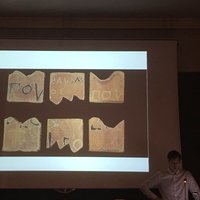
The French School of Athens builds a kleroterion

Kathimerini reports about a project of the French School of Athens involving building a full size marble reconstruction of an Athenian kleroterion:

It is made of marble and weighs about 300 kilos. It is 1.20 meters tall, but on its wooden base it’s the height of a tall adult. And while it looks like an inscribed column, if you get close up, you’ll find that it has many rows of slots in a vertical and horizontal arrangement. What are they for? To receive wooden tiles with the names of citizens who, through a special process, will be selected for public office, or not, at least until their luck is tested again.

It is a faithful copy of an ancient kleroterion, a randomization device similar to the one that the Athenians of the 5th and especially the 4th century BC used to select citizens to be lawmakers, state officials and jury members.

“The best method of democratic selection was to draw lots,” archaeologist and historian Veronique Chankowski, director of the French School of Athens, who coordinated the construction and study of the ancient lottery device, tells Kathimerini. “A person was selected not because they belonged to a specific family or social network, nor because they were rich. This machine chose them.”

The New Republic: There’s little doubt that sortition beats election hands down

Roger Hallam, “a co-founder and strategic mastermind of the civil resistance groups Extinction Rebellion (often called XR) and Just Stop Oil”, and who is also serving “five years in prison for ‘conspiracy to cause a public nuisance'” is the protagonist of a supportive article in The New Republic. The article makes a very sympathetic presentation of Hallam’s anti-electoral and pro-sortition ideas:

Hallam calls our current moment a “pre-revolutionary period.” Such eras have arisen throughout history—if never on such a grand scale—and they unfold according to a distinct logic. One of the first casualties is moderation. “The center does not hold,” Hallam said. “You saw this before the Nazis, you saw it before the Bolsheviks, and you’re seeing it at the moment in slow motion in Western democracies.” It’s easy to miss the signs, because “the center still has institutional power,” he added. “In other words, like it’s a zombie space. It’s dead, but it hasn’t yet been pushed over by the new.”

Under such conditions, wrenching paradigm shifts are inevitable. The only question, Hallam suggested, is whether we submit to authoritarianism, as many Americans seem all too eager to do, or embrace a genuinely pro-social revolutionary alternative. While it would have been comforting to hit the snooze button with four more years of Biden-style liberalism—a sound approach in simpler times—when survival hangs in the balance, there are distinct advantages to being awake.

The centerpiece of Hallam’s plan is a radical reinvention of democracy aimed at turning elections into a historical relic. Continue reading

Sortition Advocated in the Windsor Star

The Windsor Star just published an editorial by James Winter, a professor emeritus at the University of Windsor, advocating the replacement of federal elections with sortition. The reasons given are diverse, from the cost of elections to the disproportionity resulting from “first-past-the-post” elections to the self-serving nature of politicians. I am unaware of anything previously written by James Winter on this subject, but perhaps others know more.

Coccoma: The Case for Abolishing Elections

Nicholas Coccoma writes about sortition in the Boston Review. While some of the narrative is standard, Coccoma makes some crucial points that are often avoided by the prominent members of the sortition milieu.

The Case for Abolishing Elections

They may seem the cornerstone of democracy, but in reality they do little to promote it. There’s a far better way to empower ordinary citizens: democracy by lottery.

In response to [popular] discontent, reformers have proposed a slew of solutions. Some want to expand the House of Representatives, abolish the Electoral College, or eliminate the Senate. Others demand enhanced voting rights, the end of gerrymandering, stricter campaign finance laws, more political parties, or multi-member districts and ranked-choice voting. The Athenians would take a different view. The problem, they would point out, lies in elections themselves. We can make all the tweaks we want, but as long as we employ voting to choose representatives, we will continue to wind up with a political economy controlled by wealthy elites. Modern liberal governments are not democracies; they are oligarchies in disguise, overwhelmingly following the policy preferences of the rich. (The middle class happens to agree with them on most issues.)
Continue reading

A kleroterion-inspired statue at the Storm King art center

Artist Taryn Simon created a statue inspired by the kleroterion. It is on display at the Storm King art center in New York state.

Artist Taryn Simon (American, b. 1975) has imagined an election machine based on surviving archaeological fragments of the kleroterion, an ancient device from the beginnings of democracy in Athens.

More at artnet.com.

Patrick Deneen on democracy, populism and sortition

Patrick Deneen is a professor of political science at Notre Dame university. He is a fairly prominent public intellectual in US politics, popular especially among the Republican elite. His 2018 book, Why Liberalism Failed, drew quite a bit of attention.

A piece by Deneen has recently been published by the Notre Dame magazine. It is a surprisingly, even impressively, good. The heavy punches just keep coming. Here are some excerpts.

Democracy and Its Discontents

The claim that our democracy is imperiled should rightly strike fear in the souls of citizens, but it ought also to give pause to any student of politics. During most of the four decades I have studied and written about democracy, political scientists, and especially political theorists such as myself, would begin not with a claim about the relative health of democracy, but rather with a seemingly simple question: What is democracy?

Yet according to a dominant narrative among today’s academics, public intellectuals, media personalities and even many citizens, it is largely assumed that we know what democracy is. Continue reading