Étienne Chouard: Public decision-making from the perspective of the common good, Part 2

Previously published parts of this essay are the Introduction and Part 1.

(i) Elections infantilize, and in this way paralyze, the voters. They discourage thinking and defending the common good (whereas sortition does not)

Starting with the governed, let’s see, point-by-point, how elections infantilize, and in this way paralyze, the voters:

1. By definition, elections are aristocratic, whereas sortition is democratic

The greatest political thinkers have long known what we have now forgotten:

Aristotle (332 BC): “Elections are aristocratic and non-democratic: they introduce an element of deliberate choice, of selection of the best citizens, the aristoi, in place of government by the people” [Politics IV, 1300b4-5]. This quote is spurious. EC has requested that it be replaced with the following quote.

Aristotle (332 BC): “It is thought to be democratic for political offices to be assigned by lot, for them to be elected oligarchic” [Politics IV, 1294b].

Montesquieu (1748): “Sortition is natural to democracy. Elections are natural to aristocracy” [The Spirit of the Laws].

Cornélius Castoriadis (1996): “It is the Greeks who have invented elections. It is an established historical fact. They may have been wrong to do so, but they have invented elections! Who was elected in Athens? They did not elect political officers. Those were selected using sortition or rotation. For Aristotle, you should know, a citizen is someone who is able to govern and be governed. Everybody is able to govern, and therefore sortition is used. Why? Because politics is not a business for experts. There is no science of the political. That was the conventional knowledge among the Greeks” [Post scriptum on Insignificance].

So, the word aristos means the best in Greek. Elections, which by definition aim to choose the best, are by construction aristocratic. The promise of democratic equality is therefore not kept. The elected representatives and the voters are not on equal footings: the elected dominate the voters, the few control the many. We should therefore suspect that the common good would be threatened as the elected come to serve personal interests rather than the general interest.

In contrast, sortition selects indiscriminately. It is therefore the only procedure that respects the foundational promise of democracy – political equality between citizens.
Continue reading

An interview with a member of the French Citizen Climate Convention

In January, Le Télégramme interviewed Denis Boucher, a member of the French Citizen Climate Convention:

How is the convention organized?

We are 150 citizens of all ages and walks of life, including some who are younger than 18 and others who live in overseas France. There is great diversity and I believe that we represent French society quite well. We gather one weekend each month for a session of three days. We work around five themes dealing with the objective of reaching a 40% reduction in greenhouse gas emissions by 2030: food, transportation, housing, consumption, and production. I am part of the housing theme. The allocation to themes was by sortition – that is the principle of the convention. We reject expertise from the outset and it is normal citizens who express themselves, whoever they may be. It is an altogether original organization which really embodies direct democracy. It is a little like the citizens of Ancient Greece would discuss the issues of the city in the agora.

Where are you now in the process?

We are in the fourth session and we just finished the latest weekend of work. After 4 months during which we heard numerous speakers and understood the climate and the objectives we are now entering into the thick of it. We are going to propose measures that will become bills of legislature, decrees or constitutional amendments. That is not going to be easy!
Continue reading

Sortition in the New Yorker, again

For the second time in less than a year, sortition is mentioned in the New Yorker. Last time, it was merely an off-handed comment. This time, sortition is front and center. Nathan Heller’s article is built around an interview with Hélène Landemore. Alexander Guerrero also gets quoted.

Landemore’s ideal is participative, but she seems to be working with a rather loose concept for her proposals:

What distinguishes Landemore’s ideal from other lottocratic models, such as Guerrero’s, is the breadth of her funnel: the goal is to involve as much of the public organically in as many decisions as possible. Her open-democratic process also builds in crowdsourced feedback loops and occasional referendums (direct public votes on choices) so that people who aren’t currently governing don’t feel shut out.

As evidence that open democracy can work in large[…,] culturally diverse societies, Landemore points to France’s Great National Debate—a vast undertaking involving a vibrant online forum, twenty-one citizens’ assemblies, and more than ten thousand public meetings, held in the wake of the gilets jaunes protests, in 2019—and, this year, to the country’s Citizens’ Convention on Climate Change.

Continue reading

The Democratic Diarchy

Alex Kovner and myself have been banging on for some time about the ongoing necessity for political parties (albeit in a heavily-modified form) for policy proposal and advocacy in a well-functioning democracy (the disposal role being reserved for randomly-selected juries) and this has not gone down particularly well on this forum. We’re presenting a short paper on it at the Association for Political Thought conference at Oxford in January and would greatly appreciate feedback before we go. It’s very short and we’ve put a lot of effort into refining and clarifying the necessary distinctions. The full paper is on Academia.edu, here’s the abstract:

Isegoria (equal speech) and isonomia (equal law), the two norms that constituted classical Athenian democracy, were implemented respectively by the right of every citizen to propose (or argue against) new laws (isegoria), and equal voting rights over their implementation (isonomia). In the fourth century the latter (disposal) function was entrusted to large, randomly-selected juries (nomothetai) that could be viewed as descriptively-representative microcosms of the citizen body. Isegoria rights were restricted to the five citizens elected by the assembly.

Most current models for ‘citizens’ assemblies’, although claiming Athenian provenance, more closely resemble modern parliaments in that the proposal and disposal functions are conflated, the only difference being that citizens’ assemblies are not constituted by preference election. This paper argues that such models result from a conceptual confusion, have no historical precedent and are vulnerable to corruption and domination by the very hegemonic forces that they seek to counter. The paper argues that, whilst the democratic argument for legislative decision-making (disposal) by a large ad hoc representative jury is persuasive, sortition can have no role to play in the proposal function and such sortition-based bodies can only be part of a mixed constitution in which political parties (albeit of a radically different form to their current incarnation) are required in order to implement ‘representative isegoria’.

And here’s details of the conference panel:

‘The Circumstances of Sortition’

  • David Owen (University of Southampton), ‘The Uses of Sortition’
  • Yves Sintomer (Université de Paris 8), ‘The Contrasted Models of Democracy in Sortition-Based Innovations’
  • Alex Kovner; and Keith Sutherland (University of Exeter), ‘Isegoria and Isonomia: Election by Lot and the Democratic Diarchy’
  • Peter Stone (Trinity College Dublin), ‘The Paradox of Sortition’

The framing wars: Have the elites gone off on frolics of their own unsupported by the community?

Are you pro-choice or pro-life? Language like this shows us how fundamental framing has become to political combat. Political debate isn’t just ‘dumbed down’ or simplified. There’s a geography to the ground on which it’s fought and those with an eye to victory head for the high ground.

There’s much talk these days about the divide between political elites and ‘ordinary folk’. It’s tearing western democracies apart. I think that the elite lack respect for the hoi polloi and their view of the world. Hence my frequent reference to the ancient Greek political principle of isegoria or equality of speech.1

In Sam Roggeveen’s response to my review of his essay Our Very Own Brexit (which I recommend by the way), he isn’t the first to argue that I do my cause no favours by “aligning it so closely with causes that our political elites would endorse (e.g. welcoming of immigrants and refugees; against Brexit)”.2 This is definitely sound political advice if one ventures among the red meat folk at Quillette.

But for the record, while I think Brexit makes lousy economic policy and statecraft, I wouldn’t just respect the will of the British people if they chose the course they are embarked upon with open eyes. I’d be awestruck with admiration. I’d think it was a fantastic development in which people decided that there were more important things than money and power to live for. But I don’t think any of that. I think they’ve been sold on a particular framing of the story in which the EU is an elite project gone mad, and so something which is coming after their nationhood and something on which they can heap their rage.

Roggeveen’s response goes on:

The problem I identified in the book is that the party-political class in Western democracies has become a separate caste with few connections to a social or economic base; Brexit shows what happens when the policy preferences shared by that caste runs too far ahead of the public.

I’ll call this the ‘frolic’ school of analysis. The elites have just kept doing what elites do – pursuing various hubristic agendas until the inevitable Wile E. Coyote moment comes and they realise that they have, in their zeal, arrived at a place where there’s no ground underneath them. Now it has to be admitted that the EU has major flaws. It seemed to me that its treatment of Greece was and continues to be a disgrace, and even if you disagree with that – as Paul Frijters does – the whole Euro project was ill-conceived and devastating.  Continue reading

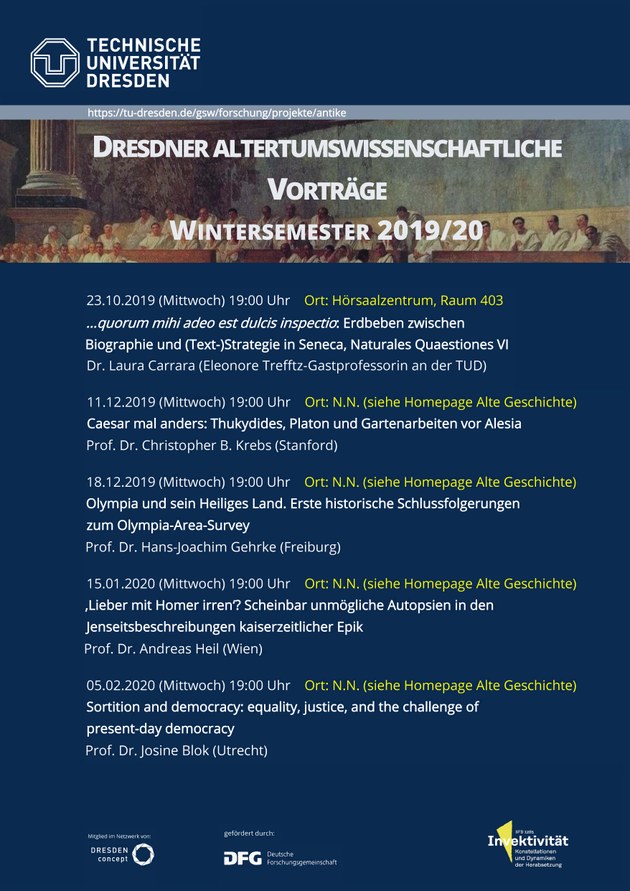
Blok: Sortition and democracy: equality, justice and the challenge of present-day democracy

Prof. Josine Blok, a classicist from the University of Utrecht, will be giving a talk titled “Sortition and democracy: equality, justice and the challenge of present-day democracy” at the University of Dresden on Feb 5th, 2020.

It turns out that Blok has been interested in sortition for some time. In 2014 she has published a paper called “Participatory Governance: The Case for Allotment” in the journal Participation. The paper is viewable and downloadable here.

In the paper, Blok hypothesizes that sortition was legitimated in Athens by the custom of using the lottery to allocate shares of inheritances among the heirs. Other parts of her discussion are interesting and original as well.

Democracy without political parties: the case of ancient Athens George Tridimas

Here’s the abstract of a recent article by George Tridimas in the Journal of Institutional Economics:

Democracy without political parties: the case of ancient Athens

Political parties, formal, durable and mass organizations that inform voters on public policy issues, nominate candidates for office and fight elections for the right to govern, are ubiquitous in modern representative democracies but were absent from the direct participatory democracy of ancient Athens. The paper investigates how the political institutions of Athens may explain their absence. The arguments explored include voter homogeneity; the conditions at the start of the democracy, characterized by single constituency configuration of the demos, simple majority voting and lack of organized groups; the irrelevance of holding public office for determining public policy; appointment to public posts through sortition; and voting on single-dimension issues. The paper then discusses how in the absence of parties voters became informed and how political leaders were held accountable by the courts.

I’ve not yet read it. If you want to email me on ngruen at gmail, I might be able to help you out with access to the article.

Modern citizen assemblies are an affront to Athenian democracy

The burgeoning media interest in citizens’ assemblies (it was the lead discussion on the BBC R4 Today programme last Saturday) prompted me to contribute my own article to The Spectator, explaining some of the underlying political theory and the (spurious) claims for their origins in the fourth-century Athenian nomothetai. Again it’s a short article so best to read it on the Spectator blog. It will be interesting to read the comments.

A Citizens’ Assembly on climate change is the coward’s way out

Interesting article by Melanie McDonagh in The Spectator on citizens’ assemblies. In response to the demands of Extinction Rebellion, letters inviting 30,000 households across the UK to join a citizens’ assembly on climate change were sent out last week by an alliance of six Commons select committees, chaired by Rachel Reeves. The author (an Irish Catholic) has some alarming claims to make regarding the citizens’ assembly on the repeal of the eighth constitutional amendment (on abortion). It’s a short and interesting piece, so I won’t bother to post extracts.

All the comments posted after the Spectator article are critical of the design of such deliberative assemblies which (IMO) run the danger of bringing the entire sortition movement into disrepute.

Cook: Sortition is an element in a war on civilization

Michael Cook, editor of MercatorNet, issues a strong warning against the Extinction Rebellion movement. Here are some excerpts:

Extinction Rebellion’s loopy politics

The movement’s “Declaration of Rebellion”, a pastiche of America’s “Declaration of Independence”, states: “We hereby declare the bonds of the social contract to be null and void, which the government has rendered invalid by its continuing failure to act appropriately. We call upon every principled and peaceful citizen to rise with us.”

Declaring the “social contract” null and void is a radical step – so radical that either the author did not understand it (unlikely) or he thought that no one else would (likely). Stopping traffic? You ain’t seen nothin’ yet. This is a declaration of war on civilization.

There is but one rational, ethical, and spiritual position on climate change. None other is possible. “The ecological crises that are impacting upon this nation, and indeed this planet and its wildlife can no longer be ignored, denied nor go unanswered by any beings of sound rational thought, ethical conscience, moral concern, or spiritual belief,” the declaration says.

In a democracy, questioning an opponent’s sincerity about his convictions is the ultimate offence. Convictions are tested by rational debate, not by smearing people as venal, wicked or stupid. But this is just what XR is doing.

XR demands that countries go “beyond politics”. “Government must create and be led by the decisions of a Citizens’ Assembly on climate and ecological justice.” Why? Because “Political power in the UK is in the hands of a few elected politicians” says the “Our Demands” page on the XR website. This, of course, is true. Putting power in the hands of elected politicians is called representative democracy and it has a long and successful history of defending political and personal freedom.
Continue reading