

This post was withdrawn at the request of the author. You can still read the post on the author’s blog.
Filed under: Elections, Sortition, Theory | 2 Comments »

This post was withdrawn at the request of the author. You can still read the post on the author’s blog.
Filed under: Elections, Sortition, Theory | 2 Comments »
This is the second and final part of a translation of an article by Claude Sicard published in July 2020 in Le Figaro. The first part is here.
In order to put an end to the Gilets Jaunes revolt, Macron embarked in January 2019 upon what he called the “Great National Conversation”. This has consisted of organizing huge meetings in city halls with the participation of mayors and the local elected politicians, and urging the population to share their comments in person in during the meetings or through an online platform. Macron himself made many animated appearances in these meetings all over the country, which usually lasted more than four hours. Macron would take off his jacket and respond to all the questions addressed to him. Meetings took place in more than 10,000 municipalities, and 1.9 million comments were made. The “Great Conversation” was concluded with a press conference on April 25th, 2019. On that occasion Macron said: “I wished to meet you in order to draw the main lessons from the Great National Conversation and to propose to the nation directions for a new way that our citizens are looking for, a new way for our republic”. He has described the Great Conversation as “an unprecedented exercise for contemporary democracies”. This was therefore a mass popular consultation whose goal was to orient the actions of public institutions over the coming years.
That was followed by a second step. Following the coronavirus crisis, on May 25th, the “Health Conference at Ségur”. The crisis required great dedication from health professionals in order to make up for grave weaknesses of our public hospital system. It was therefore necessary to take their many demands into account without any further delay. Macron saw himself as forced to try to address as well as possible those demands, having been the first praise the exceptional dedication of the health personnel during the crisis, going as far as calling the first responders “national heros”. Macron initiated another great consultation, this time among 300 principal actor in the health sector. This was a second exercise, then, in participative democracy. The goal of this consultation was particularly ambitious. The prime minister defined it as follows in his opening speach: “To construct together the future of the hospital, to heal a system that was blocked and impoverished, and build a new health system organization in each territory”. The participants were given an incredibly short period for reforming our public health system: a month and a half at the most.
Continue reading
Filed under: Applications, Elections, History, Mass action, Participation, Press, Sortition | Leave a comment »
 This is the third and last part of a translation of an article published by Reporterre following the aftermath of the French Citizen Climate Convention. Part 1, Part 2.
The situation mystifies the citizens. “We were sent to the front because government has to take responsibility”, says Willaim Aucant. “For us it is out of the question to re-debate our measures. We simply want to explain to those measures to all the actors”, he explains. The task is not simple. “France in its totality” is much more discordant than the allotted “France in miniature”.
“We are getting to a time when the citizens are going to come to reassert themselves”
“The government’s strategy is very clever”, observes Yolande Bouin. “While the cameras are trained on 150 regular folks, the executive short-circuits government bodies and civil society. We find ourselves the only ones speaking on the issue and the environmental organizations are completely marginalized. It’s absurd! We would like to have the doors of the ministries open to the activists, they know much better than us about the climate!” She regrets “the lack of countervailing powers and of oversight to monitor the actions of the executive”. The balance of powers is tilted. “The government dominates the discussion”, she emphasizes. In the media, the comments of the ministers are picked up more often than those of the citizens. The voices of the Convention’s guarantors, Cyril Dion and Laurence Tubiana, who are increasingly critical of the government, and of political supporters, like Matthieu Orphelin and Éric Piolle, do not get heard either.
“We are tired”, admits Grégoire Fraty, former president of the Association of the 150. “This experience, enriching as it is, has lasted for over a year. We all have jobs, family lives, it is complicated to find times in the evenings and the weekends for meetings and lectures”, he says. “It’s good to be in the midst of it, but at the end of the month that’s not what puts food on our tables.”
The citizens have not official standing, no legal existence. This weakness has already been observed by several legal experts such as Arnaud Gossement. “It is necessary to create a legal status for engaged citizens”, says Grégoire Fraty. As of now the citizens remain waiting. “For the moment, we do not boycott and do not throw a fit, but we would like to see things said clearly, truthfully and plainly”, he says.
Continue reading
Filed under: Applications, Elections, Press, Sortition | 4 Comments »
An article in Reporterre, original in French.
The members of the Citizen Climate Convention rebel against Macron
November 2, 2020
Gaspard d’Allens

Anger mounts among the members of the Citizen Climate Convention. Left to “face the lobbies” all by themselves, disappointed that many of their proposals have been thrown out or unraveled, some lose their energy, others do battle.
Promises oblige only those who believe them. The same is true for Emmanuel Macron’s commitments. It seems so long ago that the President has talked, with great gusto, in the gardens of the Élysée about the climate crisis and the adoption “without filtering” of 146 out of the 149 measures of the Citizen Climate Convention. “I want to have all your proposals implemented as soon as possible. Let’s go! Let’s act!”, he exclaimed to the sustained applause of the citizens, reburnishing, on the cheap, his environmental credentials.
Four months later, however, the ground covered is limited and motion has nearly stopped. Discussion of the bill handling the proposals of the CCC was postponed to next year instead of being discussed this fall. The idea of a constitutional referendum has disappeared and many proposals were dismissed or watered down. Time is passing and opportunities are lost. The stimulus plan and the financing bill could in fact have included the Convention’s measures but they did not.
Continue reading
Filed under: Applications, Elections, Press, Sortition | 39 Comments »
In an election day post, I discuss how traditional voting and sortition can be viewed as aspects of the same right. Unifying both is the need to reverse the burden of action: while voting requires citizens to decide to vote, sortition requires proper authorities to find participants. Instead, voting in democracies now should require electoral authorities to obtain a valid vote from everyone who is eligible. At that point, calling random juries and assemblies will be a breeze.
Filed under: Distribution by lot, Elections, Sortition | Tagged: citizen juries | 2 Comments »
Luca Belgiorno-Nettis, the founder and director of the newDemocracy Foundation, takes the opportunity of US elections day to propose sortition to the readers of The Sydney Morning Herald. Belgiorno-Nettis recounts Australia’s historical record of electoralist innovation.
Australia led the world in democratic innovations throughout the 19th century, beginning with the secret ballot, the first independent electoral commission, and then compulsory and preferential voting. […] New Zealand is often heralded as pioneering the vote for women, but it was Australia that also enabled women to stand for office – 20 years ahead of the Kiwis. The American political scientist Louise Overacker wrote in 1952: “No modern democracy has shown greater readiness to experiment than Australia.”
He then offers the adoption of sortition as continuing this trend:
[W]e need to go further. In 2017 the former secretary-general of the United Nations, Kofi Annan, said: “We need to make our democracies more inclusive. This requires bold and innovative reforms to bring the young, the poor and minorities into the political system. An interesting idea would be to reintroduce the ancient Greek practice of selecting parliaments by lot instead of election. In other words, parliamentarians would no longer be nominated by political parties, but chosen at random for a limited term, in the way many jury systems work. This would prevent the formation of self-serving and self-perpetuating political classes disconnected from their electorates.”
Continue reading
Filed under: Elections, History, Press, Sortition | 3 Comments »
A translation of an article from Le Figaro.
Replacing representative democracy with participative democracy is dangerous
Claude Sicard, economist and international consultant
July 6, 2020
Seeing his popularity ratings decline, Emmanuel Macron appeals to the French people for a reform. For this economist, the head of state’s seemingly bright idea is a mistake because making decisions concerning the future of a country requires thorough study and the assistance of experts.

The distance in our country between civil society and the institutions never stops increasing. In every democratic system it is the law that the majority prevails: the dominant fraction imposes its will on the minority, and the electoral moment is decisive for the duration of the mandate of the elected representatives. These principles are increasingly questioned these days. Minorities are increasingly unwilling not to be heard, and moreover they too often observe that the elected do not always have the virtues which they claimed to have during the campaign. Pierre Rosanvallon, a noted researcher of democracy, tells us that we are seeing in our modern democracies the rise of the “people as a judge”. The “monitoring citizen”, he says, is replacing the “voting citizen”. In this way a tendency has developed in our modern societies toward the creation of “counter-democracies”.
CEVIPOF surveys confirm this claim: 70% of the French think that in our country democracy “does not function very well”, and assert that they have no confidence in the ability of members of parliament to address issues that the country is facing. The American political scientist Yascha Mounk, a Harvard professor, writes in his book The People vs. Democracy published in 2018 that “in North America and in Western Europe, a growing number of citizens are turning their backs on democracy: they are feeling that they have less and less influence over political decisions”.
Continue reading
Filed under: Academia, Books, Elections, Mass action, Opinion polling, Participation, Press, Sortition | 2 Comments »
Akito Yamaguchi is a second-year doctoral student at the University of Tokyo, Japan, specializing in political philosophy, especially lottocracy. This is the author’s summary of a paper by Yamaguchi published in the Japanese Journal of Political Thought (May 2020).
Lottocracy: Considerations on Representative Democracy by Lot
This paper aims to examine the relevance of “lottocracy” as a lawmaking system. Lottocracy is the idea of a representative system in which representatives in the legislature are appointed by lottery rather than by election. This paper compares lottocracy and electoral democracy in terms of instrumental value, i.e., the value of the outcomes of these procedures. It assesses the value of both systems in terms of the interests of the people: how well do the systems promote the interests of the people?
To assess the instrumental value of the electoral and lottocratic systems, I use two methods. First, I use two criteria to assess the interests of the people: the criterion of equal reflection and the criterion of competence. The criterion of equal reflection is a criterion for assessing the extent to which the system equally reflects the will of the people. The criterion of competence is a criterion to assess for assessing how competent a legislator is in terms of lawmaking.
Second, I assess the electoral and lottocratic systems in both an ideal condition and a non-ideal condition. In the ideal condition, I assess each system in the condition in which it functions best. In the non-ideal condition, I assess each system in the real world in which we live.
Section 1 assesses both systems in the ideal condition. In the ideal condition, the electoral system is superior to the lottocratic system. This is because representatives who are superior to others are elected in the electoral system and so the electoral system is higher in terms of the criterion of competence. Continue reading
Filed under: Academia, Elections, Proposals, Sortition | 11 Comments »
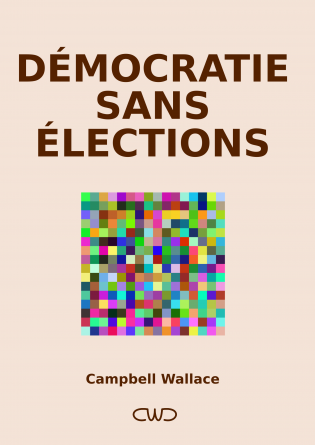 The latest edition of “Down with Elections! a plan for Democracy without Elections” is now available. The paperback is at https://www.amazon.com/DOWN-ELECTIONS-plan-DEMOCRACY-WITHOUT/dp/B0851M9H3F.
Users of this forum can obtain a free digital version (epub, mobi or PDF) directly from me (email to cwallace@free.fr).
Changes from the last published version (V3) are mainly explanatory, there are no major changes to the model of government proposed. (Changes from earlier versions are too numerous to list here.) Nothing I have seen or read recently has persuaded me that the overall design of the system proposed in the book needs changing, and events of the last few years – indeed of the last two hundred years – have only reinforced my opinion that we cannot have true democracy until we replace elected parliaments by ones chosen by lot.
Une version française est maintenant disponible (en broché) :
https://www.amazon.fr/démocratie-sans-élections-Campbell-Wallace/dp/B085R72PK5 (5,38 € + livraison)
ou
https://www.thebookedition.com/fr/democratie-sans-elections-p-372653.html (7,23€ + livraison)
On peut avoir la version digitale gratuitement en envoyant un mail à cwallace@free.fr.
Filed under: Books, Elections, Proposals, Sortition | Leave a comment »
The US Chapter of the Sortition Foundation is changing its name to Democracy Without Elections. We are still affiliated with the Sortition Foundation.
We will be using an online democratic lottery on Sunday to select nine Directors for our new Board from our 80+ members. No stratification will be used, and no preference given to whether a person is active or not. Do you know of any Boards who use sortition to select their Directors?
We have a new website: https://www.democracywithoutelections.org/. It was determined that the website will be geared towards people who have just heard about democratic lotteries. Contact me if you have suggestions for the website. Obviously the citizens’ assembly and history sections need expansion.
Filed under: Action, Applications, Elections, Sortition | Leave a comment »
 Adam Cronkright
 Ali
Ali Ahmed R. Teleb
 avanderven
 avergne
 Alex Kovner
 azakaras
 Brett Hennig
 campbellwallace
 Simon Threlkeld
 Nick Coccoma
 codyhipskind
 Common Lot Sortitionist
 Conall Boyle
 constitutionalism
 davidschecter
 graytmatter
 gtridimas
 H.J. Hofkirchner
 Hanspeter Rosenlechner
 James Kierstead
 John Burnheim
 jgarry20151
 Jochen Krattenmacher
 johnedwardtaylor
 johnhuang865
 Jonathan Crock
 keithsutherland
 Jacob Richter
 kkoreilly
 lukewhito
 SimonPek
 Nathan El
 Nicholas Gruen
 Owen Shaffer
 Patrick Chalmers
 Paul Gölz
 peterstone
 Pierre-Etienne Vandamme
 pronfeld
 Emil
Emil rcaze
rcaze richwbrown
 Roger Knights
 roslynfuller
 Pierre-Etienne Vandamme
 shaharavin
 tbouricius
 Ted Wachtel
 Joshua Laferriere
 theodorestathis
 towardsautonomyblog
 Wayne Liebman
 Yoram Gat
 Oliver Milne
 Equality by lot