Sortition in Switzerland

The Swiss news website 24heures has a story about sortition in Switzerland. (Original in French, my translation, corrections welcome.)

And if parliament members were allotted?

Democracy A seminar examines the use of sortition in Switzerland, which some citizens want to implement.

By Caroline Zuercher, 25.10.2017
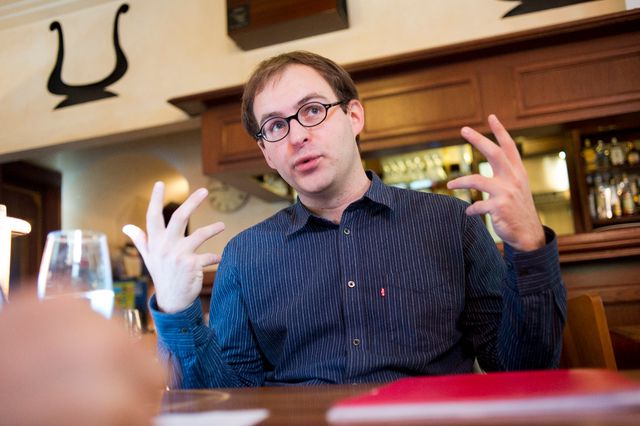
Antoine Chollet, research professor at UNIL. Photo: Marius Affolter

Allotment is useful not only for selecting the winners in lotteries. A group of citizens, Generation Nomination, wants to use it for selecting our people’s representatives in Berne. In time, they place to launch a initiative to this effect. The mechanism is far from being new having already been used in ancient Greece. An international seminar, on Friday and Saturday at the university of Lausanne is examining exactly these experiences in Switzerland and in Europe.

Sortition has been used in various contexts. And it has not always been synonymous with democracy. Antoine Chollet, teaching assistant in the University of Lausanne, gives and example. In the 18th century Berne used it to name bailiffs and other magistrates, but only the members of noble families participated in the allotment. The goal was therefore about all to share power among the powerful.

Switzerland had more democratic experiences as well. Studies supported by the National Swiss fund for scientific research examined cases in Schwytz and in Glaris. “There, the people demanded allotment in order to reduce the corruption of the elites and to enhance the circle of powerful families”, explains the researcher. In Glaris at the end of the 18 century, for example, the deputies were for allotted among the entire body of citizens. With limited success: “Our research shows that it was transformed into a form of lottery. Those who were selected could resell their post: that was the great prize!”
Continue reading

Peers at top of credibility rankings

The following data is from the “2017 Edelman Trust Barometer“, a multi-country opinion survey. Interestingly, the report seems to have generated very little press coverage.

The survey finds that in most countries surveyed, including all Western European countries surveyed, a majority of the population thinks the system is failing. In all countries surveyed, except for two, there are more people who think that the system is failing than people who think the system works. The exceptions are China and the UAE.

With loss of faith in electoralism reaching crisis levels, the mood seems ripe for democracy with trust in “a person like yourself” now at the top of the trust rankings.

Hugo Bonin: Using sortition in order to resolve the crisis of representation

The French-Canadian newspaper Le Devoir has an interview with Hugo Bonin with the publication of his book, La démocratie hasardeuse (Éditions XYZ, Montréal, 2017, 150 pages).

Using sortition in order to resolve the crisis of representation

The essayist Hugo Bonin proposes to rid democracy of that which ails it: elections

Guillaume Lepage, October 28th, 2017

On November 5th the municipal elections in Quebec will take place. In the previous elections fewer than one citizen in two exercised their right to vote, a turnout which despite being slightly higher than that of 2013, remains steady under the 50% mark. Is that evidence of a dysfunctional system?

“Our political system is in crisis, almost everybody agrees about that. A crisis of institutions, of democracy, of citizenship, a crisis, finally, of politics,” writes author Hugo Bonin in the opening of his first essay, “The uncertain democracy” (XYZ publishers).

In 150 pages, the political science doctoral candidate at UQAM and the University of Paris-VIII proposes to introduce chance in our seats of power. In allotting among the citizens our next rulers we eliminate, according to him, the principle reason for the ails of Western democracies: elections.

The author therefore invites the readers to think beyond electoral reforms. If sortition in politics appears audacious, this idea was not created yesterday but rather is an echo of antiquity in our days.

Fundamentally “elitist” by reproducing “relations of domination”, the system in place is aimed at limiting the power of the citizens, emphasizes the author, when we meet in a the Plateau Mont-Royal cafe. “And elections were seen as one way of assuring that the better people in society, or those who were already at the top, continue to be there.”

Rather than electing the people who “are considered the most competent”, sortition places its bet on the idea that anyone can carry out political roles. In this selection mode of representatives of the people “there are no better candidates. What is important is allocating political responsibilities in an equal manner and assuring that everybody can govern.”

Nor are elections “a measure of competence”, Bonin asserts. “Donald Trump seemed in the eyes of the majority as being a better candidate than Hillary Clinton. Does this mean that he is more competent?” he asks amusedly.
Continue reading

The allotment for the convention of La France insoumise has started

La France insoumise (“France Uprising”, FI) is a Left-wing French political party which was founded in 2016. In the 2017 presidential elections its candidate, Jean-Luc Mélenchon, won almost 20% of the votes in the first round and narrowly missed making it to the second round. FI has presented a platform it calls L’Avenir en commun one plank in which is having a constitutional convention where a certain proportion of the delegates would be selected by lot.

FI is now in the process of having its own internal convention “for setting its new objectives, improving its tools and modes of action and specifying its principles of organization.” This process involves allotting delegates to the convention. FI has now announced that it has sent invitations to those allotted:

The first phase of the sortition has taken place. A list of the first 1,200 people has been drawn. Each one of those people has received a registration form. Those women and men who fill out the form before November 13th will participate in the convention. The unclaimed slots will be redistributed in the second phase of the sortition on Friady, November 10th. There is therefore time for you to participate in the allotment if have done so yet.

P.S.: For the curious, here is the script which we used to implement the sortition.

Arturo Íñiguez: On the meaning of the word ‘democracy’

Arturo Íñiguez, an occasional contributor to Equality-by-Lot, recently published a rather beautiful essay touching upon sortition which weaves together history, linguistics and political philosophy (English, French, Spanish). Well worth reading in its entirety even for people familiar with the idea of sortition, here is an excerpt from the essay:

[R]epresentative regimes can be either aristocratic, if they rely on election, or democratic if they rely on sortition.

According to my experience, a lot of people, when exposed to these truths, will react in complete denial. But the fact is that this has been completely trivial knowledge for political scientists for most of recorded history: from Plato and Aristotle to Montesquieu and Rousseau, in the mid XVIIIth century, all of them wrote the same: elections are aristocratic and sortition is democratic. How come, then, that we have been so thoroughly indoctrinated as to believe the exact opposite of something that was crystal-clear for the greatest human thinkers?

Well, the change began in the late XVIIIth century, when the rich bourgeois in France and North America decided that they would be better off in the future by breaking free from the existing monarchic regime (which after all had not been so bad with them, or they wouldn’t had got so rich in the first place). Needless to say that sharing any power with the poor masses was always completely out the question. The masses would be used to fight the royal armies and then abused into thinking the the victory was also theirs. Both the Founding Fathers and the French revolutionaries were adamant in opposing democracy. Suffice to read what they said and wrote to understand that democracy was for them a very bad and ugly word.

But calling their elective system aristocracy, which would have been the logical thing to do following the philosophical tradition we have just mentioned, was also a no-go. Was not the aristocracy the despised enemy recently destroyed? And at the end they had to settle for a word like ‘republic’, an empty signifier which can mean anything you want it to mean.

A lively discussion followed the essay in the comments and Arturo exhibited the proper democratic mindset and engaged in conversation with some of the commenters. Here, for exmaple, is one comment by a reader and Arturo’s reply:
Continue reading

Detoxing democracy: Brexit and the considered will of the British people

Nicholas Gruen is an economist, entrepreneur and commentator who has been described by former Australian member of the House of Representatives Lindsay James Tanner as “Australia’s foremost public intellectual”.

On Nov. 6th, Gruen will be giving a talk at King’s College London titled “Detoxing democracy: Brexit and the considered will of the British people”.

Abstract:

Though material conditions played their part, the degradation of politics now so evident in the shock and awe of Brexit and Trump also reflect the way in which elections orient politics around political combat, rather than deliberation and problem solving. Yet Britain could use the ancient Athenian idea of selection by lot – choosing a cross-section of the public to deliberate together to complement elections – to turn its slow-motion crisis into the rebirth of democracy, moving it from government according to the will of the people, and towards the richer, safer notion of government according to the considered will of the people.

An outline of the argument: Detoxing Brexit by detoxing democracy.

Britain’s governing class is now engineering a tragedy that arose from a piece of political improvisation gone horribly wrong. Yet there’s a principled way of handling the situation.
Continue reading

Interview with John Gastil on Legislature by Lot

3.3 Legislature by Lot with Professor John Gastil

Above is the link to a podcast interview by Real Democracy Now! John Gastil is a Professor in the Communication Arts and Sciences and Political Science at the Pennsylvania State University as well as a Senior Scholar in the McCourtney Institute for Democracy. He studies political deliberation and group decision making across a range of contexts.

In September 2017 John and Erik Olin Wright, as part of the Real Utopias project, held a three-day workshop called Legislature by Lot. Participants included several contributors to this  site, Equality by Lot.  John was interviewed shortly after this workshop to learn more about what was discussed.

John described this workshop as ‘a deliberation about deliberation’.

John spoke about

  • the origins of the Legislature by Lot workshop [1:32]
  • the different ways to implement sortition (random selection) [3:54]
  • some of the arguments in favour of a legislature selected by lot [5:44]
  • different models of sortition [7:40]
  • responding to criticisms of legislature by lot [10:11]
  • how to design an oversight body to support a legislature selected by lot [14:10]
  • the prospect of institutional change and transition strategies [18:34]
  • moving the agenda of using sortition forward [23:43]
  • how much work is happening around the world to test and promote the use of sortition [28:35]
  • what representation and accountability means for bodies selected by sortition [30:29]
  • deliberation, consensus, contention and voting [34:35 and 38:50]
  • what the workshop agreed on [43:18]
  • what might happen after the workshop: building links between researchers and practitioners [45:34]
  • responses to critiques of empowered mini-publics [49:35]
  • when the book arising from the workshop will be published [53:07]

The other point of view of the debate at La Croix

The French newspaper La Croix has recently published two pieces under the title “Of what use is the senate?”. A translation of one of those pieces is here. Below is a translation of the opposing view.

Jean-Philippe Derosier: “The senate is in the DNA of our institutions”

Jean-Philippe Derosier is a professor of public law at Lille 2 university and the author of the blog “The constitution decoded”.

Personally, I do not dispute the utility of the senate, even if some changes could surely be considered. There are three reasons for the utility of a second chamber. First of all, a logical reason. The parliament represents the nation, and the nation is the people but also something else. The people are represented by the assembly and other thing, in our system, is the regions (territories). In countries which made the choice of bicameralism, this other thing can be different, for example in England the history of the British nobility is incarnated in the House of Lords, or the civil society in Ireland.

The second reason is biological: there are always more ideas in two heads than in one and the second chamber completes the role of the first through a permanent dialog instituted between the two assemblies.
Continue reading

Welsh Assembly Member proposes Citizens Juries

From the BBC News:

Compulsory Welsh citizen ‘democratic duty’ call

Welsh citizens should be called-up for compulsory democratic service in the same way as “jury duty”, an AM has said.

Conservative David Melding said a second chamber of the assembly should be created for residents to influence decisions and laws.

Mr Melding said introducing a “citizens service” in Wales would help narrow the gap between politicians and the public.

He said it would help keep politicians and officials “rooted”.

The AM for South Wales Central said the growing distance between politicians and the public, and the lack of engagement was “very damaging”.

Speaking on BBC Wales’ Sunday Supplement programme Mr Melding said a “citizens’ service” should be introduced, in a similar way to jury duty, with residents randomly selected to sit on panels, including local health boards to look at how hospitals and GP services are run, and local town and county councils to have their say on new leisure facilities and bin collection changes.
Continue reading

Loïc Blondiaux on a citizen senate


A France Insoumise rally at the Place de la République in Paris, July 3rd 2017, Thomas Samson/AFP

La Croix has a short interview with Loïc Blondiaux on the idea of a “citizen senate”. Original in French here. My translation, corrections welcome.

What could a citizen senate look like?

Compiled by Béatrice Bouniol, Sept. 22nd, 2017

On the eve of the senate elections, Loïc Blondiaux, professor of political science specializing in participative democracy, discusses the idea of citizen senate and the questions it raises.

La Croix: Why does this idea of a “citizen senate” come up in political debates?

Loïc Blondiaux: The idea of a citizen senate indicates two major developments. First, the return to consciousness of the idea of sortition, which was suppressed for centuries. More and more political players and thinkers are considering the possibility of using it in different ways: citizen juries in a more-or-less ad-hoc setting, citizen assemblies aimed toward an institution change or a new sortition-based institution. Secondly, we witness today an increase in proposals that aim to modify the workings of government bodies, to open them more toward civil society and toward discussion with citizens.
Continue reading