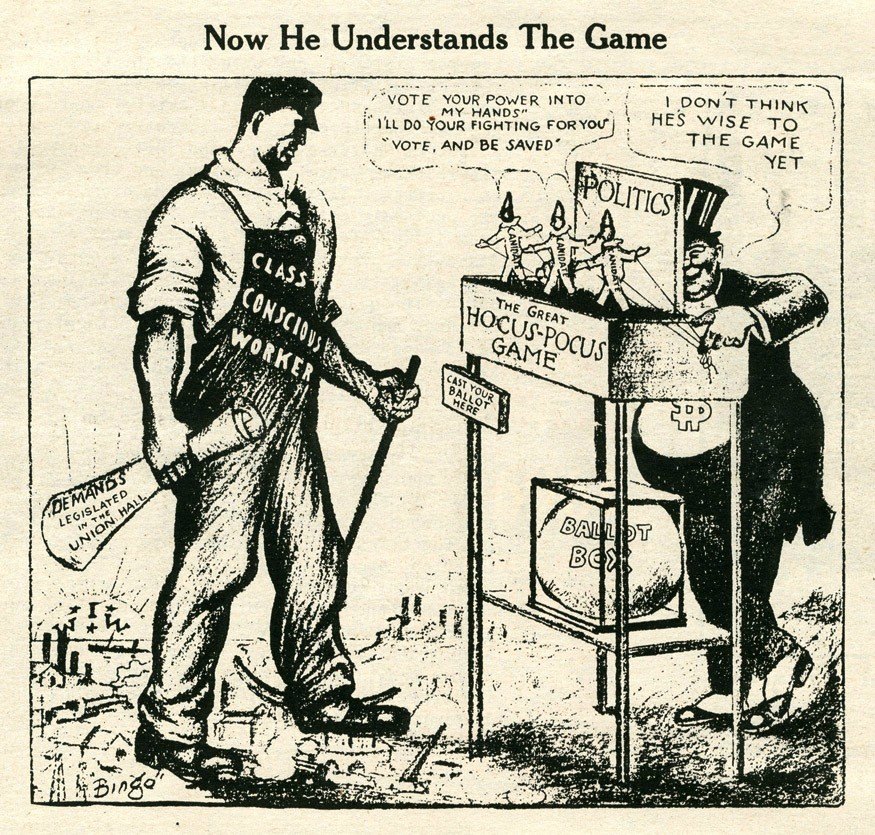
Nicholas Reece: The momentous success of radical democracy

Nicholas Reece writes in The Age:

Experiment pays off: Melbourne People’s Panel produces quality policy

Citizen juries are one of the most promising innovations to emerge in the conversation about democratic renewal.

Melbourne’s radical experiment in democracy has reached a momentous conclusion, with the City Council announcing on Friday it will accept nearly all the recommendations of a 10-year financial plan developed by a citizens’ jury. That a group of 43 randomly selected Melburnians meeting over six weekends developed sound policy that is now being implemented is a profound result for anyone despairing at the state of our democracy. And it invites the exciting question, what’s next?

It turns out that having a plan “developed” over 6 weekends to guide the expenditure of billions of dollars over 10 years is considered a momentous success of radical democracy. What’s next, indeed.

Op-ed piece calling for a sortitioned Canadian Senate

Claudia Chwalisz writes in The Globe and Mail:

Replace this archaic institution with a citizens’ senate

While calling for unicameralism would be a mistake – it would reduce the government’s legitimacy due to lack of oversight – the more radical proposal of “abolition” leaves the path clearer toward true structural change that moves beyond tinkering at the edges (such as elected senators).

Why not replace the archaic institution with a citizens’ senate – a rotating group of randomly selected citizens that serve as a house of review? The random group could be stratified, to ensure representativeness of sex, age, race, socio-economic status and regional diversity, matching the makeup of Canadian society.

Granted that this is only an op-ed piece, but I have to admit I am rather amazed that the idea of a sortitionally-selected federal legislature is making it so rapidly into the mainstream.

Short refutations of common objections to sortition (part 4 of 4)

Part 1 Part 2 Part 3

16. Why not use direct democracy?

“Direct democracy” is not a democratic mechanism – it suffers from much of the same fundamental problems of electoral systems.

Much in the same way that an electoral candidate has to have the backing of powerful people or organizations in order to become well-known enough to have a chance to be elected, so a proposition has to have powerful backing in order to become well-known enough to have a chance to appear on the ballot. Just like people have no real way to know how well a particular elected official represents their views and interests, so it is difficult to know what the effects of a particular proposition will turn out to be.

In addition, there is too much for government to handle for the cumbersome proposition mechanism to handle. Much of the business of government will necessarily be handled by professionals. “Direct democracy” offers no mechanism for controlling those professionals as they carry out the day-to-day workings of the government.

17. An electoral career provides training for statesmanship.

That is a very questionable assertion. An electoral career provides training for manipulation and self-promotion. A person habituated in such ways of thinking is not likely to pursue policy which serves the public.
Continue reading

Short refutations of common objections to sortition (part 3)

Part 1 Part 2

11. Elections are a mechanism of accountability. It allows the electorate to reward or punish those with power. There is no way to hold government accountable using sortition.

Using elections as an accountability mechanism is like a bank’s board of directors appointing a new bank manager for a 4-year term and telling him that if he steals the depositors’ money then there is some chance that he will not be re-appointed to run the bank for another term (but he will get to keep the money he took). A manager who sees his job as a means for self-enrichment is clearly better off simply taking the money. No matter how many years of service he can secure if he stays honest, his salary will never amount to what he can steal in a single term.

Besides, if the replacement managers are all as greedy as the current manager, what good would replacing the manager do?

In short, seeing elections as providing an effective means of incentivizing a government to promote the interests of the average citizen is hopelessly unrealistic. It is remarkable that this view is standard in both popular discourse and professional political science literature.

12. The training and service experiences would likely cause people to change their minds about various issues and in this way become unrepresentative.

As the allotted delegates study issues it is indeed to be expected that they will adopt views on matters that they were not aware of before, and occasionally will even come to have opinions that contradict previously held ones. In this sense the allotted become unrepresentative – they are better informed and have spent more time and effort considering various matters of policy than the average citizen does.
Continue reading

Short refutations of common objections to sortition (part 1)

1. It would be madness to appoint public officials by lot. No one would choose a pilot or builder or flutist by lot, nor any other craftsman for work in which mistakes are far less disastrous than mistakes in statecraft.

The problem with this ancient argument against sortition (attributed to Socrates) is that it implicitly assumes that there is some consensus around who should be running the state (those are the pilots, builders or flutists of politics). If there was such consensus politics would be very simple. Politics to a large extent is about identifying whose advice should be taken on which subject. The pretense of elections is that the voters can identify such people. This is a fantasy.

A small group, meeting together and discussing and examining matters in depth, would be able to do a much better job of getting the best advice than the citizens can do as isolated individuals. In fact, most voters already know that – they tend to be very disapproving of elected officials – the very people whom they supposedly selected as being the best suited to handle statecraft.

2. Average people suffer a great many shortcomings (some combination of stupidity, laziness, apathy, greed, selfishness, lack of education, lack of experience, inability to work together with others, etc.).

This dismissive view of the average person is offensive and unsubstantiated by the facts. Continue reading

Effect of salaries on legislative congruence with public opinion

This Salon article, This is how the oligarchy wins: Money, politics, and the perils of part-time lawmakers argues that a well-paid, full-time ‘professional’ legislature is more likely to enact laws that the majority of citizens support.

A professionalized legislature differs from a citizen legislature in several ways: Professional legislatures generally meet for a more extended period of time and are paid enough that they do not have other careers. Professional legislators have larger staffs, more money to research policy and more time to deliberate and hold hearings. Professionalized legislatures also tend to attract politicians interested in working their way to higher levels of government.

Political scientist Patrick Flavin has focused his attention on the question of equality of representation. He created an index of how equal legislatures were in responding to constituents across income groups. He tells me that his still-unfinished analysis suggests that professionalized legislatures might have more equal political representation. One reason may be that professional legislatures are less susceptible to organized lobbying interests.

In recent years, many conservatives have fought to weaken legislatures. Ben Boychuk of the right-leaning publication City Journal argues, “Priorities, ladies and gentlemen. Priorities. A Legislature with [only] 95 days to enact laws is one less likely to spend a great deal of time introducing and passing useless legislation.”

Although the citizen legislature has a certain appeal, seeming to reflect the democratic ideal, in fact such legislatures are more open to manipulation from professionalized interest groups.

The article doesn’t consider what a statistically-representative legislature — a non-professional but well-paid citizen legislature — might do.

Humor in Article Based on Erroneous Assumption About Athenian Democracy

A rather amusing article in the Onion makes the mistake of assuming that the Athenian democracy was an electoralist system and therefore subject to the same elitist control:

Anthropologists Discover Ancient Greek Super PAC That Helped Shape First Democracy

ATHENS, GREECE—In a finding that provides new insight into the roots of Western civilization, a team of anthropologists from Cambridge University announced Monday the discovery of an ancient Greek super PAC that helped shape the world’s first democracy. “At the same time Cleisthenes first instituted a representative form of government in Athens, it appears that a group of wealthy citizens and merchants created an organization to influence these new voters by bombarding them with around-the-clock political messages,” lead researcher Daniel Rogers said of the early political action committee, named Athenians for a Better City-State, which is said to have received millions of drachmas’ worth of funding in gold, lambs, dates, loaves of bread, and slaves from Athens’ largest and most influential trade groups. “While the committee was prohibited from coordinating directly with candidates seeking public office, AFBCS nevertheless spent astonishing sums on orators hired to stand in the Agora and recite the negative traits of politicians that the super PAC opposed, as well as on writers who were hired to pen slanderous epic poems.”

Easton: Who would be a member of parliament?

A widespread public view (also prevalent on this blog) is that elected politicians are members of a remote political class, dedicated to pursuing their own interests at the expense of those who they purport to represent:

As the Times journalist Louis Heren said when asked what went through his mind when a politician shared a confidence, many members of the public hear an MP and think: “Why is this bastard lying to me?”

BBC home editor Mark Easton, however, takes a different perspective

Most politicians in my experience are driven by a sense of public service. Some of them advance ideas for improving common well-being that are far removed from my own. But that doesn’t make them self-serving.

Full post

Belgiorno-Nettis: Power to the people, unnamed and unadvertised

Luca Belgiorno-Nettis, founder of the new Democracy Foundation, writes in The Sydney Morning Herald:

[M]odern democracy was born of privilege and nurtured through class conflict. Conceived in partisan contest, initially as kings and barons, then as landed gentry in elections, the disenfranchised became chartists, then socialists, and the ultra-disenfranchised became communists. Even though the claims of the working class and the suffragettes have largely been resolved, the saga continues in a fossilised relic of divisiveness. Modern democracy rejected the Athenian ideal of equality, wherein the poor, as much as the rich, were automatically accorded a place in government.

Continue reading

The principle of distinction