Posted on October 19, 2014 by Yoram Gat
This is the clever headline of an article in The Independent about a survey by the Royal Statistical Society and King’s College London measuring public perceptions of various public policy related facts:
A new [2013] survey by Ipsos MORI for the Royal Statistical Society and King’s College London highlights how wrong the British public can be on the make-up of the population and the scale of key social policy issues. The top ten misperceptions are:
1. Teenage pregnancy: on average, we think teenage pregnancy is 25 times higher than official estimates: we think that 15 per cent of girls under 16 get pregnant each year, when official figures suggest it is around 0.6 per cent.
2. Crime: 58 per cent do not believe that crime is falling, when the Crime Survey for England and Wales shows that incidents of crime were 19 per cent lower in 2012 than in 2006-7 and 53 per cent lower than in 1995. 51 per cent think violent crime is rising, when it has fallen from almost 2.5 million incidents in 2006-7 to under 2 million in 2012.
3. Job-seekers allowance: 29 per cent of people think we spend more on JSA than pensions, when in fact we spend 15 times more on pensions (£4.9bn vs £74.2bn).
Continue reading →
Filed under: Academia, Elections, Opinion polling, Press | Tagged: Ipsos MORI, King’s College London, public perceptions, Royal Statistical Society | 14 Comments »
Posted on October 17, 2014 by Yoram Gat
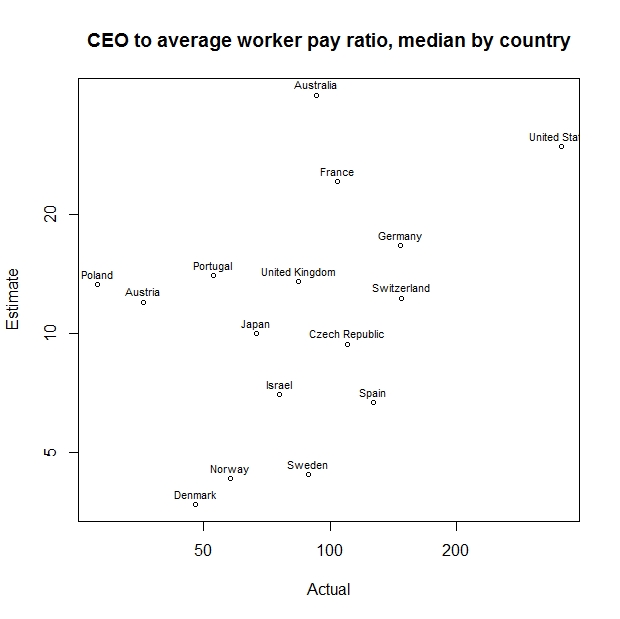
A recent international study of inequality by Michael Norton and Sorapop Kiatpongsan was already mentioned here for its findings about how uninformed the public was about matters of public policy. The study collected the opinion of people about what the CEO-to-average-worker pay ratio should be, and their best guess of what it actually was. A summary of the findings are shown in the table at the bottom.
Interestingly, not only do median estimates of the pay ratio in all countries grossly underestimate the true values, but there is essentially not correlation between the two (R2 = 14%, 3.5% after dropping the U.S. outlier):

Continue reading →
Filed under: Academia, Elections, Opinion polling | Tagged: economic inequality, income inequality, inequality, Michael Norton, Sorapop Kiatpongsan | 1 Comment »
Posted on October 8, 2014 by Yoram Gat
Susan C. Stokes, a professor of political science at Yale university, is the author of a book called Mandates and Democracy: Neoliberalism by Surprise in Latin America.
I find the following excerpts from a chapter called “Explaining policy switches” generally amusing and rather illuminating about the practice of political science (I introduced some light editing to improve readability of the excerpts):
[B]oth qualitative evidence from campaigns and statistical analysis of cross-sectional data offer evidence that fear of losing elections induced politicians to hide their policy intentions.
Yet evidence of this belief structure does not adjudicate between the representative and the rent-seeking model of policy switches. Both kinds of politicians are expected to hide their true intetions to win office. The critical question is, Did they dissimulate and switch because they thought efficiency policies were in the best interest of voters or because they found efficiency policies advantageous for themselves, whether or not they would be good for voters?
Continue reading →
Filed under: Academia, Books, Elections, History | 5 Comments »
Posted on September 30, 2014 by Yoram Gat
Democracy and elections
Dear Justin,
I am writing in response to the recent column by Raymond Critch “Why should every vote count?” (Sept. 29th). Mr. Critch describes his feeling of disenfranchisement due to the process that led to the selection of a new Premier of Newfoundland and Labrador – a process not involving public elections.
However, as Mr. Critch himself alludes by quoting John Kenneth Galbraith, elections are in fact not a tool of democracy but rather a way to inoculate the population against the feeling that the government is not theirs.
Mr. Critch also points out that democracy originally did not rely on elections to select political decision makers. In ancient Greece everybody knew that elections are typical to oligarchies, like Sparta, while democracies, like Athens, used sortition. Sortition is the mechanism of selecting decision makers by drawing lots – generating a decision making body that is statistically representative of the entire population.
Modern society is trapped in a situation where we have an elections-based elite-dominated political system and yet we call it “a democracy”. We are unhappy with it, and yet we keep venerating it. Until we free ourselves from identifying elections with democracy we will not be able to start working our way toward what can properly described as democracy.
Only rule by a statistically representative body – a portrait of the people in miniature – can produce a democracy: rule by the people for the people.
Best regards,
Yoram Gat
https://equalitybylot.wordpress.com
Filed under: Athens, Elections, Press, Sortition | Tagged: John Kenneth Galbraith | 30 Comments »
Posted on September 24, 2014 by Yoram Gat
Voters don’t trust elected officials. One of the ways this phenomenon manifests itself is by popular support for various forms of regulation of the officials’ political activity. The fact that this sentiment doesn’t get reflected in policy – just like public opinion regarding the salaries of elected officials – is a blunt failure of the electoral responsiveness dogma.
Rhetoric being cheaper than policy, some promises to regulate lobbying do get made:
I am in this race to tell the corporate lobbyists that their days of setting the agenda in Washington are over. I have done more than any other candidate in this race to take on lobbyists — and won. They have not funded my campaign, they will not run my White House, and they will not drown out the voices of the American people when I am president. Barack Obama, 2007
This promise was not, of course, translated to policy. But that aside, even as rhetoric this is rather tepid. Hammering lobbyists publicly – one of the only groups of people more widely distrusted than elected officials themselves – should have been an easy way for candidates and incumbents to win votes. But doing so would involve not only offending benefactors who finance the politicians’ campaigns but also offending former and future colleagues who happen to currently be on the other side of the revolving door.
Filed under: Elections, Opinion polling | Tagged: Barack Obama, corporate lobbyists, public opinion | 35 Comments »
Posted on September 22, 2014 by keithsutherland
Writing in the Sunday Times in the aftermath of the Scottish Referendum, deputy prime minister Nick Clegg proposes a citizen-jury based constitutional convention:
I welcome Labour’s decision to embrace the long-standing Liberal Democrat call for a constitutional convention — but it needs a precise mandate, beginning next year and concluding in 2017. It should have a citizen’s jury at its heart, representing every corner of the UK. One area it will need to address is the future of the House of Lords, which, in my view, would better serve people as an elected second chamber, in keeping with federal systems across the world. Ultimately, however, it will not be up to politicians — this process will be led by the people.
It’s often puzzled me that politicians are eager to use sortition as a way to determine complex constitutional issues, but we can’t be trusted to make everyday political decisions (the price of bread, tax rates, invading foreign countries, gay marriage etc). Clegg’s proposal also appears to confuse the notion of a jury (which determines the outcome of a debate) and political leadership — “this process will be led by the people” — reminding one of Ledru-Rollin’s epithet: “there go the people, I must follow them for I am their leader”. We won’t make any progress until the conceptual and practical distinction between these two aspects of politics (leadership and decision-making) is respected. In a democracy, political leaders can propose and advise but they should not determine the outcome — the decision should be in the hands of a statistically-representative microcosm of the citizen body. The problem in this particular instance, of course, is that English citizens would outnumber those of the other nations of the UK by an order of magnitude and the English would be unlikely to accept numerical parity between the nations (i.e. 1/4 of the composition of the citizen jury). So sortition, in this case, would only make the problem worse.
Filed under: Elections, Juries, Press, Proposals, Sortition | Tagged: constitutional convention, Nick Clegg, Scottish Referendum | 9 Comments »
Posted on August 11, 2014 by Yoram Gat
The virtue-based justification of electoralism implies an indirect connection between public opinion and policy. According to this justification, the public identifies people it trusts and puts them in office. Those people then determine policy as they see fit. According to this theory, then, the connection between policy and popular opinion is mediated by character judgments.
The rewards-based justification, on the other hand, implies a direct connection: elected officials wish to please the public in order to be re-elected and thus pursue policy that matches public opinion (in the sense that if they pursue policy X, then there exists no alternative policy which would win higher approval ratings).
The rewards-based theory suffers from two fundamental defects:
- It ignores the epistemic difficulties facing voters. In reality voters’ ability to determine the effects of government policy is very limited. They are therefore unable to tell whether government policy matches their world view and promotes their interests.
- It assumes that politicians lack policy preferences of their own. The theory assumes that politicians want to be elected simply and solely for pleasure of being in office rather than to promote any specific policy.
Those defects indicate why the rewards-based theory cannot be expected to explain policy setting by elected government. However, those defects do not apply to the rewards-based theory in the limited context of campaign rhetoric. Continue reading →
Filed under: Elections, Opinion polling, Press | 24 Comments »
Posted on July 22, 2014 by Yoram Gat
Approval ratings of U.S. congress have been stuck at single digits or low double digits for years. However, Americans tend to like Congresspeople elected in their own districts and states more than they like Congress as a whole.
A recent Rasmussen poll found that Congresspeople are quite unpopular even in their own districts:
[O]nly 25% of voters think their representative in Congress deserves reelection […]. Forty-one percent (41%) now say that representative does not deserve to be reelected, but 34% are undecided.
(This is still much better than Congress as a whole whose approval ratings are at 8%.)
Other findings from the poll:
70% think most [incumbents] get reelected because election rules are rigged in their favor, not because they do a good job representing their constituents.
[O]nly 14% of voters think most members of Congress care what their constituents think, and only slightly more (21%) believe their congressional representative cares what they think. These numbers, too, have been trending down over the last four-and-a-half years and are now at new lows.
Sixty-nine percent (69%) think most members of Congress don’t care what their constituents think, while 17% are not sure. Fifty-three percent (53%) say their representative doesn’t care what they think, but 26% are undecided.
Filed under: Elections, Opinion polling | Tagged: approval ratings, Congress, elections, incumbents | 2 Comments »
Posted on July 22, 2014 by keithsutherland
Kleristocracy is a term, coined by Jon Roland, for the concentration of political power in sortition-based systems, and has been advocated by a number of commentators on this blog. It’s struck me recently that this has a lot in common with the neoconservative worldview that has led to such disastrous outcomes in (for example) Iraq and Libya and I want to use this post to explore the parallels.
Neoconservatives argue that the goal of foreign policy is the liberation of oppressed nations from tyranny – ideally through their own efforts, if not then with a bit of help from the “forces of freedom” – followed by the institution/imposition of democracy, enabling the self-organising powers of “the people” to operate in an unfettered manner. Kleristocrats also argue that “the people” should be liberated from tyranny (of the rich and powerful) and empowered by “real” democracy – the only difference between kleristocrats and neoconservatives being the use of an alternative balloting method.
Continue reading →
Filed under: Ballot measures, Elections, Sortition, Theory | 71 Comments »
Posted on July 16, 2014 by keithsutherland

David Cameron used his reshuffle to promote a number of women – and to sack Michael Gove
Francis Elliott, Michael Savage and Laura Pitel, The Times, July 16 2014:
Michael Gove was removed as education secretary after David Cameron’s election guru warned about his “toxic” polling. Mr Gove paid the price as the prime minister reshaped his cabinet into an election-fighting unit, more than doubling the number of women in a top team that he claimed “reflects modern Britain”. . . [P]olling showing that more than half of voters thought the education secretary was doing a bad job fatally undermined him. Insiders say that Lynton Crosby, the Tories’ election strategist, led a powerful coalition inside No 10 calling for Mr Gove to be removed.
Michael Gove was the architect of the government’s ‘free schools’ policy, which was intended to encourage state-maintained schools to aspire to the values and achievements of independent (fee-paying) schools. This was certainly not a policy designed to appeal to the ‘rich and powerful’ (who can afford the fees of independent schools) as it increases the competition for places in top universities. The toppling of Gove is, ironically, a victory for the rich and powerful, but it was instituted by the need to pander to the preferences of the median voter. The commitment of the government to free schools was ideological, as opposed to reflecting the interests of the ruling elite, and the overturning of it was in response to the perceived [i.e. short-term] interests of the median voter. The main reason that Gove appeared unpopular with parents in Crosby’s focus groups, was his insistence on rigorous examination standards and the attempt to return to a traditional (ie academically challenging) core curriculum. David Cameron and the vast majority of the cabinet supported Gove’s strategy but he was sacrificed for purely electoral purposes (another factor being the need to reduce the alienation of teachers and other public-sector workers).
Continue reading →
Filed under: education, Elections, Opinion polling, Press, schools | 4 Comments »


 Adam Cronkright
 Ali
Ali Ahmed R. Teleb
 avanderven
 avergne
 Alex Kovner
 azakaras
 Brett Hennig
 campbellwallace
 Simon Threlkeld
 Nick Coccoma
 codyhipskind
 Common Lot Sortitionist
 Conall Boyle
 constitutionalism
 davidschecter
 Ethan McCutchen
 graytmatter
 gtridimas
 Henry Tuttle
 H.J. Hofkirchner
 HpR
HpR James Kierstead
 John Burnheim
 jgarry20151
 Jochen Krattenmacher
 johnedwardtaylor
 johnhuang865
 Jonathan Crock
 keithsutherland
 Jacob Richter
 kkoreilly
 lukewhito
 SimonPek
 Nathan El
 Nicholas Gruen
 Owen Shaffer
 Patrick Chalmers
 Paul Gölz
 peterstone
 Pierre-Etienne Vandamme
 pronfeld
 Emil
Emil rcaze
rcaze richwbrown
 Roger Knights
 roslynfuller
 Pierre-Etienne Vandamme
 shaharavin
 tbouricius
 Ted Wachtel
 Joshua Laferriere
 theodorestathis
 towardsautonomyblog
 Wayne Liebman
 Yoram Gat
 Oliver Milne
