Anti-sortition attitudes

It is an unfortunate state of affairs that, despite the fact that proposals of empowering allotted bodies do enjoy significant popular support, most people are not mobilized into action by the idea of sortition. Much of that can no doubt be attributed to despair. There is no point in being politically attached to radical ideas since such attachment has insignificant impact on society and is bound to end in frustration, and quite possibly to being seen by friends and acquaintances as slightly unhinged.

Still, it is rather surprising that despite the unending contempt that many people heap on the existing electoralist system, or more accurately, on its outcomes and on those who act within the system, there is still a strong attachment to the idea of elections and aversion toward proposals at eliminating them altogether in favor of a sortition-based system. Of course, a long list of arguments against sortition is available, and they are endlessly regurgitated (often as if they were brand new) to justify the suspicion toward sortition. However, since all of these arguments are easily refuted, it is quite clear that the arguments are not the cause behind the aversion toward sortition, but rather that some underlying attitudes against sortition must be common, attitudes for which the arguments merely serve as rationalizations.
Continue reading

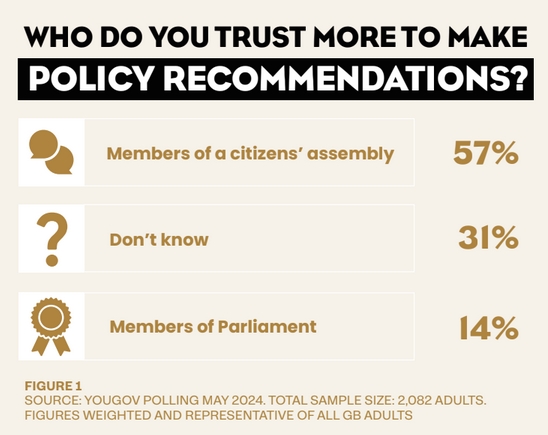
UK citizens trust citizen assemblies 4 times more than MPs

Findings from a 2024 poll appearing in a paper by Sortition Foundation.

The Demos citizen assemblies report. Part 2

The first post regarding the recently released report by the UK think tank Demos proposing the use of allotted bodies as part of the British political system is here.
In this part of the post, I highlight some quotes collected by the authors of the Demos “Citizens’ white paper“, from their interviews with former and present ministers and civil servants as well as interviews with members of the public at large. The picture which emerges from those interviews is not new: the elites are frustrated that public is too unruly, and that they are making unreasonable demands on the political system. Some of them hope that allotted bodies could be a tool for getting the people in line.

The people, on the other hand, feel that the elites are self serving at their expense. While the idea of giving decision power to allotted bodies is seen favorably, there is a lot of suspicion that this would be just another elite ploy. A member of the public expresses this attitude so:

Overall, no, I don’t think we’ve got a say. You give your vote to one party. And that’s the end of it, basically, you probably like to believe that you’re doing the right thing by voting for that party. But the proof is in the pudding, and I’ve never seen it happen yet.

A civil servant offers an the explanation for this:

Policymakers, be they the politicians and their advisors or the civil servants, do not look like the country either in all of its entirety, and quite a lot of them will not have had to go to the Jobcentre Plus, or many of them, given the age profile, and particularly younger ones will probably have not had to interact with the social care system yet.

This explanation hints at the principle of distinction – the decision makers are different from the public at large. However, the civil servant does not clarify whether they see this difference as resulting in decision makers lacking necessary knowledge, or a in having different interests and world views. A lack of knowledge can presumably be fixed relatively easily, while the second effect is much more stable.

Naturally, an elected politician thinks this difference between decision makers and the public applies to civil servants but the elected are not like this at all. He or she says:

But if you think about it, [civil servants] don’t engage with people day in day out, having discussions with constituents.

Continue reading

Democracy Perception Index

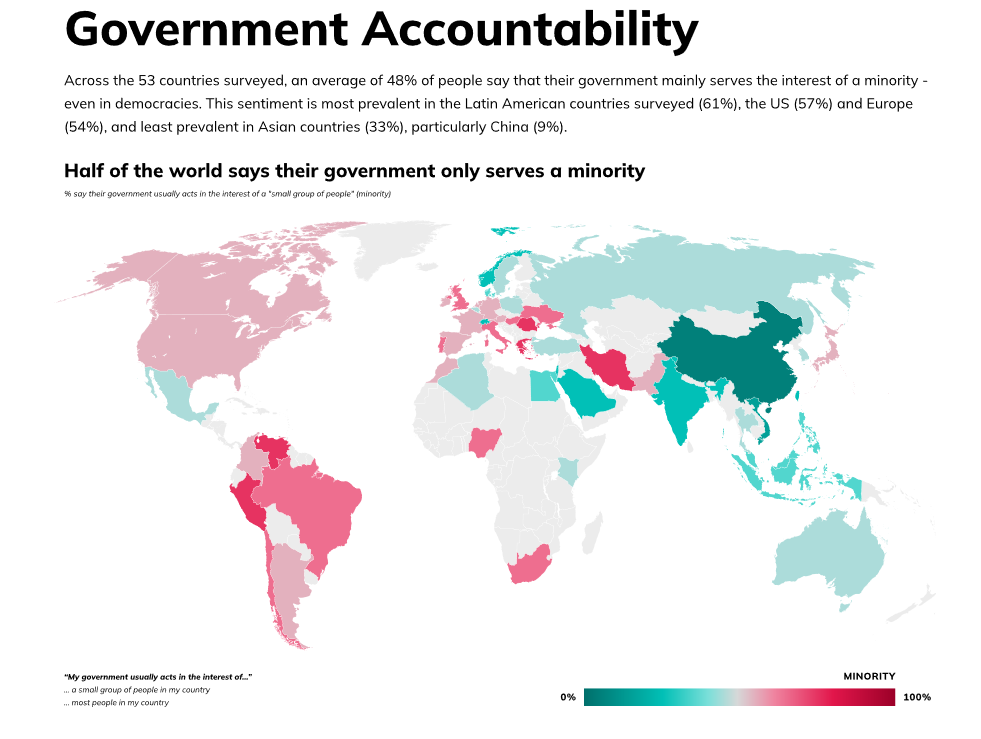
It turns out that there is a rather interesting yearly report called “Democracy Perception Index” which has been published since 2019. The report is based on opinion surveys conducted in more than 50 countries and in which people are asked about the perceptions of democracy and of the government of the country in which they live.

The report is contains various pieces of information of interest. One of the interesting findings in the 2024 edition is that majorities in Japan, in almost all European countries, and in all American countries with the exception of Mexico, see their governments as serving “a small group of people in my country”. In Asia, in contrast, majorities in most countries (with the notable exception of Iran) see their governments as serving “most people in my country”.

Also interestingly, some light is shed on the way people use the under-defined term “democratic”. The criterion people use for stating that their country is democratic is rather more lax than the question of whether the government serves most people. Since majorities in many countries in Europe and America say that their government is democratic, it seems that quite a few Western and South American people are willing to assert both that their government is democratic and that it serves a small group of people at the same time. In China the situation is the opposite: More people assert that the Chinese government serves most of the people in the country than assert that China is democratic, implying that quite a few of the Chinese see China as undemocratic despite asserting that its government serves most people.

Rather bemusingly, the report uses the terms “democratic”, and “free” as factual labels (as opposed to reflecting perceptions) to refer to the Freedom House classification of countries. This follows the convention of referring to [Western] expert opinions as scientific fact, while delegating people’s perceptions of their governments to mere opinion.

Effects of electoralism: Food insecurity

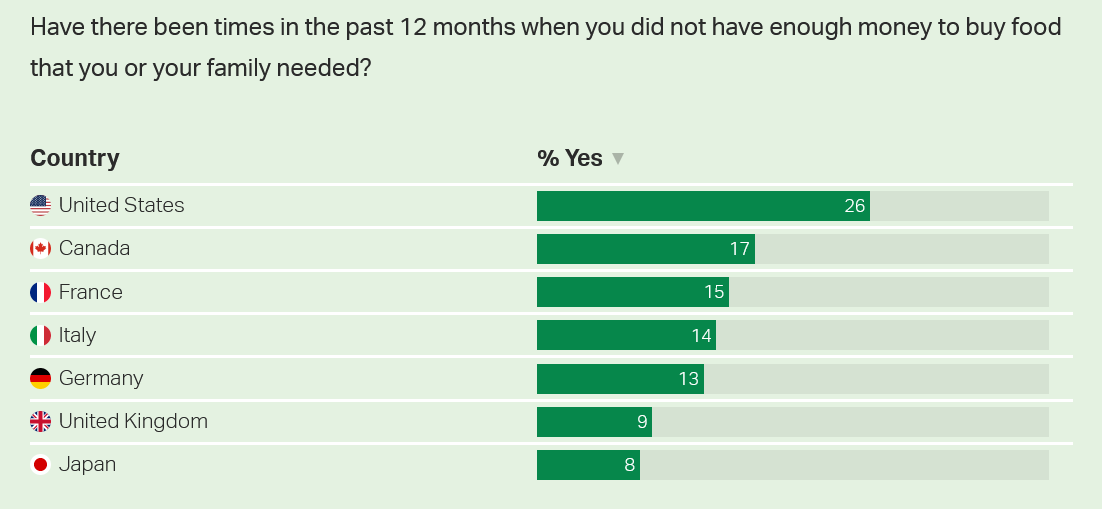
A Gallup poll finds that the inability to afford food is common within Western nations.


Effects of electoralism is a new category of posts is that is devoted to documenting the social and political effects of the elections-based system of government. The aim is to generate a steady stream of up-to-date items that can be easily referred to in order to highlight the fact that the system is inherently anti-democratic. Discussion of the persistent failure of the system to serve those ruled under it is studiously avoided not only by those who overtly promote the status quo but also by many supposed reformers who express concern about people losing confidence in the system, but rarely discuss the underlying causes for this loss of confidence.

Iain Walker: Gaza needs democracy without elections

Iain Walker, executive director of The newDemocracy Foundation, has an opinion piece in The Jerusalem Post. Walker offers Israel and its allies advice about what government they should set up in Gaza (once they tire of killing tens of thousands of its inhabitants).

Gaza needs democracy without elections

Instead of elections, Athenian democracy used a simple random draw among citizens (known as “sortition”).

Prime Minister Benjamin Netanyahu receives regular criticism for failing to share the plan for Gaza after the military role concludes. The lack of an official position on this subject could stem from the fact that all over options are unattractive, and so a new approach is required.

Israel as an occupying force is undesirable, it would draw global criticism and simply push off the problem to a later date.

Equally, traditional electoral democracy is an unworkable option.

With polls reflecting up to 80% support for Hamas among Gaza residents, elections would only allow for some incarnation of Hamas to emerge newly empowered – an untenable situation following its acts of terror targeting civilians.
Continue reading

Citizen trust in European government

Eurobarometer data shows that the trust European citizens have for their governments has recovered significantly from the depths of distrust felt in the wake of the 2008 financial crisis. At the bottom, in 2013, only a quarter of European expressed trust in their governments and parliaments. Now the average EU government and parliament enjoy a level of trust of 36% and 39% respectively. These numbers have been fairly steady over the last 5 years and are comparable to the numbers before the crisis.

It seems then this is the European “normal”: those who distrust their government outnumber those who do by a 3 to 2 margin or more. Currently, of the 27 EU countries, there are only 6 countries in which a plurality of citizens trust their governments.

Gallup poll: Record Low in U.S. Satisfied With Way Democracy Is Working

Gallup finds that “satisfaction with the way democracy is working” in the U.S. has eroded dramatically over the last 4 decades.

Satisfaction has been declining among both Republicans and Democrats as well as among independents. Satisfaction is highly positively correlated with education in the latest poll, but was less so in the previous poll in 2021.

Americans’ views about what drives politicians

A Pew poll conducted in July this year probes the views of U.S. citizens about the motivations of politicians. There is widespread agreement that politicians are in it for money, ambition and fame.


Continue reading

Low acceptance rate as an anti-democratic excuse

An argument against sortition that is fairly common among academics is that allotted bodies are not representative because the acceptance rates of offered seats are low. It is often claimed that “experience has shown” that “less than 10%” of people are willing to serve on allotted bodies. Such a finding, it is claimed, is grounds for not using sortition at all, for limiting the powers of allotted bodies, or for various forms of meddling in the way allotted bodies are made up.

Despite the fact that it is sometimes admitted that acceptance rates change depending on the circumstances, the “fact” of low acceptance rates is largely treated as being an immutable, if unfortunate, obstacle to the representativity of allotted bodies. In fact, however, it is obvious that acceptance rates can be easily increased, quite possibly reaching fairly close to 100%, if compensation for acceptance is high enough. How many people would refuse to commit a few weekends to participating in an allotted body if they are paid a few months’ worth of the median salary for their efforts? The answer to this question is obviously that (while we can probably make a good guess) we do not know for sure. But equally obviously it would be fairly easy to find out by running a few experiments.

It is a small miracle then that all those who busy themselves with attacking sortition by arguing that low acceptance rates make allotted bodies unrepresenative have not argued strongly for running such experiments. One may suspect that complaints about low acceptance rate is a tool for resisting the democratic power of sortition, rather than a real concern coming from people with a genuine interest in democratizing society.
Continue reading