

A surprisingly militant video from David Van Reybrouck.
Filed under: Elections, History, Opinion polling, Sortition | Tagged: video | 6 Comments »

A surprisingly militant video from David Van Reybrouck.
Filed under: Elections, History, Opinion polling, Sortition | Tagged: video | 6 Comments »
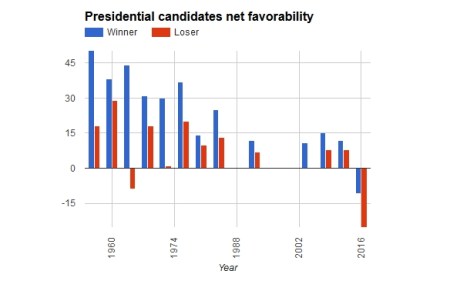
Gallup has been tracking U.S. presidential candidate favorability ratings for 60 years. It turns out that this year’s candidates have the lowest net favorability (i.e., % favorable minus % unfavorable) ratings observed over those six decades, with, for the first time, both candidates having negative net ratings. Even more interesting, there is a steady trend of decline in favorability over the years.
Filed under: Elections, History, Opinion polling | 2 Comments »

Political scientists Christopher Achen and Larry Bartels have a new book, Democracy for Realists: Why Elections Do Not Produce Responsive Government.
I have not read the book. Chapter 1 is available online, and it certainly makes for some interesting reading. Some comments following reading that first chapter:
(1) It seems that despite their critique of electoralism the authors are not ready to abandon it. At some point they seem to indicate that they cannot imagine something better when they opine that “[n]o existing government comes close to meeting all of Dahl’s criteria [for democracy]; in our view, no possible government could.” The book’s objective seems purely analytical: to produce “a democratic theory worthy of serious social influence [which] must engage with the findings of modern social science.”
(2) The book appears to adopt the conventional electoralist terminology which makes no clear distinction between electoralism and democracy. The authors should have known better.
(3) “Democracy for realists” seems to largely retrace the elitist democratic theories which rose to prominence in political science in the third quarter of the 20th century. Indeed Joseph Schumpeter and Walter Lippmann – leading propounders of those ideas – make a prominent appearance in the first chapter. Those theories fell out of fashion when, after the civil rights struggles, dominant ideology changed and became incompatible with their conclusions. It may be that the main innovation of the book is not in “engaging with the findings of modern social science”, but in being willing to (re)acknowledge the (now-)inconvenient truths that were buried over the last 40 years or so. In that, the book seems to be very much a product of current politics.
Excerpt:
In the conventional view, democracy begins with the voters. Ordinary people have preferences about what their government should do. They choose leaders who will do those things, or they enact their preferences directly in referendums. In either case, what the majority wants becomes government policy — a highly attractive prospect in light of most human experience with governments. Democracy makes the people the rulers, and legitimacy derives from their consent. In Abraham Lincoln’s stirring words from the Gettysburg Address, democratic government is “of the people, by the people, and for the people.” That way of thinking about democracy has passed into everyday wisdom, not just in the United States but in a great many other countries around the globe. It constitutes a kind of “folk theory” of democracy, a set of accessible, appealing ideas assuring people that they live under an ethically defensible form of government that has their interests at heart.
Continue reading
Filed under: Academia, Books, Elections, Opinion polling, Participation, Theory | 4 Comments »
The unexpected Conservative majority in the 2015 UK general election has led to considerable agonising in the polling industry. Why were the polls — which consistently predicted a hung parliament, or even a Labour victory — so wrong? A polling industry enquiry has come to some interim conclusions, here paraphrased by the BBC political editor, Laura Kuennsberg:
Pollsters didn’t ask enough of the right people how they planned to vote. Proportionately they asked too many likely Labour voters, and not enough likely Conservatives.
Nobody is suggesting that this bias was intentional — it was the accidental by-product of the polling methodology which, rather than drawing a random sample and then knocking on doors (the gold standard, but very expensive), relied heavily on telephone and online surveys. The problem with phone surveys, according to Martin Boon from ICM, is that out of 30,000 random numbers only around generally 2,000 agree to participate. This sample is anything but representative:
Adam Drummond, from Opinium, suggested that the people who agreed to be interviewed were so politically enthusiastic that the would even vote in elections for the European Parliament. . . This seems like a Groucho Marx problem — people answering the phone and agreeing to answer questions about their political opinions automatically means that they are too politically engaged to be representative.
Online polling is even worse:
Online polls are answered by a database of volunteers who have signed up to be on a panel and who the company knows a lot about. When the company is commissioned to do a poll it can be sure that the people it is asking have the same features as the whole population in — for example, the proportion of men and women, or the age profile or income distribution.
However what stratified sampling does not do is to control for the level of political engagement, so
The online polls came out with much the same inaccuracies as the phone ones. Does people’s willingness to be on a panel automatically make them unrepresentative?
Filed under: Elections, Opinion polling | 62 Comments »
Forbes reports:
On Friday, Congress repealed the country-of-origin-labeling rule (COOL) on beef and pork after the World Trade Organization (WTO) imposed $1 billion in retaliatory import tariffs against United States if the rule was not overturned.
90% of those surveyed in 2013 favored country-of-origin-labeling for fresh meat sold in stores.
Dr. Ron Prestage, president of the National Pork Producer’s Council, released a statement expressing gratitude to Congress for repealing COOL. “I know tariffs on U.S. pork would have been devastating to me and other pork producers,” he said.
Filed under: Elections, Opinion polling, Press | 41 Comments »
An English version of an op-ed piece I wrote recently. I am still looking for an Israeli mass media venue that would publish it.
Another round in the long struggle over the way Israel’s gas fields are to be exploited is upon us. Like most of Israel’s citizens, my understanding of the technical and economic details associated with this matter is sketchy. It is clear to me that a very lucrative resource is involved and that there are various proposals about how to deal with it – proposals which will see the value of this resource divided in different ways among different groups. Beyond that things are rather murky as far as I know. It seems that politically powerful people are exerting political pressure to obtain parts of the value of the gas wealth and that at least some of these people have personal, business or political connections to government officials. Like a large majority in the Israeli public I suspect that the balance of powers in the government serves primarily narrow interests (“the tycoons”) rather than serving the general public. Having said that, I have not followed the details and I cannot confidently say who is associated with whom and whose interests are served by each proposal.
Continue reading
Filed under: Opinion polling, Proposals, Sortition | Tagged: citizens' jury, Gas | Leave a comment »

Filed under: Elections, Opinion polling | 1 Comment »
Keane Bhatt writes for FAIR:
According to [CNN TV anchor Wolf] Blitzer, policy proposals such as paid sick leave and maternity leave, an increased minimum wage and free community college are all liabilities to pragmatic Democrats concerned with winning elections–which explains Obama’s reticence prior to November’s midterm elections. However, public opinion polls show widespread support for those measures, including, in many cases, from Republican voters.
A CNN poll (6/9/14) found 71 percent of the public supporting an increase in the minimum wage, including a majority of Republicans and conservatives. In November, voters in the Republican-leaning states of Arkansas, Nebraska, South Dakota and Alaska passed ballot initiatives to increase the minimum wage by large margins (Huffington Post, 11/4/14).
Continue reading
Filed under: Elections, Opinion polling, Press | 5 Comments »
Tomas Mancebo highlighted the proposals for using sortition that were part of the constitutional process at Podemos – a party which emerged this year as a highly popular alternative to the established parties in Spain.
Adam Cronkright wrote about his work with Democracy In Practice in Bolivia applying sortition to student governments.
Together with Tomas, I find the fact that sortition was relatively prominently proposed and discussed (although ultimately rejected) as part of the power structure within Podemos as the most significant sortition-related event of 2014.
Other 2014 sortition-related events of significance were:
Happy new year and best wishes to all!
Filed under: Academia, Elections, Opinion polling, Press, Sortition | 21 Comments »
A new Spanish political party called “Podemos” (“we can”) has seen meteoric growth in public support according to opinion polls. According to some polls, it has now surpassed in popularity the two major Spanish parties.
Its founding manifesto (a somewhat awkward translation here) presents Podemos as an outgrowth of the 2011 “Indignados” protests and the unrepresentative nature of the existing system:
Turning outrage into political change
Just as with other moments in history, we see today a European continent submerged in perplexity. Whilst the majorities look back with nostalgia on the past that is lost, certain powerful minorities, with no criterion other than their own survival, show that enrichment is their flag and impunity their horizon. Never in Europe have there been so many people discontented with their loss of rights, and, at the same time, so few prospects for channeling this outrage through a voting option that excites while at the same time, shows the capacity to represent the majorities under attack and a capacity for committed and efficient administration that makes the best possible options become real. Many find it intolerable that in the greatest crisis in the system since the crash of 1929, those forces that claim to be progressive are at their weakest point, thereby condemning the majorities in our countries to a kind of melancholy that leads to resignation and political depression. [Excerpted from the translation linked above with my touch ups.]
Filed under: Academia, Applications, Ballot measures, Elections, Opinion polling, Participation, Press, Proposals, Sortition | Tagged: Pablo Iglesias | 6 Comments »
 Adam Cronkright
 Ali
Ali Ahmed R. Teleb
 avanderven
 avergne
 Alex Kovner
 azakaras
 Brett Hennig
 campbellwallace
 Simon Threlkeld
 Nick Coccoma
 codyhipskind
 Common Lot Sortitionist
 Conall Boyle
 constitutionalism
 davidschecter
 graytmatter
 gtridimas
 H.J. Hofkirchner
 Hanspeter Rosenlechner
 John Burnheim
 jgarry20151
 Jochen Krattenmacher
 johnedwardtaylor
 johnhuang865
 Jonathan Crock
 keithsutherland
 Jacob Richter
 kkoreilly
 lukewhito
 SimonPek
 Nathan El
 Nicholas Gruen
 Owen Shaffer
 Patrick Chalmers
 Paul Gölz
 peterstone
 Pierre-Etienne Vandamme
 pronfeld
 Emil
Emil rcaze
rcaze richwbrown
 Roger Knights
 roslynfuller
 Pierre-Etienne Vandamme
 shaharavin
 tbouricius
 Ted Wachtel
 Joshua Laferriere
 theodorestathis
 towardsautonomyblog
 Wayne Liebman
 Yoram Gat
 Oliver Milne
 Equality by lot