Jurriaan Kamp: Juries can save America’s eroding democracy

Jurriaan Kamp writes in the Huffington Post:

America proudly sees herself as the leader of the democratic world. Democracy is on the rise around the globe. Forty years ago, think tank Freedom House published its first annual report ranking the world based on democratic freedoms. A mere 40 countries had free elections. Back then, Spain and Portugal were military dictatorships. Today, Freedom House counts 87 nations as “free countries,” a doubling in less than four decades. An additional 60 countries are “partly free,” leaving 48 countries still labeled “not free.”

Good news. However over the same forty years America’s own democracy has been eroded. First politics became a terrible money game with candidates having to spend ridiculous amounts of money to get elected based on sound bite simplifications of all important issues. And ultimately that money game has ended in a stalemate on Capitol Hill where two parties now only agree on one strict rule: If they want “yes” we will certainly and clearly say “no” — no matter the arguments.

Somewhere at the core of the idea of democracy is the notion that the people — or their representatives — get together for a dialogue out of which insight and vision may emerge. Continue reading

A short sortition debate

A short online discussion of sortition yields familiar arguments:

[S]ortition is a form of government based upon the drawing of officials by lottery. It was used in Ancient Greece and is rarely used now. To me, it seems a lot less corruptible than a regular democracy, it seems to me that it represents the people better, by literally selecting by random, rather than certain people picking certain people because he looks cool or “my dad met him”.

If you do it with a large enough pool of people it should represent the larger public well. It works with polling science I dont see why it wouldnt work there.

Most people are incompetent at their chosen profession. Why should we assume that if they are selected randomly they will behave anymore rationally than they do in other areas of their life?

Continue reading

British public wrong about nearly everything, survey shows

This is the clever headline of an article in The Independent about a survey by the Royal Statistical Society and King’s College London measuring public perceptions of various public policy related facts:

A new [2013] survey by Ipsos MORI for the Royal Statistical Society and King’s College London highlights how wrong the British public can be on the make-up of the population and the scale of key social policy issues. The top ten misperceptions are:

1. Teenage pregnancy: on average, we think teenage pregnancy is 25 times higher than official estimates: we think that 15 per cent of girls under 16 get pregnant each year, when official figures suggest it is around 0.6 per cent.

2. Crime: 58 per cent do not believe that crime is falling, when the Crime Survey for England and Wales shows that incidents of crime were 19 per cent lower in 2012 than in 2006-7 and 53 per cent lower than in 1995. 51 per cent think violent crime is rising, when it has fallen from almost 2.5 million incidents in 2006-7 to under 2 million in 2012.

3. Job-seekers allowance: 29 per cent of people think we spend more on JSA than pensions, when in fact we spend 15 times more on pensions (£4.9bn vs £74.2bn).
Continue reading

No government responsiveness on economic inequality and minimum wage

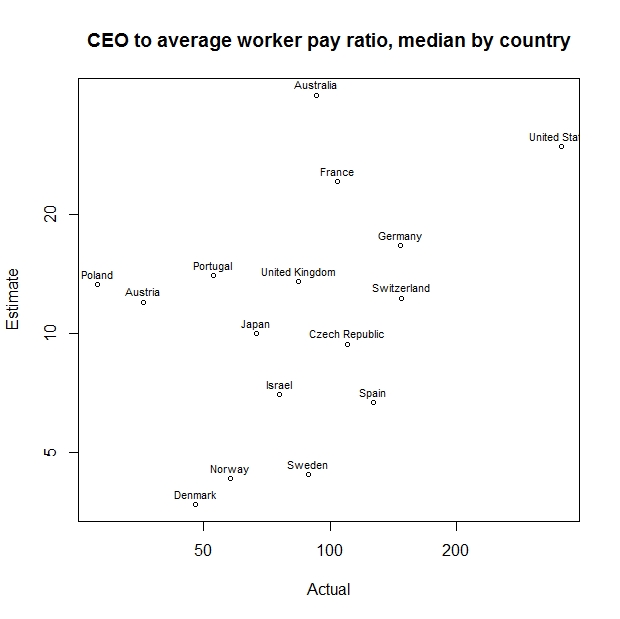
A recent international study of inequality by Michael Norton and Sorapop Kiatpongsan was already mentioned here for its findings about how uninformed the public was about matters of public policy. The study collected the opinion of people about what the CEO-to-average-worker pay ratio should be, and their best guess of what it actually was. A summary of the findings are shown in the table at the bottom.

Interestingly, not only do median estimates of the pay ratio in all countries grossly underestimate the true values, but there is essentially not correlation between the two (R2 = 14%, 3.5% after dropping the U.S. outlier):

estimate-vs-actual
Continue reading

Not so wise: median estimates around the globe underestimate income inequality

A recent study by Michael Norton and Sorapop Kiatpongsan finds that for all countries studied median estimate of income inequality is much lower than reality:

In their study, Norton and Kiatpongsan asked about 55,000 people around the globe, including 1,581 participants in the U.S., how much money they thought corporate CEOs made compared with unskilled factory workers. Then they asked how much more pay they thought CEOs should make. The median American guessed that executives out-earned factory workers roughly 30-to-1 — exponentially lower than the highest actual estimate of 354-to-1. They believed the ideal ratio would be about 7-to-1.

“In sum, respondents underestimate actual pay gaps, and their ideal pay gaps are even further from reality than those underestimates,” the authors write.

Americans didn’t answer the survey much differently from participants in other countries. Australians believed that roughly 8-to-1 would be a good ratio; the French settled on about 7-to-1; and the Germans settled on around 6-to-1. In every country, the CEO pay-gap ratio was far greater than people assumed. And though they didn’t concur on precisely what would be fair, both conservatives and liberals around the world also concurred that the pay gap should be smaller. People agreed across income and education levels, as well as across age groups.

Voters’ demands for lobbying regulation are unmet by elected officials

Voters don’t trust elected officials. One of the ways this phenomenon manifests itself is by popular support for various forms of regulation of the officials’ political activity. The fact that this sentiment doesn’t get reflected in policy – just like public opinion regarding the salaries of elected officials – is a blunt failure of the electoral responsiveness dogma.

Rhetoric being cheaper than policy, some promises to regulate lobbying do get made:

I am in this race to tell the corporate lobbyists that their days of setting the agenda in Washington are over. I have done more than any other candidate in this race to take on lobbyists — and won. They have not funded my campaign, they will not run my White House, and they will not drown out the voices of the American people when I am president. Barack Obama, 2007

This promise was not, of course, translated to policy. But that aside, even as rhetoric this is rather tepid. Hammering lobbyists publicly – one of the only groups of people more widely distrusted than elected officials themselves – should have been an easy way for candidates and incumbents to win votes. But doing so would involve not only offending benefactors who finance the politicians’ campaigns but also offending former and future colleagues who happen to currently be on the other side of the revolving door.

Impact of money raising considerations on campaign rhetoric

The virtue-based justification of electoralism implies an indirect connection between public opinion and policy. According to this justification, the public identifies people it trusts and puts them in office. Those people then determine policy as they see fit. According to this theory, then, the connection between policy and popular opinion is mediated by character judgments.

The rewards-based justification, on the other hand, implies a direct connection: elected officials wish to please the public in order to be re-elected and thus pursue policy that matches public opinion (in the sense that if they pursue policy X, then there exists no alternative policy which would win higher approval ratings).

The rewards-based theory suffers from two fundamental defects:

  1. It ignores the epistemic difficulties facing voters. In reality voters’ ability to determine the effects of government policy is very limited. They are therefore unable to tell whether government policy matches their world view and promotes their interests.
  2. It assumes that politicians lack policy preferences of their own. The theory assumes that politicians want to be elected simply and solely for pleasure of being in office rather than to promote any specific policy.

Those defects indicate why the rewards-based theory cannot be expected to explain policy setting by elected government. However, those defects do not apply to the rewards-based theory in the limited context of campaign rhetoric. Continue reading

Americans don’t like the Congresspeople of their own districts

Approval ratings of U.S. congress have been stuck at single digits or low double digits for years. However, Americans tend to like Congresspeople elected in their own districts and states more than they like Congress as a whole.

A recent Rasmussen poll found that Congresspeople are quite unpopular even in their own districts:

[O]nly 25% of voters think their representative in Congress deserves reelection […]. Forty-one percent (41%) now say that representative does not deserve to be reelected, but 34% are undecided.

(This is still much better than Congress as a whole whose approval ratings are at 8%.)

Other findings from the poll:

70% think most [incumbents] get reelected because election rules are rigged in their favor, not because they do a good job representing their constituents.

[O]nly 14% of voters think most members of Congress care what their constituents think, and only slightly more (21%) believe their congressional representative cares what they think. These numbers, too, have been trending down over the last four-and-a-half years and are now at new lows.

Sixty-nine percent (69%) think most members of Congress don’t care what their constituents think, while 17% are not sure. Fifty-three percent (53%) say their representative doesn’t care what they think, but 26% are undecided.

The Median Voter Rules — OK?

Cabinet reshuffle montage: ministers in Downing Street
David Cameron used his reshuffle to promote a number of women – and to sack Michael Gove

Francis Elliott, Michael Savage and Laura Pitel, The Times, July 16 2014:

Michael Gove was removed as education secretary after David Cameron’s election guru warned about his “toxic” polling. Mr Gove paid the price as the prime minister reshaped his cabinet into an election-fighting unit, more than doubling the number of women in a top team that he claimed “reflects modern Britain”. . . [P]olling showing that more than half of voters thought the education secretary was doing a bad job fatally undermined him. Insiders say that Lynton Crosby, the Tories’ election strategist, led a powerful coalition inside No 10 calling for Mr Gove to be removed.

Michael Gove was the architect of the government’s ‘free schools’ policy, which was intended to encourage state-maintained schools to aspire to the values and achievements of independent (fee-paying) schools. This was certainly not a policy designed to appeal to the ‘rich and powerful’ (who can afford the fees of independent schools) as it increases the competition for places in top universities. The toppling of Gove is, ironically, a victory for the rich and powerful, but it was instituted by the need to pander to the preferences of the median voter. The commitment of the government to free schools was ideological, as opposed to reflecting the interests of the ruling elite, and the overturning of it was in response to the perceived [i.e. short-term] interests of the median voter. The main reason that Gove appeared unpopular with parents in Crosby’s focus groups, was his insistence on rigorous examination standards and the attempt to return to a traditional (ie academically challenging) core curriculum. David Cameron and the vast majority of the cabinet supported Gove’s strategy but he was sacrificed for purely electoral purposes (another factor being the need to reduce the alienation of teachers and other public-sector workers).
Continue reading

Commentary on Gilens and Page, “Average citizens have no political influence”

This is an interesting paper, that brings admiral clarity to the competing theoretical models that address the problem, ‘Who governs? Who really rules?’ (Gilens and Page. 2014, p.3). However I’m skeptical as to whether the authors’ dataset provides unequivocal support for the general equation between ‘electoralism’ and oligarchical rule claimed by Yoram Gat in his open letter to Professor Gilens, for the following reasons:

1. Dataset
It’s surprising that a total of 1,932 cases yielded as many as 1,779 instances demonstrating a clear relationship between public preferences and policy change (p.10). Most legislative outcomes involve messy compromises involving trade-offs between the preferences and interests of the various parties involved. What criteria were employed by Gilens’s ‘small army of research assistants’ in order to decide that these 1,779 instances involved a ‘clear, as opposed to partial or ambiguous, actual presence or absence of policy change’ (ibid.)? Are public preferences really as unambiguous as the authors claim? An influential work by Benjamin Page’s frequent collaborator Robert Shapiro used the examples of Bill Clinton’s (failed) healthcare reforms and Newt Gingrich’s ‘Contract with America’ as examples of elite- and partisan-driven policy initiatives (Jacobs and Shapiro, 2000). However in the former case survey evidence was ambiguous: a Gallup Poll conducted in early August 1991 indicated that 91 percent of the public felt there was a ‘crisis in healthcare’ (Gallup, 1991, p. 4) and a large majority (75% of adults polled) wanted the government to provide healthcare (Times, 1992). But it was not clear what the public wanted done about health care, being torn between the desire for comprehensive provision and the deep-seated American aversion to big government: ‘different polls and even successive questions in the same polls turn up seemingly contradictory responses’ (Kosterlitz, 1991, p. 2806). In any event, Clinton’s healthcare reforms were defeated: ‘the policy outcome turned, in the end, on the response of the relatively few centrist legislators to – exactly – the median national opinion as measured by polls’ (Quirk, 2009, p. 6, my emphasis). Similarly the GoP ‘Contract with America’ was entirely driven by the median-voter strategy:

The issues that garnered very favourable ratings with the public were included in the contract and those that did not were left off. There was little discussion about how these policies fit together, rather the concern was maximizing popularity. (Geer, 1996, pp. 34-5, my emphasis).

Continue reading