Book Review: Democracy: A Life

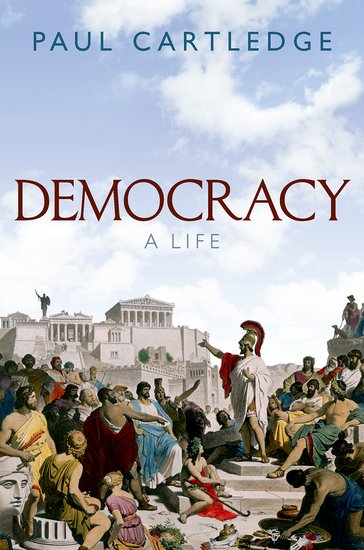
I seem to be reviewing a lot of books lately, including this review of Paul Cartledge’s Democracy: A Life in the Los Angeles Review of Books (cited in a previous post by Peter Stone). While the book covers what will be familiar ground for many here, the author also charts how the idea of ‘people power’ has been treated over the centuries that have elapsed since Athenian democracy. As such, I feel that he (intentionally or unintentionally) made an important contribution to challenging the negative perception that we have of citizen participation by explaining how this view developed over time. Another one to order for the library!

Cartledge goes to some effort to show how later [post-Athens] historians and statesmen were anxious to portray Greek democracy as a horrible mistake, the unworkable aspiration of starry-eyed dreamers that was preprogrammed to end in chaos. Under the onslaught of these propagandists, the vast majority of whom never experienced Athenian democracy — and indeed were often born several hundred years after it ceased to exist — the idea of political equality came to be regarded as a myth, the notion of the collective people holding power a danger to be shunned, suppressed, and preferably forgotten.

The truth was that democracy was a dangerous idea — to the kings, emperors, and high clergy who controlled information in the centuries after it ceased to be a living form of government. As the author puts it, while these autocrats held sway throughout the Middle Ages, the very idea of democracy was “on life-support.” And while things may have improved since, modern democracy is, in Cartledge’s view, not in much better shape — off the machine perhaps, but still staggering around the hospital ward, clutching at bits of furniture, and trying to remember what had happened to bring it there in the first place.

Gutting: Should Everyone Vote?

An op-ed piece in The New York Times by Gary Gutting, a professor of philosophy at the University of Notre Dame:

At election time we inevitably hear earnest pleas for everyone to vote. Voter participation is a data point often cited in political studies, along with an assumption that the higher the percentage, the better: 100 percent participation is the goal. But we rarely question this belief, or objectively consider whether everyone who can vote ought to vote.

The author then outlines the problems of mass democracy, including ‘trumpery’, plutocracy and rational ignorance, and attempts to justify voting as an act of participatory solidarity. But he goes on to consider sortition as an alternative:

At least one political philosopher has put forward the radical idea that we could ensure informed voters by employing an “enfranchisement lottery.” Such a lottery would restrict voting to a randomly chosen group of citizens who are provided unbiased in-depth information relevant to an election. We can think of this approach as a matter of modeling our voting on our jury system. We would never accept deciding important and highly publicized trials by a vote of the general public. We think only people fully informed of the facts and relevant arguments put forward in a trial should make such important judgments. Shouldn’t we be at least as careful in deciding who should be president?

Notice that answering yes does not imply the elitist view that only a small minority of citizens are capable of making informed votes. The idea is not that voters are too stupid or biased to access the needed information; it’s just that they don’t have the time and resources to do so. Ideally, we would provide everyone with the relevant knowledge, but that would be impractical, time-consuming and expensive.

Continue reading

Achen and Bartels: Democracy for Realists: Why Elections Do Not Produce Responsive Government

Via Garreth McDaid.

Political scientists Christopher Achen and Larry Bartels have a new book, Democracy for Realists: Why Elections Do Not Produce Responsive Government.

I have not read the book. Chapter 1 is available online, and it certainly makes for some interesting reading. Some comments following reading that first chapter:

(1) It seems that despite their critique of electoralism the authors are not ready to abandon it. At some point they seem to indicate that they cannot imagine something better when they opine that “[n]o existing government comes close to meeting all of Dahl’s criteria [for democracy]; in our view, no possible government could.” The book’s objective seems purely analytical: to produce “a democratic theory worthy of serious social influence [which] must engage with the findings of modern social science.”

(2) The book appears to adopt the conventional electoralist terminology which makes no clear distinction between electoralism and democracy. The authors should have known better.

(3) “Democracy for realists” seems to largely retrace the elitist democratic theories which rose to prominence in political science in the third quarter of the 20th century. Indeed Joseph Schumpeter and Walter Lippmann – leading propounders of those ideas – make a prominent appearance in the first chapter. Those theories fell out of fashion when, after the civil rights struggles, dominant ideology changed and became incompatible with their conclusions. It may be that the main innovation of the book is not in “engaging with the findings of modern social science”, but in being willing to (re)acknowledge the (now-)inconvenient truths that were buried over the last 40 years or so. In that, the book seems to be very much a product of current politics.

Excerpt:

In the conventional view, democracy begins with the voters. Ordinary people have preferences about what their government should do. They choose leaders who will do those things, or they enact their preferences directly in referendums. In either case, what the majority wants becomes government policy — a highly attractive prospect in light of most human experience with governments. Democracy makes the people the rulers, and legitimacy derives from their consent. In Abraham Lincoln’s stirring words from the Gettysburg Address, democratic government is “of the people, by the people, and for the people.” That way of thinking about democracy has passed into everyday wisdom, not just in the United States but in a great many other countries around the globe. It constitutes a kind of “folk theory” of democracy, a set of accessible, appealing ideas assuring people that they live under an ethically defensible form of government that has their interests at heart.
Continue reading

Paul Cartledge: The case for sortition is persuasive

Just read a short piece by Paul Cartledge in which he talks about the history of sortition, a topic treated more extensively in his book Democracy: A Life (Oxford University Press). He even manages to plug my own book, The Luck of the Draw: The Role of Lotteries in Decision Making (also Oxford University Press) along the way. Check it out:

It is quite easy to compile a checklist, perhaps even a decalogue, of differences between their democracy (or rather democracies, as there was no one identikit ancient model) and ours (ditto). And in no respect did they and we differ more than on the issue of sortition, that is, the application of the lottery to the conduct of politics (another Greek invention, both the word and the thing, with – again – the accent to be placed on difference as well as similarity between theirs and ours). We today take the exercise of voting in either general or local elections to be the very quintessence of what it is to do ‘democracy.’ The ancient Greeks took the exact opposite view: elections were elitist and for the nobs, appropriate more for oligarchy (the rule of the few rich) than for democracy (the rule of the masses, most of whom were poor), whereas sortition, the lot, was the peculiarly democratic way of selecting most office-holders and all juror-judges to serve in the People’s jury-courts.
Continue reading

Aftermath of the Irish Election

I recently ran in the Irish general election that was held on Feb. 26th as an Independent (Non-Party) candidate, campaigning on a platform of direct digital democracy.

As some of you may know, this election did not deliver a clear winner or even a clear coalition. A month on, a government has yet to be formed. While some prefer to see this as an argument in favour of the need for stronger government and an end to Independents like me, my view is that it is but one further indictment of the party system. The major parties did badly because they refused (for years) to listen to the people who voted for them, and utterly failed during their campaigns to credibly address any of the mistakes they had made or even to present reasonable solutions for the future. Despite these failures, rather than getting on with the business of governing the country, we are left in limbo waiting to see whether any of them (Fianna Fail, Fine Gael and Sinn Fein) will condescend to form a government with each other. This is a distinct possibility for Fianna Fail and Fine Gael, who between them received nearly 60% of all seats with less than 50% of first-preference votes. The constantly trumpeted line that the public voted for the establishment parties is thus wildly over-stated, and there has definitely been a serious push towards alternative politics.

I definitely noticed this while out canvassing, with most people at least open to the idea of more participatory politics and a surprising number already fairly well-informed about participatory initiatives at home and abroad. Most surprisingly of all, I could knock on people’s doors out of the blue and they would not only answer the door, but read through my literature there and then and really engage with the issues.
Continue reading

Aspects of decision-making

1. Public affairs and rational ignorance.

The argument: It is rarely rational for anybody to vote or engage in some other political activities because the chance of influencing the outcome is so infinitesimal that it does not merit the slightest effort.

Reply. That is one consideration, but it is not only a false picture of the thinking of most people, but not the only rational consideration. Many, I think most, voters also recognise two other dimensions to their role as voters.

One is that they see voting as an expressive act and feel it is important to them to express themselves in this way. That is why opposition voters still turn out to vote in what is a safe seat for the incumbent party. Moreover, voters are concerned that in expressing their support for a candidate or a party they are ding something that reflects credit on them. So they are concerned to exercise what influence they can on that candidate or party to adopt policies that they find admirable.

Another reason why the selfish approach is not rational is that people quite rightly do not take an entirely selfish attitude to public goods. Their identity as members of a particular community is closely bound up with the quality of the public goods in which they can share as members of the community. So they do have an interest in the quality of the community’s educational institutions, even though they do not expect any particular pay-off to them from those institutions. Moreover, they are usually well aware that the sort of cost-benefit analyses that reduce benefits to measurable benefits to individuals leads to a penny-pinching approach to funding policy decisions that is often destructive and counterproductive in its effects. It is not rational.

That is not to say that it is improper in choosing to support one rather than another of competing proposals about, say, an educational program, to do so because it suits one’s own interests better. Practical decisions are rarely one-dimensional. They involve diverse, often competing, considerations in varying degrees in different contexts.
Continue reading

Demarchy and the ways of the world

1. Demarchy assumes that enough people will engage in the complex of serious activities it is supposed to work on to convince people that the outcome of those activities can claim to represent public opinion.

Looking at the way in which public opinion is in fact formed in our society that seems an absurd assumption.

Even if we go back to Habermas’s beloved 18th century coffee house it is utterly unrealistic. Public opinion emerges from a host of conversations in which what is going on or what is proposed is talked about in terms of familiar images. What is prized in conversation in all sorts of social contexts, from groups of labourers on lunch break to elite dinner parties is wit, the remark that encapsulates a way of looking at a subject in a new light that is at least in some respect plausible.

The cardinal sin in conversation is to insist on spelling out in detail just where that slant on the subject is misrepresented. People are not expected to take casual remarks seriously. That is utterly boring and destructive of conversation. Nevertheless there is overwhelming evidence that people are very strongly influenced by the cumulative effects of the caricatures that prevail in representations of ideas and states of affairs and come to be seen as expressing public opinion.

Even very sophisticated people succumb to this sort of conversation, because they are very aware that political affairs are usually so complicated that there is little chance of arriving at a rationally justified analysis and verdict on them. One just despairs or hopes that the obscure processes of social change will tend towards decisions one can live with. But there is no prospect of getting reliable decisions about political matters by discussion. So Demarchy is nonsense.

Reply: I concede there is a great deal of truth in this picture, but as a generalisation it is too sweeping. At the risk of being boring I shall try to explain why. There are several aspects to it.
Continue reading

The Paradox of Democratic Selection: Is Sortition Better than Voting?

A draft book chapter by Anthoula Malkopoulou:

Sortition, or the selection of political officers by lot, has its antecedent in the direct democratic tradition of ancient Athens. Its transfer into a modern context of representative democracy poses rightful scepticism not only about the practical difficulties, but more so about the theoretical inconsistencies that arise. Modern systems of political representation are based on the aristocratic idea of ‘government by the best’, who are to be selected through a competitive call for candidates (Manin 1997). Sortition, on the other hand, replaces this aristocratic criterion of competition and evaluative election with the democratic mechanics of direct and equal distribution of political office by chance. Hence, the very expression ‘democratic (s)election’ includes a paradoxical contradiction in terms, between the democratic concept of equal access to public office and the aristocratic idea of government by the (s)elected best.

My aim in this chapter is to shed some light into this contradiction by critically discussing the benefits and pitfalls of using sortition today, comparing it throughout the chapter with voting and the general effects of electoral representation. More specifically, my arguments are divided in four sections. I begin by addressing the reasons that drive klerotarians away from electoral representation (1). Next, I consider alternative modes of political ‘outsourcing’, such as the inclusion of civil society actors or the use of quotas (2). I continue by discussing the democratic legitimacy of sortition by dividing the subject in two questions: (a) political equality and (b) political participation (3). Last, I focus on the type of political representation that the lot produces, viewed from the perspectives of descriptiveness, authorization and accountability (4). In conclusion, I suggest that lotteries may offer valuable improvement to current practices of democratic selection, but only if special measures are taken to compensate for the limitations they entail.

Full text (uncorrected draft: not for citation).

Lasserre: Sortition in politics – the false good idea, part 2

This is the second and final part of a translation of an article by Tommy Lasserre. The first part is here. Again, proofreading and corrections of the translation are welcome.

Sortition eliminates popular participation

While fewer and fewer Frenchpeople bother vote, the membership of parties evaporates, the feeling of powerlessness intensifies, the advocates of stochocracy seem to think that the new selection mechanism could revitalize popular participation. After all, since each person could be called upon to assume political responsibilities, or see their spouse, their neighbor, or their colleague be called to assume them, it is natural that they would grow interested in political questions. Likewise, the disappearance of the political caste would restore the enthusiasm which multiple betrayals have drained over the years. However, this argument in favor of sortition seems unconvincing.

First, everyone must know that the chance of finding yourself sitting in the assembly, or even seeing one of your acquaintances sitting in the assembly, remains extremely small. Using the proposal discussed in the introduction and considering the existing electorate, there are 45 million registered voters (that is without considering those who meet the criteria but are not registered, or expected population growth), the sample selected for exercising the sovereignty for the people in the assembly would represent 0.004% of the electorate. This means that each year only one person in 25,000 would be drawn. Of course, this is better than the chance at the lottery, but it must be admitted that the chances of knowing someone who was allotted remain tiny.
Continue reading

Lasserre: Sortition in politics – the false good idea, part 1

André Sauzeau referred me to a polemic against sortition by Tommy Lasserre. This text is the most elaborate argument against sortition ever written (as far as I am aware) and it is therefore of significant interest to sortition advocates. In view of that, and despite my essentially non-existent French I have undertaken to translate it from the original French to English. The first part of the outcome is below. If your French is better than mine I’d be happy with any corrections.

Sortition in politics – the false good idea

By Tommy Lasserre, September 2014

Immersed in scandals, disconnected from the realities of the majority in society, demonstrating every day their total submission to finance and the dogmas of liberalism, and therefore their complete incapacity to pull us out of the crisis, the political caste today is largely discredited, in France as in the rest of Europe. This is expressed well in record low turnouts and in the rise of false alternatives, but equally, fortunately,, reflection, shared by increasingly significant number of citizens, about the ways to change politics. Suggestions for changing the Republic through a constitutional process, proposals for giving citizens greater control over our elected officials, in particular opening the way for recallability, garner, therefore, significant response on the Web.

Among all the ideas that emerged in the blogosphere or on the social networks, one idea, that could appear absurd keeps appearing frequently: putting the reins of power in the hands of an allotted assembly. It is often mentioned in conversations on Facebook, or in argument between bloggers, the controversial intellectual Étienne Chouard has made it his battle cry and the political party Nouvelle Donne (“New Deal”) even made an argument for this idea during the European elections.
Continue reading