New Zealand: Fresh water requires fresh ideas

Nicolas Pirsoul, Policy Analyst and Research Assistant, and Maria Armoudian, Lecturer, Politics & International Relations, both at the University of Auckland, write:

While the primary industry sector undeniably plays a key role in New Zealand’s economy (5-7% of GDP for agriculture), its true contribution might look quite different if environmental impacts – and freshwater quality in particular – were taken into account.

Currently, New Zealand taxpayers shoulder the heavy cost of lax oversight and regulation of freshwater. While the public is aware of the issue of freshwater quality, arguably there is less awareness of the democratic deficit contributing to the problem.

In a liberal representative democracy such as New Zealand’s, political decisions result from elections. The three-yearly electoral cycle, however, tends to encourage symbolic politics geared towards winning votes rather than generating long-term solutions to complex problems like freshwater quality.

In 2017, for example, Labour campaigned on cleaning up our waterways. Its eventual plan, “Essential Freshwater: Healthy Water, Fairly Allocated“, appeared promising but is ambiguous and short on detail or substance. Some of the promised reforms have since been delayed.

Elections won’t help

With no real mechanism for public participation beyond the next general election or non-binding public consultation and submission processes, New Zealanders are left largely powerless.
Continue reading

Rebooting Democracy candidate is running for Cambridge city council

Keith Garrett, co-founder of the Rebooting Democracy party (named after Manuel Arriaga’s book), is running for Cambridge city council. He was interviewed by Alya Zayed.

[Rebooting Democracy] puts forward a system whereby decisions are made by randomly selected members of the public, who discuss and deliberate the issues before coming to a decision, like a jury – a process known as ‘sortition’.

[Garrett] said: “I’ve stood before for the Green Party and nothing has changed. One of the key things in my life is climate change – although it’s not the focus of my party. I did everything I could and it makes no difference because you’re essentially trying to appeal to people in charge who have a set of vested interests. They’re career politicians. They’re interested in keeping their jobs and staying in that party machine.

“But actually, if you directly devolve decisions to a group of people, you give them true power, and it would solve most of our big world ills, like social inequality or climate change.”

He added: “You have deliberation, you talk, and you listen to each other. It’s ‘optimise’ not ‘compromise’. It’s about trying to find the best decision, not just the one that keeps everyone happy.”

If elected as councillor, he plans to use this kind of thinking to change the council’s decision making process.

Continue reading

Not a one-off threat

The Morning Star is a UK newspaper which describes itself as “a reader-owned co-operative and unique as a lone socialist voice in a sea of corporate media”.

In a recent editorial it writes:

Groups like Extinction Rebellion (XR) have raised the profile of the climate emergency, forcing politicians to acknowledge it. [But the] link between environmental action and anti-capitalism is one movements like XR have been reluctant to concede.

This probably stems from a desire to appeal to the broadest possible coalition willing to take action, but it is self-defeating.

Green parties that have reached the mainstream through accommodation with the capitalist system in Germany and Ireland have become pillars of the centrist, liberal and environmentally catastrophic status quo.

One approach to circumventing this promoted by XR especially is the Citizen’s Assembly, a representative body chosen by sortition (as a jury is, rather than by election) that stands outside the political system and would be tasked with decreeing solutions to the environmental crisis.

The suggestion has one key merit, in drawing attention to the inability of our current political structures to meet the biggest global challenge of our time.

But it falls into the trap of viewing climate change as a one-off threat that can be seen off independently of our political and economic system, rather than a process driven by the economic system itself.
Continue reading

Waserman: What the Convention has brought to us is different from what government or Parliament would have produced

Sylvain Waserman is a representative from Bas-Rhin and the vice president of the French National Assembly. He is a member of Macron’s party, LREM. He published the following piece in the French Huffington Post.

The Climate Convention: a democratic innovation or a sign of crisis of the representative system?

The citizen climate convention tests our democratic model. It was born in an atmosphere of general skepticism, or even worse, a certain condescension. We kept hearing that sortition has no democratic legitimacy and that its place is only in the history books under the heading “Ancient Greece”.

Today the situation is quite the opposite: no one doubts anymore the value of the proposals formulated, and the only question is about knowing how those proposals will be implemented and if they are going to be implemented in full.

When the so-called “climate and resilience” bill arrived at the Assembly, numerous deputies expressed irritation and some opined that this signaled another decline in the status of Parliament and a negation of the role of its members.

Following the example of the citizen members of the Convention

Let’s be clear: what the Convention has brought to us is different from what either the government or the Parliament would have produced in a classic legislative process. Surely it is more audacious and truly different. Let’s have the humility to recognize that and the intelligence to see that as a virtue rather than as an affront. The best example is the text for the amendment of the first article of the Constitution. Few among us would have spontaneously proposed the bold formulation adopted by the Convention: “France guarantees the preservation of the environment and of biodiversity, and the struggle against global warming”. The term “guarantee” is vertiginous and could open the door to questions of constitutional priorities, leading to complex issues and giving constitutional judges wide discretion in invalidating laws which would not respect this guarantee. Indeed: Nicolas Hulot, a sincerely committed environmentalist, had proposed constitutional reforms that are judicially less risky and more convenient legalistically, such as “France acts in order to” or “committed to promote”.
Continue reading

Democratic lotteries featured in FastCompany

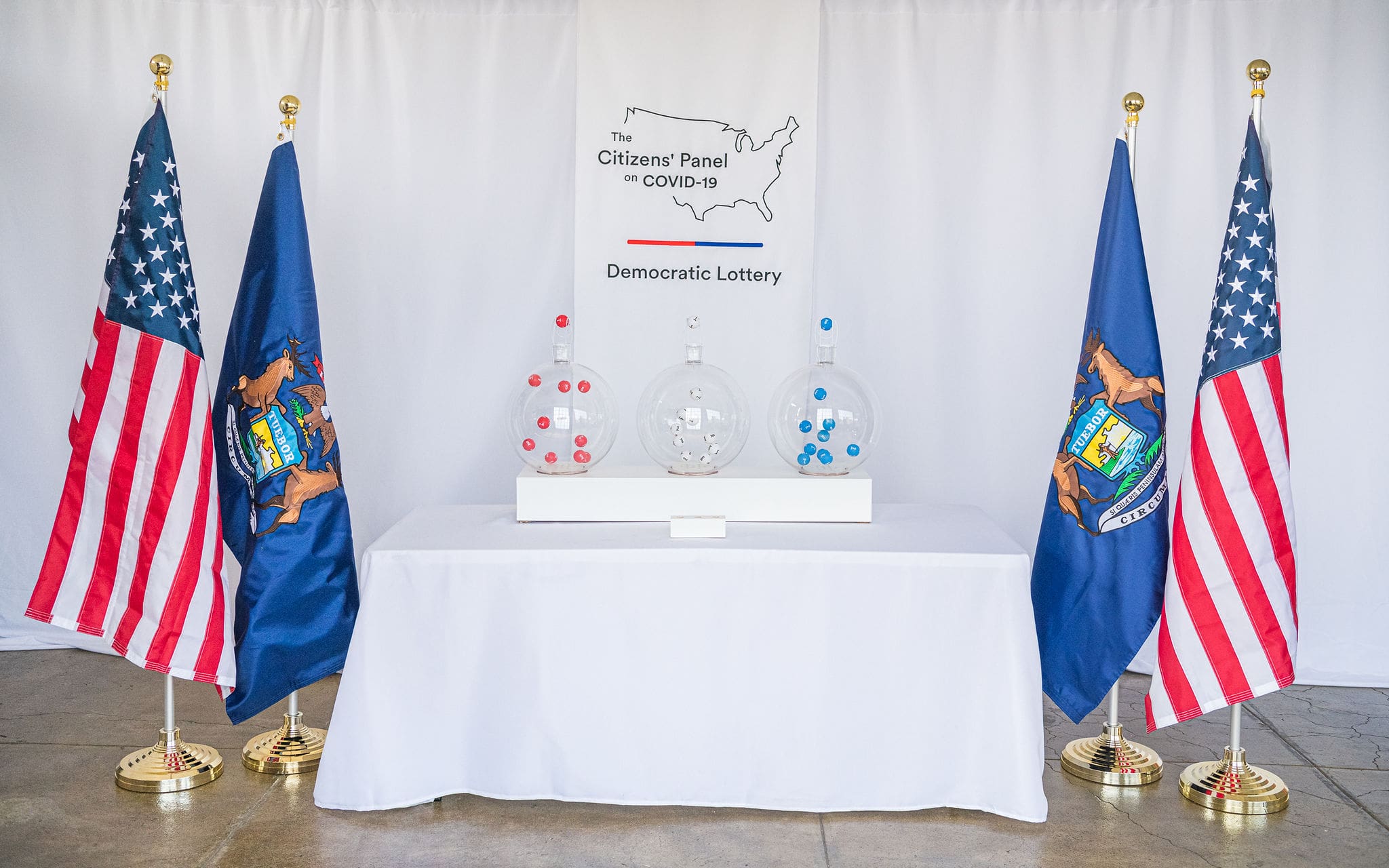
Democratic lotteries and our organization, of by for*, were recently featured in a piece in FastCompany. The article introduces selection of representatives by lottery, the history in Athens, Democracy R&D, and our recent Citizens’ Panel on COVID-19. It will be followed up by a ‘World Changing Ideas’ podcast episode within the next month.

Excerpt below and full article here: What if we replaced elected politicians with randomly selected citizens?

For Cronkright, drawn-out election cycles—filled with stump speeches, attack ads, and super PACs—are dysfunctional. The candidates are often “slick and vicious performers” trained to put on a show and say the right things, who spend most of their time fundraising. “We are awarding power to those who can win, and keep winning, cutthroat popularity contests,” he says. When elected, many politicians are then at the whim of parties, lobbyists, and corporations and don’t have personal incentives to make the right decisions for the average Joe. “To me, they’re the least qualified bunch to represent us,” he adds.

Real representation can only be achieved by putting ordinary people in charge of governing. That means “representatives” should reflect the greater population’s demographics, but also its struggles, fears, hopes, and values. These people would be accountants, waitresses, engineers, business owners, single mothers, and students, who are actually affected by the decisions they make for everyone. “If they sink the ship,” he says, “they, too, are going down.”


Lotteries instead of point-scores on exams: A great quote from Peter Stone

A story in the Irish Times (25th Feb 2021). This is a paywalled link. The full text of the article appears below.

The Leaving Cert is not fair. Why not just replace it with a lottery?
Joe Humphreys
Unthinkable: We can no longer plead ignorance of the inner workings of our State exams

‘I think recognizing the wider role luck plays in society is very important,’ says TCD political scientist Peter Stone.

The Leaving Cert has had an untouchable status in Irish life. It may be a brutal memory test but it is our brutal memory test – a rite of passage nearly as old as the State itself.

In the past 12 months, however, the bonnet has been lifted on this national treasure and we can no longer plead ignorance of its inner workings. The attempt to manufacture a distribution of grades under pandemic conditions equivalent to those produced by the annual exams has spotlighted long-running questions of fairness.

As a test of ability, the Leaving Cert is fair in the narrow sense that a bobsleigh race between Jamaica and Norway is fair. Contestants do not start with the same advantages, and the format – which lends itself to a parallel grinds industry – gives an extra edge to students from better-off families.

However, there’s a second matter of fairness surrounding the appropriateness of using the Leaving Cert to determine who gets what college places. This must be considered against the backdrop of stark figures showing that, on average, a third-level graduate earns much more over her or his lifetime than a worker who doesn’t have a degree – at least €100,000 more, according to one conservative estimate.
Continue reading

Chevallier: The chic populism of participative democracy

A column by Arthur Chevallier in Le Point is yet another condemnation of the allotted committee monitoring the French vaccination campaign. The author sees the creation of the committee as a sign of weakness and hesitation. The government, he asserts, must act resolutely and dispose of attempts to over-communicate.

Chevallier is an editor at Passés composés and the author of the book “Napoléon et le Bonapartisme” published by Que sais-je ?.

The chic populism of participative democracy

Jan. 5, 2021

The allotment of 35 citizens to follow the vaccination campaign was aimed to be the perfect exercise in communication. It turned out to be the opposite.

Democracy is not about weakness. It is not about the promotion of amateurism. The creation of a committee of 35 allotted citizens which is supposed to follow the vaccination against Covid-19 invited mockery. What should have been proof of transparency turned into evidence of failure. If criticising the management of the crisis is less a matter of courage than of cynicism, since the matter is not as easy as it may seems, it is still necessary to denounce the unhealthy attempt to compensate for lack of efficacy by populism. Horizotalization of power is an illusion. Democracy did not gain its prominence by getting amateurs to run complex matters, but rather by its successes.

Without being aware of it, progressivism gives way to a stereotype of recationism. Since the 19th century, an ideology which may be called counter-revolutionary mocks democracy for being “feminie”, attaching to it labels such as the well-known “prostitute”, and hurling insults claiming that it is incapable of creating a powerful and harmonious state. History proves the opposite. Democracy is in fact quite often a radicalization of politics. In antiquity, Athens was at its height of power and imperialism at the 5th century BC, being its age where its democracy attained its most sophisticated form.
Continue reading

Sortition has progressed, it seems, into the ridicule phase

As Mahatma Gandhi didn’t say:

First they ignore you. Then they ridicule you. And then they attack you and want to burn you. And then they build monuments to you.

The fondness of the Macron administration for allotted bodies has prompted the following piece by the satirical site Francheinfo. Marlène Schiappa is Macron’s assistant minister in charge of citizenship.

Marlène Schiappa is going to allot 15 citizens for a free Brazilian hair straightening

Democracy above all else, like in ancient Greece, Marlène Schiappa has chosen to use sortition in order to select 15 citizens of all origins, religions and hair types as winners of Brazilian hair straightening at the Ans Brazil salon.

“Under current conditions, we must allow the French people to enjoy soft and silky hair, such as mine, all for a reasonable price as offered at Ans Brasil. This is first of all a matter of social justice. Whether one lives at Aulnay or at Poissy sur Brie, we must allow French people’s hair to be nourished from its tips to its roots, with a sufficient dose of keratin so that it does not become brittle,” explained the minister for citizenship and for the hair-growing areas of the skin.

A government that resembles us?

A piece by Hervé Gardette in France Culture.

A gay man as the secretary of transportation, a Native American single mother as the secretary of the interior, a Black woman as vice president, a transgender person as assistant secretary of health, a Black general at the Pentagon, a person in her forties as secretary of commerce, and at the lead, a White man nearing 80 at the White House. Thus will look Joe Biden’s cabinet, if confirmed by the American Senate. A diversity in the executive that is supposed to best represent the population of the United States.

This is not the first time that an American government presents such diversity. In 2015 Canadian prime minister Justin Trudeau used similar criteria to select his team, having for example a First Nations member holding the post of minister of justice and a member of the Sikh community being the minister of defense. A message addressed to the Canadians: this government is yours, it understands you because it resembles you.

The idea that political institutions should be representative of the population is not new, and it is not unique to North America (even if communitarianism is more developed there than here). The concern regarding the best representativity of power claims to be a response to the crisis of confidence in democracy: if the voters do not show up at the polls, it is because they don’t see themselves reflected in the people who represent them. So the near absence of workers in political decision-making positions has the consequence of demobilizing the electorate. The same goes for French people who are descended from immigrants and those (sometimes the same ones) who are from “diverse” backgrounds.

We may be in agreement with this idea, or may reject it in the name of universalism, but this is not the issue which I wish to discuss here. The question which I pose is this: what should the French government resemble if it is to be the most representative of the French society? If it is to resemble us? How many should be residents of Auvergnat? How many plumbers? How many should hold a community college degree?
Continue reading

Covid Treatment Lottery

“For patients with similar prognosis, who cannot be separated in other ways, a random allocation, such as a lottery, may be used”, says the protocol.

So says a Report in the Daily Telegraph (UK) of 5th January by Paul Nuki titled “Covid ‘lottery’: Doctors draw up triage protocol in the event treatment has to be rationed” (Telegraph usually paywalled, but this seems open-access)

It refers to a paper in J Medical Ethics “Development of a structured process for fair allocation of critical care resources in the setting of insufficient capacity: a discussion paper” also accessible f.o.c.

This is circulating in NHS hospitals as a proposed protocol.

The protocol – drafted by medical, legal and palliative care specialists at the Royal United Hospital Bath NHS Trust – is the most sophisticated attempt yet to devise an ethical system for rationing care in the event that there are insufficient resources to treat everyone.

Now this is exciting! But it is not new. Right from the start of organ transplantation (1960s) such moralistic contentions were weighed up.

In Seattle the so-called ‘God committee’ was set up to make these difficult choices (reported in Calabresi & Bobbit (1978) Tragic Choices). The committee eventually found that it was too agonising to make these choices, and passed the task back to the medical practitioners. In the end it was felt that only medical  factors should be taken into account. Even if no overt rules on social merit were in place, we should not be surprised if the doctor, genuinely uncertain on medical grounds,  was to pick the ‘nicer’ of the two patients.

A secret lottery?

Elster (1989) in his masterly ‘Solomonic Choices’ gives the example of child custody cases, where the judge is frequently unable (in his own mind) to give a clear-cut decision. Yet decide he must, so he goes ahead, dressing up the verdict with trappings of rationality.

This, claims Elster, satisfies both parties, the winner praising the wisdom of the judge, the loser cursing his bias. No doubt a similar process might go on when a medical doctor decides, even if partly randomly and in secret, between her two patients: So long as both patients believe that their case is decided clinically by an expert, then both winner and loser may find it acceptable.

The doctor herself may even be a bit cognitively dissonant—convincing herself that she is doing the right thing for the right reason, exercising judgement based on intuition  rather than validated knowledge. This form of fudging may be acceptable all round, but it is fraught with dangers.

If fakery is suspected, patients rapidly lose their trust in their professionals. Unwitting discrimination seems inevitable. True expertise will fail to develop unless its limits are acknowledged.

Against a lottery is Greely (1977) who suggests that if recipients can argue about any allocation, they feel more satisfied. Anand was also interested in what is called ‘voice’—that one of the reasons a coin-toss was thought to be unfair is that it deprived customers of a say in the decision.

In favour of a visible act of coin-tossing Calabresi & Bobbit explain that it draws attention to the fact that resources are limited. Edgeworth (1888) suggested another benefit would be that the public, seeing a random drawing take place, would be alerted to the ‘aleatory nature’ of the decision. Bureaucrats might not like having such attention focussed on this shortage of resources and their uncertain knowledge.

[This was part of my 2006 thesis Who Gets The Prize. It can be viewed in full on my website www.conallboyle.com]