Replacing elections with lotteries on The Daily Show

Malcolm Gladwell, who recently had an episode on his podcast devoted to sortition, was interviewed yesterday on The Daily Show and for a few seconds in the beginning of the segment the topic of replacing elections with lotteries was “discussed” (for some definition of this term). It is really a shame that this was not tied to the topics mentioned during the rest of the segment: policing and struggles for democratization of society in the present and in the past.

The Morning Star: An allotted assembly could not address the climate crisis

The British socialist newspaper The Morning Star has published an editorial in which it criticizes XR’s “non-ideological” stance and XR’s demands for an allotted climate assembly. The background for the editorial is a recent tweet by XR:

Just to be clear we are not a socialist movement. We do not trust any single ideology, we trust the people, chosen by sortition (like jury service) to find the best future for us all through a #CitizensAssembly A banner saying ‘socialism or extinction’ does not represent us 🙏🏽🙏 [@XRebellionUK, 4:56 PM · Sep 1, 2020]

This tweet has apparently been issued in response to a photo showing participants in an XR protest carrying the said “socialism or extinction” banner.

The Morning Star editorializes:

The proposal of a citizen’s assembly selected by sortition, frequently made by XR, is linked to its claim to be non-ideological.

But the problem with the assumption that such an assembly could address the climate crisis is the same as that of XR’s whole tweet: it wilfully ignores the central role of the capitalist system in driving climate chaos.

Appeals to parliaments and presidents to “do something” about climate change will fail if they treat such decision-makers as neutral actors rather than instruments of class power.

Will blames everybody

George Will writes in the Washington Post about the troubles democracy is having. It seems everybody is to blame: the people and their unrealistic expectations of self-rule fed by careless descriptions of democracy, the French revolutionaries and their nationalistic “fraternité”, the former captive nations of the former Eastern Bloc that are illiberal, U.S. universities, new media, right-wing and left-wing extremists, protesters and their assertions that the U.S. was founded upon genocide and slavery, the infantile panic of liberal Democrats, elections themselves that produced a floundering elite.

Aristotle told us (or at least told Harvard political philosopher Harvey Mansfield) that elections are aristocratic and aim to produce the rule of the best. That seems hard to believe. Maybe selection by lot should be considered?

Citizens allotted for drawing electoral districts in Michigan

Back in January it was reported that Michigan has sent out invitations to voters to apply to serve on the Independent Citizens Redistricting Commission. 13 citizens have now been selected to serve on the commission “charged with drawing new district lines for members of the state House and Senate”.

The commission is being assembled as a result of a November 2018 ballot proposal, Proposal 2 which passed with support from 61% of voters. Redistricting was previously handled by the Michigan legislature and approved by the governor, which, Proposal 2 supporters pointed out, allowed politicians to set their own district lines.

Despite the rather limited purview of the commission, it has two important characteristics that set it as an independent source of political power and thus lend it importance. First, the body was constituted through a ballot measure. Thus it was legitimated and mandated directly by the citizens. Second, the body’s function is to supervise, and indeed to limit the power of, the elected officials.

Information about the allotment is available on the state government website. Some of the skews in the applications demographics are quite interesting.

A proposal for using sortition in a women’s party in India

An op-ed by Sucheta Dasgupta in the Deccan Chronicle.

The Women’s Party: An opening manifesto
Aug 2, 2020

The case for an all-women party becomes all the more urgent seeing as the women’s reservation bill has been hanging fire for 12 years and at the panchayati raj level, where 33 per cent reservation has been implemented, many of the elected are being seen as stooges of their husbands, or worse, more malevolent forms of patriarchy.

Clearly, whether equity of outcome or equality of opportunity is the goal, reservations are not the final answer.

Say, we form a women’s party. Luck (sortition), and not election experience or ‘winnability’, will be the criterion for handing out tickets within this women’s party (it will perhaps make for grooming of many good leaders and save it from the trap a certain young Delhi-based, and now Delhi-confined, party has fallen into).

Turncoats may avail party membership but will be barred from this draw of lots. The left/right nature of electoral politics excludes perspectives and concerns falling outside particular party agendas — these are deliberately kept out for fear of misperception of ideological dilution on the part of the electorate.

One advantage of sortition over intra-party elections will be that, not being partisan in the old sense of the word, new members will bring to the table many more of these perspectives and concerns.

Malcolm Gladwell on sortition

Malcolm Gladwell is a well-known popular science author. Gladwell has a podcast called “Revisionist History”. A recent episode of the podcast is devoted to sortition, with much of it being about Adam Cronkright’s work in applying sortition to student bodies in schools in Bolivia. Gladwell himself visits a school in the US and finds that the students are receptive to the idea. He also mentions the idea of using a lottery to allocate research funds.

Testart on democracy, democratic debate and citizen power, Part 2/2

This is the second part of a translation of a 2017 interview in Le Comptoir with Jacques Testart, a prominent French biologist, and long-time advocate for citizen power. The first part is here.

Le Comptoir: Citizen juries have so far been employed in a consultative role. Can you explain what those procedures are and within which frameworks they do they work?

Testart: The democratic procedures for citizen juries or assemblies are very vague. The principle is always to ask a group of allotted people to express their opinion on a certain problem. Citizen conferences, which are the most well-formed model, were invented by the Danish parliament in the 1980’s, perhaps because the Danish MPs are less conceited than ours. They noted that they were unqualified to politically manage technological and medical problems.
Continue reading

Shaw: A transfer of power from the elite to the masses

Ethan Shaw advocates sortition in International Policy Digets:

Voter reform in America aims to increase turnout in elections, however, this focus dismisses the glaring weaknesses of the American democratic process. Congressional approval ratings are abysmally low, and you have probably heard the phrase “Congress is not doing their job” countless times. The problem is not about the accessibility to the ballot box; it is the inconsequentiality of voting that keeps people home on election day. So how does one solve the systemic issues with Congress that promotes voter apathy? By going back to the birthplace of democracy.

A Civic Duty to Legislate

The United States should have mandatory legislative service. Ancient Athenian citizens were randomly selected to serve a 1-year term in a legislative assembly. This process is known as sortition and has been purported by democratic reformists across the globe. In the American political discourse, sortition has never been fully discussed as a viable replacement to the current legislative infrastructure. Many individuals scoff at the idea, worried that random selection will create a legislature full of inept buffoons.

Continue reading

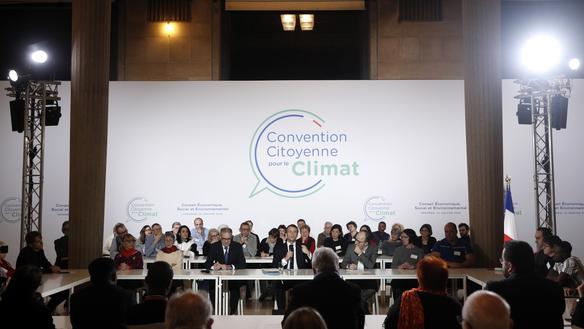
Macron “accepts all but three” of the CCC’s 149 recommendations

RFI reports:

A day after a powerful push by the Greens in French municipal elections, President Emmanuel Macron on Monday vowed to speed up environmental policies – promising an extra €15 billion to fight global warming over the next two years, and throwing his support behind two referendums on major climate policy.

Macron was responding to proposals put forward by the 150-member Citizens Climate Convention (CCC), a lottery of French people chosen to debate and respond to the climate challenges facing society.

During a meeting in the gardens of the Elysée Palace, Macron told convention members that he accepted all but three of their 149 recommendations which would, he promised, be delivered to parliament “unfiltered”.
Continue reading

Feertchak: The Citizen Convention for the Climate does not meet with unanimity

With the Citizen Convention on the Climate publishing its report, Alexis Feertchak writes in the Le Figaro about early reactions.

The Citizen Convention for the Climate does not meet with unanimity
June 20th, 2020

The 150 allotted citizens are voting this weekend for as many environmental proposals. But since its introduction, reactions to this body have been mixed.

“Involve citizens in the governance of transportation at the local level as well as at the national level.” The “technical” tone of this proposal makes it sound more like a recommendation in report of the state bureaucracy than a conclusion of a citizen assembly chosen by lot. It is one of the points that are regularly made on the social networks: if we involve citizens directly in democratic deliberation, we should have been able to get more original results than that one.

Rather than being original, the 150 proposals or so, showing a leftist slant economically, seem quite familiar. Responding to the proposal of reducing the work week to 28 hours (a proposal that was eventually not presented), increasing the minimum wage, taxing dividends, etc., Philippe Bas, senator for [the center-right party] Les Républicains and head of the laws committee, twitted: “The results of the so-called citizen convention are a disappointment: a rehashing of the hymn book of the environmental lobby, (…) economic ignorance, total lack of legitimacy. Sortition exposed as a democratic deception!”
Continue reading