Tim Dunlop: It’s time to replace voting with sortition

In 2014 Tim Dunlop had just been introduced to the idea of sortition by David Van Reybrouck. He was “not completely convinced by his [Van Reybrouck’s] argument, but [was] sufficiently incensed by our current parliamentary democracy and its many failures to at least consider what he suggests.”

Four years later, Dunlop has written a book advocating sortition, and has an article in the Guardian that opens with an unambiguous statement:

If we want to fix the way our governments work, the first thing we should do is replace voting with sortition in at least some of our governing bodies.

Like many feel-good reformists, Dunlop puts much emphasis on the potential for fostering deliberation, trust and respect amongst the members of the allotted chamber and by extension, in the population at large. However, bucking the norm among such reformists (including Van Reybrouck), Dunlop’s message is very clearly democratic in the most fundamental sense (i.e., making power representative) and his rejection of elections and its elitist implications is uncompromising.

If we are really serious about bottom-up reform of our democratic institutions, then reforming the seat of government itself in this way, a way that installs ordinary people at the heart of power, is essential. Our neoliberal economy and the representative form of government that dominates our societies do everything they can to divide us from and pit us against each other. A People’s House transcends these divisions and brings us together. The basic concept of sortition is pretty straight-forward, and introducing it as a replacement for voting in, say, the Australian Senate, while leaving that body’s other powers intact, represents, at least administratively, fairly minimalist change. But on every other level, the potential effect is explosive. In one fell swoop, you diminish the power of the parties and that of many of the lobbyists who exist to influence their decisions. You transform the way in which the media covers politics. You hand control of at least part of the legislative process to a genuinely representative sample of the population as whole, rather than vesting it in a bunch of elites and their representatives. You empower people in a way that the current system could never hope to do, and you reconnect our chief democratic institution with the life in common.

Nothing is going to change until the main source of power in our society, our seat of government, is populated by people who are genuinely representative of the society at large. We have been taught forever that the way to do that is by voting, but that is simply wrong, and the quicker we unlearn it the better, no matter how counterintuitive it might seem at first. If you want a truly representative government of, by and for the people, then you need to choose it not by voting, but by sortition.

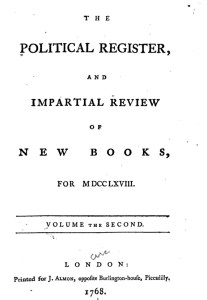
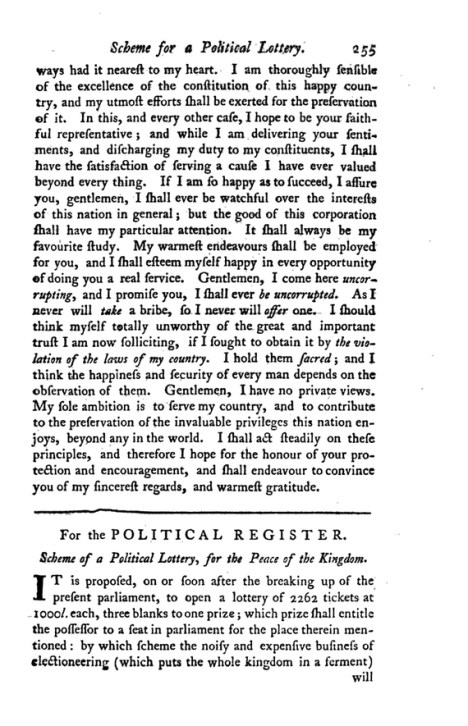
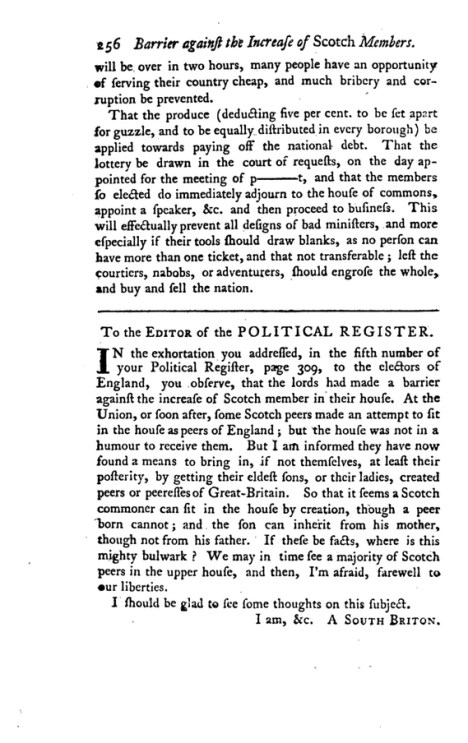
1768: Scheme of a Political Lottery, for the Peace of the Kingdom

The following letter to the Political Register and Impartial Review of New Books, printed in London in 1768, offers sortition of parliament as a way to remedy the corruption of elections. Thanks to Terry Bouricius for drawing attention to this historical piece.

Scheme of a Political Lottery, for the Peace of the Kingdom

It is proposed, on or soon after the breaking up of the present parliament, to open a lottery of 2262 tickets at 1000l. each, three blanks to one prize; which prize shall entitle the possessor to a seat in parliament for the place therein mentioned: by which scheme the noisy and expensive business of electioneering (which puts the whole kingdom in ferment) will be over in two hours, many people have an opportunity of serving their country cheap, and much bribary and corruption be prevented.

The the produce (deducting five per cent. to be set apart for guzzle, and to be equally distributed in every borough) be applied towards paying the national debt. That the lottery be drawn in the court of requests, on the day appointed for the meeting of p——t, and that the members so elected do immediately adjourn to the house of commons, appoint a speaker, &c. and then proceed to business. This will effectually prevent all designs of bad ministers, and more especially if their tools should draw blanks, as no person can have more than one ticket, and that not transferable; lest the courtiers, nabobs, or adventurers, should engrose the whole and buy and sell the nation.

Sortition advocate arrested for allegedly planning to blow himself up on election day

On October 10th, various news outlets have reported that the FBI has arrested Paul Rosenfeld in NY, USA for allegedly planning to blow himself up with the goal of drawing public attention to the idea of sortition. The New York Daily News writes:

Rockland County man arrested for building 200-pound bomb, plotting to detonate it in DC on election day

A Rockland County man who cops say built a 200-pound bomb he was planning to explode in Washington, D.C., in an Election Day suicide attack was arrested Wednesday.

Paul Rosenfeld, 56, of Tappan, was busted on federal charges of manufacturing an explosive device.

“As alleged, Paul M. Rosenfeld concocted a twisted plan to draw attention to his political ideology by killing himself on the National Mall in Washington, D.C. — risking harm to many others in the process,” U.S. Attorney Geoffrey S. Berman said.

“Rosenfeld’s alleged plan for an Election Day detonation cut against our democratic principles.”

NBC News write:

New York man wanted to blow himself up on the National Mall on Election Day

Paul Rosenfeld was arrested on charges that he built a bomb and planned to kill himself with it to draw attention to beliefs in ancient election system.

The FBI has arrested an upstate New York man accused of building a bomb that he intended to use to blow himself up on the National Mall in Washington, D.C. on Election Day, authorities said Wednesday.

Court documents say Paul Rosenfeld, 56, of Tappan, wanted to draw attention to his belief in “sortition,” the ancient practice of randomly selecting legislators out of a pool of eligible voters.

The press release by the U.S. Department of Justice is here.

In 2015 Paul Rosenfeld has published an essay on Equality by Lot titled “The Extinction of Politics“. The article has been linked to by some of the reports of the arrest.

Hugo Bonin: Democracy by lottery

The newspaper Le Journal de Montréal has an article by Jacques Lanctôt about Hugo Bonin’s book, La Democratie Hasardeuse [Original in French, my translation].

Games of chance in politics

“With luck, things will turn out well.” Who has not heard this saying at some point? A chance encounter, a decision taken offhandedly, a delay that turned out for the best, any of those may change our life.

Hugo Bonin believes that luck may be beneficial in politics as well even if it is not a magical solution to all our problems of representation. In a well structured essay, well supported by numerous concrete examples stretching as far back as antiquity (Athens and Rome) and where a future that is almost within our reach is imagined, Bonin aims to show that sortition is a hundred-fold better than the so-called representative elections.

Sortition has its limits but its great merit is that it takes no account of distinctions between races, genders, ages or social classes. John and Jane Doe are worth just as much as the elitist clique of doctors, lawyers and businessmen who have been governing us for too long a time.

More “egalitarian”
In an electoral regime such as the one know here and elsewhere in the West, the voters vote to elect the supposedly better candidate. While in an allotment system, the notion of “better” does not exist because everybody are equally politically qualified. Thus, this is “an egalitarian and a democratic procedure” where all external considerations are excluded.

Random selection is already practiced here in Québec and elsewhere. We need only consider jury selection in a criminal trial. Made of lay people rather than experts, following the British law, this jury is called upon to analyze the evidence and render a decision after deliberation.
Continue reading

Wafawarova on sortition

Reason Wafawarova, columnist in The Herald of Zimbabwe, concludes a column in which he decries the disfunction of the the electoral system in Zimbabwe with the following:

Imagine having to develop a system today that would express the will of the people. Would it really be a good idea to have them all queue up at polling stations every five years with a bit of card in their hands and go into a dark booth to put a mark next to names on a list, names of people about whom restless reporting had been going on for months in a commercial environment that profits from restlessness?

We care deeply about our community, and we as people want to be heard. Maybe we can return to the central principle of Athenian democracy; drafting by lot, or sortition. In that era the majority of public functions were assigned by lot.

Renaissance states such as Venice and Florence worked on the same basis and experienced centuries of political stability. With sortition, you do not ask everyone to vote on an issue few people really understand, but you draft a random sample of the population and make sure they come to grips with the subject matter in order to take a sensible decision.

A cross-section of society that is informed can act more coherently than an entire society that is uninformed.

This perhaps brought about the idea of representative democracy or parliamentary democracy, but do our parliamentarians always act in our best interest?

“When I was allotted, I was honored to participate in the process. But I was very quickly disillusioned.”

These are excerpts from an interview with an allotted member of the electoral committee of La France insoumise which appeared in Liberation in July [original in French, my translation].

The list of La France Insoumise for the European elections: “Everything was fixed by the directorate to favor little deals between friends”

By Maïté Darnault, reporter in Lyon

An activist in Jean-Luc Mélenchon’s movement, who participated in the debates of the electoral committee for appointing the candidates for the upcoming European elections, says she witnessed “scandalous” appointment methods and calls on activists to reject the list presented this Wednesday.

Lilian Guefli, an activist in La France insoumise (LFI), a member of the electoral committee which has just presented the movement’s list for the European elections, denounces “unhealthy procedures”, an atmosphere “of suspicion” within the committee, and says that Manuel Bompard (national secretary of the Left Party and campaign director for Jean-Luc Mélenchon) and his associates dominate the eligible positions.

You were on the electoral committee of LFI. What was your role?

I was allotted in April to participate in the electoral committee. For the European elections list we examined more than 600 candidates. 70 names were eventually selected. After a phase of comment by activists – we received more than 800 comments – we proceeded to the decide on the ordering. This ranking is the most important part because the European elections use proportional representation, and the ranking therefore determines who may realistically be elected.

What is it that you protest?

A deliberate, orchestrated manipulation. When I was allotted, I was honored to participate in the process. But I was very quickly disillusioned when I saw that in fact everything was already fixed by the directorate to favor little deals between friends and cliques which have already divided up the top positions on the list in advance. A list of names of members of the Left Party that are to be promoted was given to us by a member of the directorate. One candidate was installed in a top position without debate, so that she did not appear on the list of 70. I protest that Manuel Bompard, the “head” of the movement who has no real legitimacy with the base, is a member of the electoral committee and controls it. Being himself a candidate, he is at the same time judge and judged. That poses a real problem of independence for the committee.
Continue reading

Are “citizen” parties for real?

The following op-ed by Yves Patte, sociologist and community organizer, was published in August on the Belgian website La Libre (original in French, my translation).

Are “citizen” parties for real?

A few months before the elections, have you noticed how at some point all the parties seem to be “citizen” parties? In their name (“citizen list”, “citizen party”), as well as in their platforms (“re-empower the citizens”).

Naturally, we are not going to complain. It would be grouchy to be too particular now that the political world is attending to the wish for citizen participation. However, we must remain careful and ask ourselves whether this sudden mass conversion to the faith of citizen participation is sincere. After “greenwashing”, are we witnessing a case of “citizenwashing”? So, how, as citizens, can we assess the sincerity of a list or a party that calls itself a “citizen” list or party? Of course, merely printing “citizen” on its campaign posters is not enough, nor is inserting this word into its platform.

Drawing ideas from citizen movements does not legitimate declaring a party to be a citizen party either. It is not because a party promotes local agriculture, short supply chains, social connections or “zero waste” that it would be “a citizen party”.

What is the citizen?

We know that democracy, since its origins, gave a central place to the “citizen” in managing the city-state. It is he (and today fortunately, her) who had political rights and duties, who participates “in the power to judge and to order” (Aristotle). There is a link between democratic organization (that is to say when power resides with the “demos”) and the citizens being able to take on the functions of the democratic organization.
Continue reading

Myth No. 2: Democracy is about electing representatives

In an article in The Washington Post, James Miller, professor of politics at the New School for Social Research, enumerates 5 myths about democracy. Here is myth #2:

Myth No. 2: Democracy is about electing representatives

In 2004, Stanford political scientist Larry Diamond defined democracy in terms familiar to most Americans. Among other things, it is “a political system for choosing and replacing the government through free and fair elections.” This view is echoed whenever an election rolls around. As one local paper’s editorial board wrote last year, “Democracy depends on citizens voting.” In Australia, voting is compulsory.

But this isn’t the only way to ensure the people’s input. Ancient Athens selected almost all significant officials not by voting but randomly, by drawing lots. This is how we select juries today, for the same reason: It nullifies the advantages of the wealthy and well-known, and it means a political order in which citizens engage in public life on equal terms, ratifying Aristotle’s conclusion that “from one point of view governors and governed are identical.” As Montesquieu wrote, “The suffrage by lot is natural to democracy, as that by choice is to aristocracy.”

Chris Hedges interviews David Van Reybrouck on sortition

Good interview of David Van Reybrouck by Chris Hedges, the Pulitzer Prize winning journalist who writes for Truth Dig and has a show on RT.

Chris Hedges: “Aristotle would I think have defined our democracy as an oligarchy.”

David Van Reybrouck: “For a lobbyist it is much harder to influence public decision-making when the decision-makers are drafted by lot, and do not have an interest in getting re-elected, and do not have an interest in raising campaign money.”

“So far the allotted have had no real power”

A recent article in L’Obs deals with the internal government of the French Left party La France insoumise (France Uprising). La France insoumise has employed sortition to select some of the delegates to its convention. The original in French is here. My translation – corrections welcome.

At La France insoumise, first fractures regarding internal operations

Marseille (AFP) – La France insoumise (LFI), created two years ago around the presidential platform of Jean-Luc Mélenchon, is showing the first fractures regarding its internal operations while its leader has launched a European campaign.

At the beginning of the year, the deputy Clémentine Autain, a member of Ensemble, one of the components of the Left Front, had called for the movement to “consider how to invigorate internal pluralism”. At the time, she was noted for judging as severe the disagreements between the Communist Party and LFI, and wishing for discussions “without mockery or contempt”.

Today she presents things more calmly: “The movement is in flux, it is unfinished, there are necessarily tensions about who makes decisions […]. But we do not want ignore them.” And indeed discontent exists. The group Collectif des Insoumis démocrates (CID) was formed a few months ago and its petition “For democracy within LFI” has collected 600 signatures. Among the questions that it raises is this one: Who decided that the ecology, the pensions and the link between Emmanuel Macron and Europe would be the principal point for the European campaign presented by Mélenchon on Saturday?
Continue reading