Posted on September 11, 2015 by Yoram Gat
Shlomo Papirblat reports from Brussels in the Israeli newspaper “Haaretz”:
A proposal to select the members of the Belgian Senate at random gains surprising support from politicians in Brussels. The chairperson of the socialist party: “Traditional politics is ailing and new ways have to be considered.”
Senior politicians in Brussels are supporting a legislative reform that could revolutionize Belgian democracy: according to the plan members of the Senate – the upper chamber of the nation’s parliament – would be selected in a lottery that would be held once every four years among the citizenry. The chairperson of the socialist party in the Belgian parliament, Laurette Onkelinx, a former vice prime minister, is saying that “traditional politics is ailing and new ways have to be considered.”
In an interview prominently published Wednesday in the highly regarded “Le Soir” Onkelinx explains that “today’s politicians are generally required to get involved in burning social issues but they are behind – they can’t keep up. On the other hand, more and more grassroot and activist-developed social initiatives are involved in generating solutions.” When addressing the question of who can democracy of “professionals” can be combined with present-day requirements, she said that she thinks that “sortition needs to be adopted to bring normal people to the legislature, at least half the members of the house.”
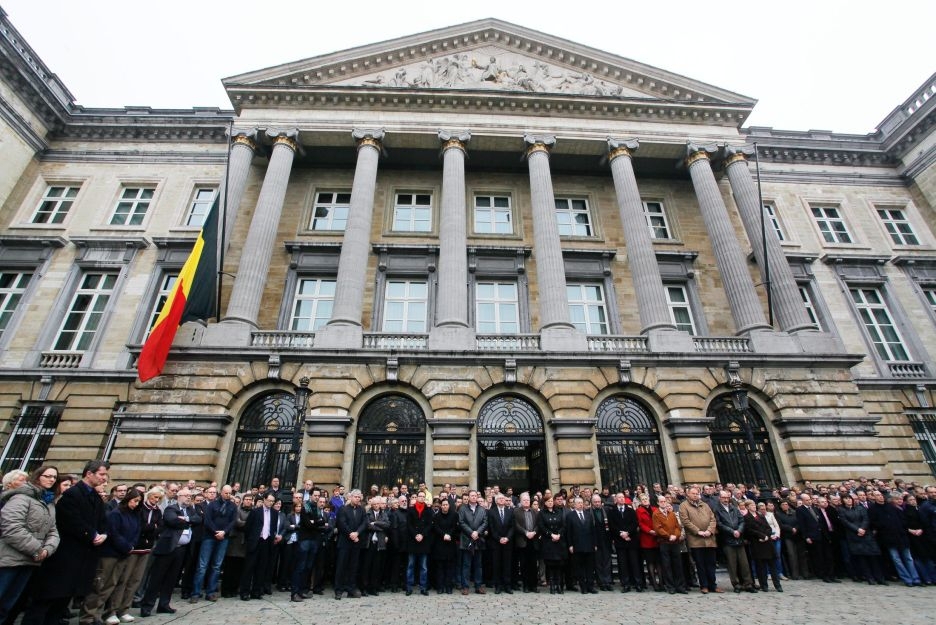
Parliament members standing outside the federal parliament building in Brussels, 2012
Continue reading →
Filed under: Press, Proposals, Sortition | Tagged: Belgium, Laurette Onkelinx, Peter Vanvelthoven, Richard Miller | 4 Comments »
Posted on September 8, 2015 by Yoram Gat
Sortition makes an appearance in the German public discourse. swissinfo.ch has an English translation of a German article which proposes short-term allotted bodies with decision making power whose agenda is externally determined. The article’s author is described as follows:
Timo Rieg, a German journalist and biologist. He developed and tested the “Youth Citizens Jury”, a form of youth parliament in which members are selected through a draw. He is the author of 18 books. His most recent publication, Democracy for Germany, examines a combination of citizens’ parliament, a directly elected government and referendums.
An excerpt from the article:
‘Citizens’ parliament’
One could firmly establish [a] procedure, which could be called the “citizens’ parliament”. Week by week, 200 new members, selected each time by a draw, could meet in the citizen’s parliament. They could listen to experts and lobbyists in a plenary session, have discussions with their jury and small groups, ask questions, suggest changes and entrust the governing authority to make improvements.
The outcome of this process would be a clear recommendation, a law (or its repeal), and the result is, unlike today’s parliament, always representative! Thus the citizen’s parliament is a “mini-populus”, an almost exact miniature replica of the general public.
All schools of thought, all social backgrounds, all occupations, artistic interests and hobbies would be proportionally represented. No one and nothing would be forgotten, and yet it’s both technically and financially a manageable size.
Continue reading →
Filed under: Elections, Participation, Press, Sortition | 2 Comments »
Posted on September 7, 2015 by Yoram Gat
The corrupting effects of “money in politics” – campaign finance and lobbying – are a frequent target for political reform. The underlying idea for this agenda seems to be that elected officials promote particular interests because they expect monetary reward, either as contribution for their re-election campaigns or, through some other channel, to their personal pockets.
Lawrence Lessig, law professor at Harvard, has now announced a presidential campaign that he presents as being based solely on the notion of tackling the corrupting influence of money in politics. Lessig seems to believe that a wide consensus among US voters can be created around this issue and that this issue would be compelling enough for voters to de-prioritize other issues to support this one since – as Lessig presents things – the issue of money in politics is preliminary to all other issues because until it is dealt with the corrupting influence of money makes progress on other issues unfeasible.
Lessig’s presents three items in his reform agenda. Two of those items – changing the way electoral districts are created, and reducing obstacles to voting – are commonplace electoral reform items and seem not to have much to do with money in particular. The third item is about pouring more money into electoral campaign – either by using public-funded matching or by using campaign funds vouchers. Those are presumably supposed to decrease the corrupting influence of money because the additional campaign funds are not a-priori unequally distributed.
Lessig seems to believe that with his activism and with this campaign he is striking at the root of the problem of modern politics. There are several reasons to infer that he is misguided.
Continue reading →
Filed under: Academia, Elections, Press, Proposals | Tagged: campaign finance, Lawrence Lessig | Leave a comment »
Posted on August 1, 2015 by Yoram Gat
From an interview with investigative reporter Lee Fang about the recent retirement of Eric Holder from his job as Attorney General of the US and his resumption of his job at the law firm Covington & Burling:
Lee Fang: One of the perhaps most cynical and and most prevalent ways that you can legally bribe a government official or an elected official is to wait to give them a multi-million dollar check, not while they’re in office, but as soon as they retire. So if a politician helps a bank or an oil company, that oil company can’t directly buy them a boat or give them a million-dollar check. But if they wait until that official retires from office, as soon as they step out the door of Congress and find an employment contract with a lobbying firm or a big bank, then they can accept a multi-million-dollar payday; and so it’s simply delayed bribery, in my perspective.
Continue reading →
Filed under: Elections, Juries, Press, Proposals, Sortition | Tagged: Corruption, Eric Holder, FAIR, Lee Fang, legal corruption, revolving door | 4 Comments »
Posted on July 31, 2015 by Yoram Gat
Nicholas Ross Smith and Zbigniew Dumienski of the Politics and International Relations Department at the University of Auckland write at the New Zealand Herald, New Zealand’s largest circulation newspaper, arguing that using randomly selected juries to make some council-level policy suggestions may be a good starting point for organically growing a more democratic governance system:

A report by Bernard Orsman published in the New Zealand Herald on the state of Auckland City Council found that 88 of the 99 positions in the council’s boardrooms and executive teams were filled by “white men from wealthy suburbs.”
The reported demographic composition of the decision-making bodies in Auckland Council suggests that we are facing a potentially harmful democratic deficit. Yet, before anyone suggests quotas or other bureaucratic mechanisms aimed at diversifying the Council’s management structure, it would be good to consider a very different and far more democratic approach currently tried by our friends across the ditch: citizens’ juries as bodies that could breathe new, more democratic and vibrant spirit into our city’s old structures.
The democratic deficit evident in Auckland City Council is part of a broader trend in democracies worldwide, both at the local and national levels, which are increasingly seen as departing from the core democratic principles that they are supposed to uphold. Meaningful deliberations and political equality are the soul of democracy.
Increasingly, our electoral system is virtually devoid of the former and its outcomes suggest the erosion of the latter. Interestingly, such an outcome would have perhaps been predicted by the founders of democracy in classical Athens who were concerned that elections and campaigning contains in themselves anti-democratic and oligarchic seeds.
Continue reading →
Filed under: Academia, Athens, Elections, Juries, Press, Sortition | Tagged: Australia, City council, Melbourne, New Zealand | 2 Comments »
Posted on July 27, 2015 by Yoram Gat
Damon Linker’s argument against compulsory voting weaves in Plato and the Socratic argument for aristocracy. His reasoning is an interesting modernization of the classical aristocratic mindset. His point about the contestability of excellence is good, and he makes use of it as a justification of electoralism.
A democracy gives every adult citizen a very small say in who rules. An individual doesn’t have to prove that he’s thoughtful or informed to exercise that right. As Plato argued 2,300 years ago, this makes democratic politics exceedingly peculiar. We don’t take a vote to determine the medical treatments that doctors prescribe, and neither do we ask for a show of hands about how to construct a bridge or a building. And yet we think it’s perfectly reasonable to ask for everyone’s opinion about what policies our country should pursue at home and abroad.
That’s because in politics, unlike in medicine and engineering, the act of determining who does and does not possess knowledge and wisdom is exceedingly contentious. (One might say it’s a political act in itself.) So we solve — or rather, we sidestep — the problem by letting everyone have a say.
Continue reading →
Filed under: Athens, Elections, History, Participation, Press, Proposals, Sortition | Tagged: compulsory voting, Damon Linker, Plato | 14 Comments »
Posted on July 19, 2015 by Yoram Gat
The persuasive juror who manages to sway the majority through his passion, eloquence and irresistible logic is part of Western cultural lore. It appears that one commenter on this blog even perceives himself as having played that very role.

The following exchange raises the possibility that the ability of a single juror to sway a whole jury is attributable to much more mundane dynamics – dynamics that are put in place by the unanimity rule. The key paragraph is the last one.
Continue reading →
Filed under: Juries, Press, Sortition | Tagged: Unanimity | 4 Comments »
Posted on June 28, 2015 by Yoram Gat
Nicholas Reece writes in The Age:
Experiment pays off: Melbourne People’s Panel produces quality policy
Citizen juries are one of the most promising innovations to emerge in the conversation about democratic renewal.

Melbourne’s radical experiment in democracy has reached a momentous conclusion, with the City Council announcing on Friday it will accept nearly all the recommendations of a 10-year financial plan developed by a citizens’ jury. That a group of 43 randomly selected Melburnians meeting over six weekends developed sound policy that is now being implemented is a profound result for anyone despairing at the state of our democracy. And it invites the exciting question, what’s next?
It turns out that having a plan “developed” over 6 weekends to guide the expenditure of billions of dollars over 10 years is considered a momentous success of radical democracy. What’s next, indeed.
Filed under: Applications, Elections, Press, Proposals, Sortition | Tagged: Australia, budget, citizens' jury | 44 Comments »
Posted on June 16, 2015 by Common Lot Sortitionist
Claudia Chwalisz writes in The Globe and Mail:
Replace this archaic institution with a citizens’ senate

While calling for unicameralism would be a mistake – it would reduce the government’s legitimacy due to lack of oversight – the more radical proposal of “abolition” leaves the path clearer toward true structural change that moves beyond tinkering at the edges (such as elected senators).
Why not replace the archaic institution with a citizens’ senate – a rotating group of randomly selected citizens that serve as a house of review? The random group could be stratified, to ensure representativeness of sex, age, race, socio-economic status and regional diversity, matching the makeup of Canadian society.
Granted that this is only an op-ed piece, but I have to admit I am rather amazed that the idea of a sortitionally-selected federal legislature is making it so rapidly into the mainstream.
Filed under: Elections, Press, Proposals, Sortition | Tagged: Claudia Chwalisz | 6 Comments »
Posted on June 9, 2015 by Common Lot Sortitionist
Three Irish political scientists, David Farrell, Clodagh Harris and Jane Suiter, write in the Washington Post:

On May 22, Ireland became the first country in the world to introduce marriage equality through a national referendum to change the country’s constitution.
The vote was a world first in one other sense: Never before has a country changed its constitution as a result of deliberation involving a random selection of ordinary citizens. The government’s decision to call the referendum came because of a recommendation from the Irish Constitutional Convention, which had been asked to consider a range of possible constitutional reform questions.
Continue reading →
Filed under: Academia, Applications, Ballot measures, Press, Sortition | Tagged: Irish Constitutional Convention, Marriage equality | 4 Comments »


 Adam Cronkright
 Ali
Ali Ahmed R. Teleb
 avanderven
 avergne
 Alex Kovner
 azakaras
 Brett Hennig
 campbellwallace
 Simon Threlkeld
 Nick Coccoma
 codyhipskind
 Common Lot Sortitionist
 Conall Boyle
 constitutionalism
 davidschecter
 graytmatter
 gtridimas
 H.J. Hofkirchner
 Hanspeter Rosenlechner
 James Kierstead
 John Burnheim
 jgarry20151
 Jochen Krattenmacher
 johnedwardtaylor
 johnhuang865
 Jonathan Crock
 keithsutherland
 Jacob Richter
 kkoreilly
 lukewhito
 SimonPek
 Nathan El
 Nicholas Gruen
 Owen Shaffer
 Patrick Chalmers
 Paul Gölz
 peterstone
 Pierre-Etienne Vandamme
 pronfeld
 Emil
Emil rcaze
rcaze richwbrown
 Roger Knights
 roslynfuller
 Pierre-Etienne Vandamme
 shaharavin
 tbouricius
 Ted Wachtel
 Joshua Laferriere
 theodorestathis
 towardsautonomyblog
 Wayne Liebman
 Yoram Gat
 Oliver Milne
 Equality by lot