Dowding, Bosworth and Giuliani: Sortition, Parties and Political Careerism

A new paper in The Political Quarterly:

Sortition, Parties and Political Careerism

Keith Dowding, William Bosworth and Adriano Giuliani

Abstract: One reason for growing distrust of politicians, parties, and governments is the increase in ‘careerism’: politicians who have never worked outside politics and seem to work inside politics for themselves as much as for the common good. Sortition—choosing representatives by lottery—is one solution. However, random selection of representatives breaks the accountability link provided by elections and leaves amateur politicians at the mercy of their civil servants. It would, critics argue, destroy competitive party politics, the foundation of modern democracy.

We suggest that parties select their candidates through sortition of party members, with successful incumbent MPs standing again. This would mitigate the ills of patronage and adverse selection without losing professionalism and political experience. It would encourage deliberation and the proper persuasive and representation function of parties, alongside the accountability that elections provide. It would also, we suggest, lead to better advice to politicians from policy units within and outside the public service.

Keywords: careerism, democracy, political careers, political parties, professional politicians, sortition

Summer Anwer: The Need for Ireland’s Citizens’ Assemblies in a Post Roe America

A post by Summer Anwer, an undergraduate student at American University.

The intention of Dobbs v. Jackson’s Women Health Organization Supreme Court ruling was to give the authority to regulate abortion back to the people and their elected representatives. To uphold this intention and thus validate the ruling, the people’s voices of each state must be prioritized in decision making. States should adopt a form of Ireland’s citizens’ assembly to navigate abortion laws while putting citizens at the forefront of decision-making like the Supreme Court ruling intended.

Ireland’s 35-year battle for abortion rights

In 1983, the Eighth Amendment was introduced to the Constitution and established a constitutional ban against abortion. Following this strict prohibition of abortion was a 35-year battle for safe abortion access.

Several international human rights organizations called on Ireland to repeal the Eighth Amendment. The UN Committee on Economic, Social, and Cultural Rights was “particularly concerned at the criminalization of abortion, including in the cases of rape and incest and of risk to the health of a pregnant woman; the lack of legal and procedural clarity on what constitutes a real substantive risk to the life, as opposed to the health, of the pregnant woman; and the discriminatory impact on women who cannot afford to obtain an abortion abroad or access to the necessary information.”

The Citizens’ Assembly of Ireland

In 2012, Ireland created an assembly of majority citizens to discuss important topics and influence the Oireachtas, the Irish parliament. 66 citizens were randomly selected from the electorate. They require no prior knowledge, as they are given time and background information. The result is a truly representative opinion of what Ireland’s future should be. The assembly merely makes recommendations, which parliament is not required to accept. The other 33 people are politicians and the 100th person is Tom Arnold, a prominent economist.

In 2017, the citizens’ assembly voted that the Eighth Amendment also known as Article 40.3.3º should be repealed. They were given four ballots to shape the referendum, which gradually became more specific about the parameters of the potential referendum.. In 2018, the Irish government sent out a referendum for Irish citizens to vote on which asked if they wished to approve the 36th Amendment which would repeal the Eighth Amendment. 66.4% voted yes which allowed the government to introduce legislation permitting abortion in the first 12 weeks of gestation and up to 24 weeks in some circumstances. Within one year of being presented with this topic, the citizens’ assembly was able to completely change abortion policies to allow for safer abortion access. This proves that allowing the people to choose their nation’s policies and giving them a larger voice in decision-making is more efficient and leads to a happier, healthier society.
Continue reading

True Representation Sketchbook—Sketches #1 and #2

Free Webinar: Lottocracy Versus House of Citizens: Contradictory or Compatible?

The Building a New Reality Foundation is featuring Brett Hennig and Alex Guerrero on April 1 at noon EDT (UTC-4) to present and discuss their ideas, and to respond to audience questions. An optional half hour small group discussion will follow the one-hour webinar. If the time is not good for you, register anyway because we will send all registrants a link to the recording.

Register Now!

The following written “sketches” about the work of BANR’s webinar guests supplement my True Representation (2020) book and illustrate examples of how True Representation might be used in practice.

Sketch 1: House of Citizens for the UK

I first saw a video of Brett Hennig delivering a brilliant 9-minute TEDx Talk entitled, “What if we replaced politicians with randomly selected people,” in which he talked about “sortition” replacing elections and bringing about the end of politicians.

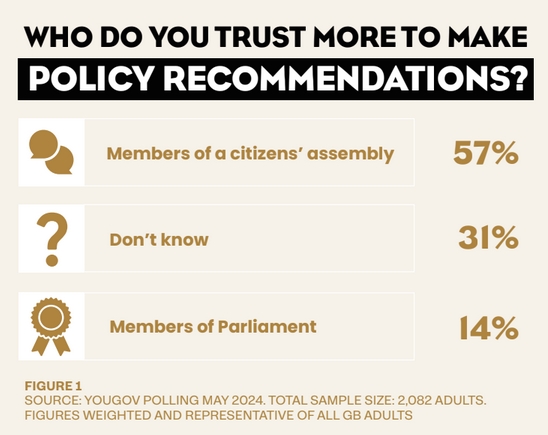
There is a growing global interest in citizens’ assemblies, with members chosen randomly like a jury, who collectively study issues and provide recommendations to government.

Hennig helps organize single-issue citizens’ assemblies as a way of demonstrating the “wisdom of crowds” but his end goal is to replace elected legislators with citizens chosen by lottery, free from party politics.

He is co-director of the UK-based Sortition Foundation that in 2024 launched Project 858 — a campaign and petition drive calling for the replacement of the utterly undemocratic House of Lords with a randomly selected House of Citizens.

The 858.org.uk website explains:

858 years ago King Henry II shook things up by introducing juries. After eight centuries they’ve more than proven their worth as the backbone of the legal system and now it’s time to put ordinary people at the helm in politics too.
Continue reading

Should a Citizens’ Assembly Complement the European Parliament?

A new book with the title “Should a Citizens’ Assembly Complement the European Parliament?” has been published by the European University Institute. The book is made of a 30-page proposal by Kalypso Nicolaidis for setting up a permanent allotted citizen assembly as part of the EU governance structure followed by about 20 short responses from different authors including many who are known names in the sortition milieu.

From a cursory look, the for and against arguments are predictable and well-worn, but someone possessing a strong character and an iron discipline may be able to go through the whole thing and find some new ideas.

Shareholder democracy using investor assemblies

Luigi Zingales (University of Chicago), Oliver Hart (Harvard University), and Helene E. Landemore (Yale University) write on the Harvard Law School Forum on Corporate Governance.

It is interesting to note how in this context the authors are able to enunciate proposals and arguments that are more systematic and thorough than sortition advocates usually manage to achieve in the context of national or local government.

How should asset managers make decisions in today’s world?

Large asset managers, like Blackrock, Vanguard, and State Street, have been quick to recognize the catch-22 they are in: good old value-maximization in the name of a restrictively understood “fiduciary interest” is no longer cutting it. But in turn any explicitly moralized or political use of their concentrated power puts a political target on their backs and subjects them to public opprobrium. Further, while asset manangers can provide expertise on how many dollars will be lost by pursuing an ethical or environment-friendly strategy, they cannot provide any insights, nor do they have any legitimacy, concerning whether the trade-off is worth it, i.e., whether the moral gains exceed the monetary losses, or whether the moral dimension trumps the financial one altogether.

One obvious way out is to offload the moral and political responsibility for value-values tradeoffs to investors themselves. In 2022, BlackRock launched Voting Choice, a program to transfer the right to cast corporate ballots from asset managers back to investors.

Continue reading

Making Sortition Accountable

The typical sortition advocate looks at the theory of electoral accountable and state, well, electoral accountability is so bad it might as well not even be there. But that doesn’t let sortition off the hook. Even if electoral accountability is terrible, that doesn’t mean that lottocratic accountability is good.

Imagine a particularly corrupt society. Random selection rotates the citizens in. These citizens understand what lottery gives them, and they use their power to pay themselves exhorbitant salaries. Or they take bribes from patrons wishing to change legislation.

Even with multi-body sortition, given sufficient coordination between the multiple bodies, all participants could conspire to be corrupt and reward themselves across every panel and assembly.

Of course this is true with elections. Elected officials occasionally conspire to reward themselves across various checked and balanced institutions. If these elected officials are sufficiently discrete, then the voters are none the wiser and cannot apply appropriate electoral feedback.

I imagine a very coarse button that voters could press to hold lottocrats accountable, a sort of nuclear option similar to the practice of banishment.

Every year, voters could have an opportunity to punish a runaway lottocracy.

A referendum shall be held every year and ask, “Should the lottocrats be punished?”

  1. Should the lottocrats serving right now be punished?
  2. Should the lottocrats that served 1 year ago be punished?
  3. Should the lottocrats that served 2 years ago be punished?
  4. Should the lottocrats that served 3 years ago be punished?
  5. Should the lottocrats that served 4 years ago be punished?
Continue reading

Sortition Advocated in the Windsor Star

The Windsor Star just published an editorial by James Winter, a professor emeritus at the University of Windsor, advocating the replacement of federal elections with sortition. The reasons given are diverse, from the cost of elections to the disproportionity resulting from “first-past-the-post” elections to the self-serving nature of politicians. I am unaware of anything previously written by James Winter on this subject, but perhaps others know more.

International Network of Sortition Advocates presents

Common Ground

Using Sortition and Georgism to reclaim the Earth for Everyone, One Plot at a Time


Can we claim the Earth for everyone, one plot at a time, by aligning people’s self-interest with a global, sortition-controlled land trust?


Sunday, December 8, 2024

20:00 – 21:00 Time zone: Europe/Copenhagen

Google Meet joining info Video call link: https://meet.google.com/myk-qegd-avu

Discussion Facilitator: Ian Troesoyer

Ian is an advocate for democratic sortition, land value taxation, corporate ownership reform, and intellectual property reform. He is a lottery-selected board member for Democracy Without Elections, a US-based sortition nonprofit. He is also a member of Common Ground USA, a US-based land reform nonprofit.


www.INSA. site

You are also invited to join our Discord server at  https://discord.gg/6sgnrphp6w

A New Advocate for a Randomly-Selected House of Lords

The Mirror recently ran an article about Baroness Smith of Llanfaes, currently the youngest member of the House of Lords. She is a Plaid Cymru nominee for a peerage who advocates for both Welsh independence and a randomly-selected House of Lords.

Meet the youngest House of Lords member plotting to bring it down from the inside

Next week, the Baroness will speak in favour of radical change at an event in Westminster calling for a House of Citizens – where every person in the country would have the chance to be randomly selected for a stint in the second chamber, as for jury service.

On Randomly Selecting Australia’s Head of State

Just out: an article proposing that Australia select its Head of State through a multi-stage process involving sortition at the beginning and the end. The author doesn’t really seem to endorse the idea; rather, he just offers it as an alternative that’s “a little bit whacky.” Here’s the link:

https://pelicanmagazine.com.au/2024/11/17/could-we-randomly-select-a-citizen-as-our-head-of-state/