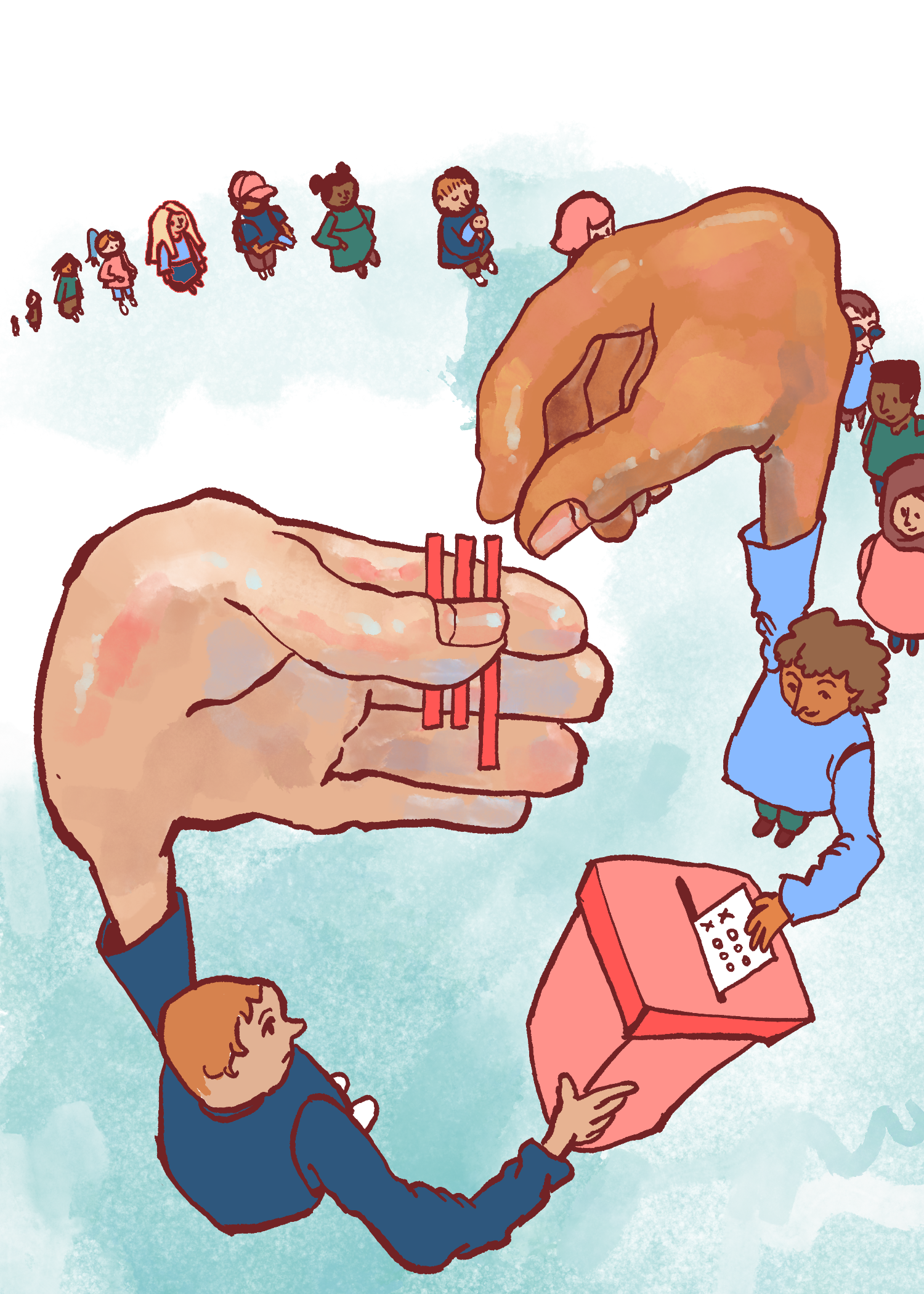
Demiocracy, Chapter 17: Initial adoption & procedural details

Experiments in oversight-only IVEs (i.e., IVEs that don’t elect legislators) of governmental bodies could start small, at the local level, and work upward, to the county, state, and national levels, if justified by prior success.

Then the power of electing a portion of the legislators under their supervision could be phased in, as experience warrants, and as voters approve, and IVEs would become PEs (Proxy Electorates).

Voters might be glad to delegate the election of certain low-level officeholders, like dogcatchers, sewer commissioners, and comptrollers to Proxy Electorates. Voters know little of their qualifications and characters—and don’t want to know. Let George Do It is their unspoken attitude.

New PE members would be given a crash course on their assigned topic, and on the rules and customs of being a Proxy Elector.

PEs would gather, usually online, at regular intervals (more frequently at high levels) to hear their officeholders—and their critics—speak, and to interrogate them. They would not gather only at election time.

In the intervals between these gatherings, Proxies would have a private cyberspace forum and a Zoom site in which they could converse among themselves about what had occurred at those gatherings.

A Secretariat’s personnel would preside at meetings, take minutes, schedule speakers, maintain a library, do background checks on candidates, provide orientation sessions for newcomers, etc.

Training would include inside-look “documentaries” of the deliberations of good-outcome PEs of the past, to serve as models for how to behave. There should also be documentaries about bad-outcome PEs, as object-lessons in what not to do.

The control of important political knowledge by leaders constitutes, of course, a very basic element in perpetuating power politics. —Robert J. Pranger, The Eclipse of Citizenship, 1968, p. 46.

Continue reading

A Brown University student proposes sortition at Brown

Continuing what is a bit of a tradition, Evan Tao, a Brown University student, proposes employing sortition to select student government at Brown.

Over the past decade, many countries have held citizens’ assemblies in which citizens are randomly selected to deliberate and make policy recommendations to legislators. Hundreds of these assemblies have been held around the world with great success. An Irish citizens’ assembly’s proposal to legalize abortion was sent to a national referendum; in France, an assembly submitted recommendations on combating climate change to the incumbent government. Citizens’ assemblies can be effective pilot programs, proving to the public that sortition works. Ideally, they will become regularized and eventually hold direct legislative power in local government.

If I’ve convinced you that lotteries are preferable to elections, and you’re wondering what to do about it, we can start right here at Brown. Our student government election process has room for improvement. I don’t know about you, but I only voted for the people who asked me to or who had cute posters, neither of which seem like a good indication of the best future leader. Voter turnout in the class of 2026 first-year elections was only 33.5 percent. And, as we saw with the recent Undergraduate Finance Board budget surplus fiasco, who our student government representatives are matters. Let’s make it an opt-in lottery at Brown—and then take it to the rest of the country.

Iain Walker: Gaza needs democracy without elections

Iain Walker, executive director of The newDemocracy Foundation, has an opinion piece in The Jerusalem Post. Walker offers Israel and its allies advice about what government they should set up in Gaza (once they tire of killing tens of thousands of its inhabitants).

Gaza needs democracy without elections

Instead of elections, Athenian democracy used a simple random draw among citizens (known as “sortition”).

Prime Minister Benjamin Netanyahu receives regular criticism for failing to share the plan for Gaza after the military role concludes. The lack of an official position on this subject could stem from the fact that all over options are unattractive, and so a new approach is required.

Israel as an occupying force is undesirable, it would draw global criticism and simply push off the problem to a later date.

Equally, traditional electoral democracy is an unworkable option.

With polls reflecting up to 80% support for Hamas among Gaza residents, elections would only allow for some incarnation of Hamas to emerge newly empowered – an untenable situation following its acts of terror targeting civilians.
Continue reading

Kalypso Nicolaidis proposes a permanent EU citizen assembly

CEPS is “a think tank and forum for debate on EU affairs”, founded in Brussels in 1983. CEPS has a project it calls Ideas Lab whose aim is “to provide a high-level intellectual forum for exchanges concerning the wide range of current and pressing issues faced by the EU”. In this forum, Kalypso Nicolaidis, chair of global Affairs at the New Florence School of transnational governance at the European University Institute in Florence, is proposing to set up a permanent allotted EU citizen assembly.

Nicolaidis writes:

Why Citizens’ Panels haven’t quite cut it…

Continue reading

Demiocracy, Chapters 6 & 7: Demiocratic Representation of the Voiceless, by Means of a Novel “Bal-lottery” Technique

There are certain segments of the population (specified in the next chapter) who are often poorly treated, but who can’t complain about it to their higher-ups—or, really, to anyone—because they can’t speak out as a group, lacking representatives.

These groups, by their nature, are not in a position to allow election campaigns. They would either not be feasible, or would be too disruptive.

Nor would it be feasible for representatives to be selected completely by chance, because: 1) They would be treated dismissively, as mere nobodies, by the officials above them; and 2) They would not be as enthusiastic about, or effective at, their duties as certain others in their group—persons who would tend to be selected by a bal-lottery.

These groups should therefore employ the novel (AFAIK), election-free bal-lottery technique described in Item 2 above to select representatives.

I urge sympathizers of such underdogs to promote this means of representation. Equally, I urge “uber-dogs” to heed it, as it is in their interest to be wise in time.

Here’s a simplified example. Let’s say that some group has 1000 members, and that the agreed-upon ballot-to-lot ratio is 50:50. (For voiceless groups the ratio would be 100:0.) INTO the bal-lottery box might therefore go 10 ballots BY each member, nominating other members, and 10 lots FOR each member, automatically.

Continue reading

Clay Shentrup: Election by Jury

Clay Shentrup wrote to announce the Election by Jury website he created.

If you were accused of a crime, who would you want deciding your fate?

  • A panel of randomly selected jurors, all of whom have spent multiple weeks sitting in a courtroom, listening to all the relevant facts and arguments put forward by both sides
  • A popular vote open to hundreds of thousands of people in your county, the vast majority of whom only know a few sound bites about the case, which they heard from a biased and one-sided source

The premise behind “Election by Jury” is simple: we believe that our government, just like the criminal justice system, will function better if our representatives are elected after weeks of deliberation by a panel of randomly selected jurors. These jurors would hear from the candidates and their expert-witnesses, deliberate among themselves, and cast their votes in secret.

Here are a few of the most compelling benefits of our proposal:

  1. An “electorate” that is better informed
  2. Better ways of combating misinformation
  3. Breaking away from echo-chambers

Demiocracy, Chapter 3: What’s the Solution? Why

By narrowing each electorate’s topical and electoral scope, and by simultaneously and necessarily multiplying the number of electorates, we enable every issue and every candidate to be thoroughly and continuously evaluated by everyday citizens. In other words, we replace P-dominated DeMockery with demos-dominated democracy.

In addition, by restricting each legislator’s topical domain, we enable ordinary citizens, who are not typically fluent in multiple political domains (unlike members of the current “political class”), to become viable political candidates, also vastly expanding the role of the demos.

Democracy should be rule by an informed public opinion acting, after deliberation, in the public interest. But, in a mass-electorate DeMockery, the average voter will NOT be adequately informed, and will engage in little deliberation—resulting in misgovernment.

The problem with letting everybody vote too is that people are really easily manipulated and they’re really undereducated. They don’t have any incentive to pay attention to the real issues, what’s at stake and what are the consequences of each vote. They just vote with whatever feels good. And they’re busy, and they’re tired … and they don’t have the time, and they don’t have the incentive to be enlightened. They don’t have the incentive to have an objective, enlightened approach to how you handle the future of our society. —“Joe Rogan’s harsh truth about American voters” —Podcast, viewed November 6, 2023.

Continue reading

Demiocracy, Chapter 2: What’s the Solution? How

My prescription is to “de-mass-ify” democracy by downsizing and dividing the electorate into multiple, issue-specific “Demi” (small) electorates, each responsible for a single electee. At a stroke the power of the Pernicious P’s would be cut by some 80%.

The representatives must be raised to a certain number in order to guard against the cabals of a few; and … must be limited to a certain number in order to guard against the confusion of a multitude. —The Federalist #10.

Such Demi-electorates would continuously oversee and supervise their single officeholder throughout his/her term, not just during an election campaign.

These Proxy Electorates (PEs) would meet for hours every few months, primarily over a private intranet. Each PE would hear a report from its officeholder (who would have a correspondingly limited, issue-specific scope), pose questions, hear criticisms, discuss matters among themselves, and optionally make recommendations, authorize research, and launch investigations. During intervals individual electors could add comments, do research, chat, message, query the webmaster, etc.

In other words, these PEs would not be solely electors—they would be, at the least, actively involved overseers, and at most semi-legislatures, with their electee being only a functionary, depending on their charter and their mood.

Proxy Electors would be chosen as follows. Each member of the “full” (or “base,” or “mass”) electorate would be given 10 (say) “ballots” with which he/she could nominate similar everyday citizens to be his/her Proxies; no more than three ballots could be cast for any one person, including for him/herself.

All nominations would go into a virtual “bal-lottery box,” along, optionally, with some percentage of randomly selected names—say from 20% to 50%. From the box the names of pending Proxy Electors would be drawn and put into a reserve pool.

This technique is a combination, respectively, of selection (by nomination) and sortition (the technical term for random selection in politics).

There would be four (say) tiers, or levels, of Proxy Electorates: Local, County, State, and National. Bal-lotteries would be used to promote Electors from one tier to the next-higher tier, while remaining as much as possible within a similar issue-specialty (or “topical domain”) —e.g., education, law enforcement, transportation, commerce, etc. These successive bal-lotteries would tend to sift out the invincibly ignorant, improving the quality of the remaining Proxy Electors, especially at the upper levels, where noxious numbskulls would be the most damaging.

A dozen or so single-topic legislators would make up a “Demi” (i.e., small), single-topic legislature. Twelve to thirty Demi legislatures would in turn make up a full, Omni-topic legislature, whose approval would be needed before bills passed by its Demi components became law. Its members would be elected by either Demi-legislators, or Proxy Electorates, or some combination of both.

Proxy Electors would in addition freely nominate their favorite fellow electors for promotion to the electorate at the next level up (town, county, state, nation), using the random selection method already described, which I’ve dubbed a “bal-lottery.”

Demiocracy, Chapter 1b: The (Mass-Electoral) System Is the Problem

It’s been famously said that the general will cannot be represented—only a factionalizing “will of all.” And it’s been found, after man tore free, that Rousseau’s warning was correct.

Rousseau’s fears about representative institutions are everywhere confirmed within the politics of power: Leaders, players or actors become isolated from an audience. —Robert J. Pranger, The Eclipse of Citizenship, 1968, p. 27.

However, the general will can be incarnated in the State—“virtually” incarnated—by inserting a small, or “demitasse,” sample from the whole population. “Demiocracy” is the name I’ve adopted for this Demi-incarnated democracy.

It is rational to use a sample when using the whole would be impossible, awkward, or undesirable. We use a sample as juries for those reasons. Likewise, we use samples in focus groups, in surveys of TV viewership, and in opinion polling.

Demiocracy’s behavior will be revolutionary, though probably not (fortunately) as revolutionary as Rousseau hoped.

To make a revolution is a measure which, prima fronte, requires an apology. —Edmund Burke.

Fundamental progress has to do with the reinterpretation of basic ideas. —Alfred North Whitehead.

The state begins by being absolutely a work of the imagination. Imagination is the liberating power possessed by man. —Ortega y Gasset.

All great truths begin as blasphemies. —George Bernard Shaw.

A man with a new idea is a Crank, until the idea succeeds. —Mark Twain.

A really new idea affronts current agreement. —White’s Observation.

Continue reading

Mueller, Tollison and Willett advocating sortition in 1972

“Representative Democracy via Random Selection”, a 1972 paper by Dennis Mueller, Robert Tollison, and Thomas Willett in Public Choice Journal is one of the earliest pieces of sortition advocacy in modern times. The proposal made and discussed is a radical one: selecting the legislature by lot. The fairly short paper covers many crucial issues: eligibility for the allotment pool, compensation, body size, etc.

If we accept that some form of national representation is efficient, the remaining task is to decide on the best practical form of such representation. We would like to propose for consideration the selecting of a national legislature at random from the voting populace. Dahl [After the Revolution, 1970, pp. 249-153] recently suggested a similar procedure, although only to give advisory votes, and the idea has historical origins in Athenian democracy and in the work of Rousseau [The Social Contract, 1762, Book IV, Chapter III]. Such a procedure would be a significant improvement over the existing political system in several ways. The incentive for pork barrel activities in order to secure votes would no longer be present since random selection would be independent of geographic base, and for the same reason minorities would be represented in correct proportion to their numbers in the society. Representation by random selection would also return political power to individual voters and give better artivulation of voter preferences in the legislative process without sacrificing the efficiencies of representation. The legislature would not be composed of median position representatives as under two-party, geographic representation. Voter abstention or uninformed voting would not be problems under this proposal, and perhaps voter alienation would be less in this case also. If viewed as a replacement for the current forms of national representation, the random selection system removes direct sanctioning power through the ballot from the voter and replaces this control mechanism with a more subtle method of articulating voter preferences on national issues. We would argue that although the final outcome is not clearcut, such a change in representative procedure could be understood by voters as the formal embodiment of democratic equality in an ex ante rather than ex post sense. One could also argue that the mass media aspect of political campaigning would be less of a problem under the random selection system, although this is not certain since the outcome depends on how this system of representation is meshed with existing political institutions (e.g., the Presidency). Finally, and importantly, it should be stressed that random selection of representatives avoids all of the traditional problems in voting theory of intransitivities in voting outcomes and the like in establishing a system of proportional representation [See Duncan, The Theory of Committees and Elections, 1958, Chapter 11]. The application of voting theory is confined in this case to the operations of the random legislature once selected, and this feature of representation by lot is an important justification for establishing and operating proportional representation in this way.