Posted on November 27, 2012 by keithsutherland
Take me down to the paradise city
Where the grass is green and the girls are pretty
Oh won’t you please take me home
Guns ‘N Roses
This fascinating book is unique amongst radical theories of democracy in that it’s written by a clinical psychologist with a particular interest in psychopathology – as such his primary emphasis is on the (two-way) relationship between political systems and character. Whereas most books focus on the institutional level, Dr. Robbins constantly reminds us that entities like ‘governments’ and ‘nations’ are merely abstractions, by adding (in parentheses) ‘person or persons in power’ every time he uses the word ‘government’. History is ‘nothing but a vast battlefield after the battle is over – a mountain of the corpses of men, women, and children from around the world and across time who have been slaughtered to satisfy the warriors in their quest for blood and glory’ (p.229). Political leaders are subjected to psychoanalytic scrutiny and are (with the exception of a small number of Athenian statesmen) mostly diagnosed in terms of psychopathy – not just the obvious cases (Hitler, Stalin, Mao, Pol Pot) or even the usual suspects (Alexander of Macedon, Genghis Kahn, Napoleon), but also less extreme examples like George Washington, Alexander Hamilton, Theodore Roosevelt and Winston Churchill. Dr. Robbins explains the development of psychopathy in terms of dysfunctional childrearing and early maternal relationships, so history is, in effect, reduced to the psychiatrist’s couch. Strangely enough (given his idolisation of Athenian democracy) this explanation is derived from Greek literature, forcing him to conclude that the dysfunctional relationship between mother and son is limited to the Greek aristocracy (p.303). Given that such psychopathic individuals – ‘a special subset of men’ – are fundamentally different from ‘us’ (p.309), then the goal of democracy is not so much ‘power to the people’ as making sure that the bad guys don’t get hold of the reins. Rotation of office (and/or mass participation in government) is not so that we may all, as Aristotle put it, ‘rule and be ruled in turn’ but simply to reduce the likelihood of handing power to a psychopath.
Continue reading →
Filed under: Books, Elections, Participation, Proposals, Sortition | 4 Comments »
Posted on November 18, 2012 by Yoram Gat
Politicians making money
As Steven M. Davidoff, a professor at the Michael E. Moritz College of Law at The Ohio State University, reminds his readers, legal bribery is endemic to elections-based systems (admittedly, he probably would not phrase it this way).
Of course, this arrangement in which retired (or on-leave) politicians are awarded large sums of money by private interests is very convenient to both politicians and powerful private interests. This fact makes it unlikely that this phenomenon would be addressed effectively in a system dominated by the interests of those groups, despite the obvious conflicts of interests involved and the despite the equivalence for-all-intents-and-purposes of the activities involved to acts of illegal bribery.
Ideologically, as well, electoralism makes it natural for politicians to claim that their monetary rewards are justified. Just like manufacturers who manage to sell their products to a large number of people and can claim that the popularity of their products is an indication of their high quality, successful politicians can claim that the fact that the were elected is evidence of their high qualifications. It is only fair, then, according to the rules of the free market, that they are rewarded handsomely for providing their skills, once they are not in office, to private employers. Any mechanisms aiming to limit the ability of former politicians to sell their skills would not only be unfair to those politicians but would also be a disincentive for highly skilled individuals to entering politics and using those skills in the public interest. Prof. Davidoff sums up this outlook in the last paragraph of his article:
I can’t begrudge politicians making money after years of relatively low-paid public service.
Filed under: Elections, Juries, Proposals, Sortition | 1 Comment »
Posted on November 14, 2012 by Yoram Gat
Alda is an Icelandic organization promoting reform of Iceland’s government system, including the use of sortition in various ways. A member, Kristinn Már Ársælsson, has an article on the openDemocracy site:
After the crash that destroyed Iceland’s economy, Icelanders started to take an interest in new forms of political and economic governance.
[…]
In some respect, Icelanders have made their voices and interests heard in a way people of other countries have not. The protests after the crash got us a new government, the head of the central bank and the financial inspection agency were axed and a process to make a new constitution with the active involvement of the people was initiated.
[…]
These are important achievements. Things that other countries could learn from. But frankly, most of these developments were also controversial in Iceland and overall, they could have been executed more efficiently. For example: the idea that the general public should be actively involved in creating a new constitution is indubitably right. But this could have been better carried out. The selection process didn’t have the legitimacy it needed and random selection should have been used as well. The time given to the process was too short. There was not enough debate all over the country and in the media. Of course, in comparison with the constitution being rewritten by a small group of politicians in closed session, as usually happens, the new process was great. But it could have been better.
Continue reading →
Filed under: Elections, Proposals, Sortition | 20 Comments »
Posted on November 10, 2012 by Yoram Gat
Vikki Campion writes in news.com.au about the wonders sortition can do for those communities looking for ways to save money:
Consulting the people – radical approach to democracy
THEY sacked sister cities, slashed mowing services and cut spending on glossy council brochures.
A pilot panel of 36 randomly selected mums, dads, students, retirees and pensioners have taken hold of Canada Bay Council’s budget for the next four years, slashing and burning inefficiencies and finding new revenue to address its mounting infrastructure backlog.
The pioneers were guinea pigs in an Australian-first method of community consultation which could be the future for cash-strapped councils which need to cut waste instead of raising rates.
Continue reading →
Filed under: Press, Sortition | Leave a comment »
Posted on November 7, 2012 by Conall Boyle
Experts say that a legislature drawn from the people at random would be more representative, especially of minority communities
Forget campaigns that cost $5.8bn, and which ignore voters outside swing states and seek to reduce their number within them. None of those issues troubled the process by which Egypt’s 10 million Copts chose a new pope. First, over 2,000 clergymen and laymen shortlisted three candidates. Next, a blindfolded boy, himself chosen by lottery, picked out a plastic ball containing one of the three names, the idea being that his right hand doubles as the hand of God. Thus was Pope Tawadros II chosen. Experts say that a legislature drawn from the people at random would be more representative, especially of minority communities. Think it couldn’t happen here? Jury selection shows we are already happy to leave some crucial appointments to chance. And in May, in Runnymede’s Chertsey South and Rowtown ward, the Tory and the independent tied at 503 votes apiece. How was this democratic deadlock broken? By drawing lots, of course.
0.000000
0.000000
Filed under: Elections, Press, Religion, Sortition | 5 Comments »
Posted on November 3, 2012 by Yoram Gat
The primary negative effect of the electoral system is the obverse of its ostensible function. This effect is what Bernard Manin called “the principle of distinction” – the delegation of political power to people whose situation and outlook is significantly different from those of the population at large. As a result of this difference, the political elite serves interests that are different from, and often antithetical to, those of the average voter.
However, the electoral system is often presented by academic advocates and by electoral activists and politicians as providing a value to society above and beyond its function for selecting government officials. It supposedly encourages meaningful popular participation in government through voting, informed discussion, organized activism in electoral campaigns and awareness of the importance of compromise and coalition building. In fact, the electoral system encourages none of those patterns – on the contrary: it is antithetical to them. This is due to several characteristics of the electoral system that do not follow from the principle of distinction.
1. Politics as competition The electoral system is a mechanism in which groups compete for power. Allocation of power through competition has several related effects:
Continue reading →
Filed under: Academia, Elections, Participation, Sortition | Leave a comment »
Posted on October 31, 2012 by keithsutherland
The last Paris sortition meeting was devoted to Bernard Manin’s argument that sortition was replaced by preference election on account of the natural right theory of consent. I challenged Manin on this with an argument based on Fishkin’s claim that the decision process of an allotted assembly modelled on a Deliberative Poll would be a proxy for the informed consent of all citizens. During the report presented to the recent Dublin meeting Peter Stone returned to this point by arguing, with Bentham, that the whole social contract theory of consent was just nonsense on stilts.
Peter recently referred me to Hanna Pitkin’s two-part paper on Obligation and Consent. The paper is hard work, but could be boiled down into just two claims:
Continue reading →
Filed under: Academia, Elections, Sortition, Theory | 51 Comments »
Posted on October 6, 2012 by Yoram Gat
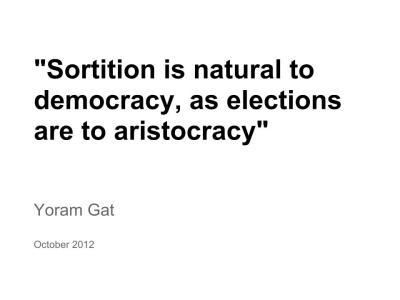
An introductory presentation about sortition for a talk I’ll be giving to a general audience. Comments are welcome.
Filed under: Sortition | 52 Comments »
Posted on September 18, 2012 by Yoram Gat
September 17 was marked as the anniversary of the Occupy Wall Street movement. While the dismissal of the movement as a spent force by its opponents including corporate mass media is only to be expected, it seems that the feeling that this movement has reached the limits of what can be achieved with its past tactics is shared by sympathetic observers.
Matt Taylor at The Daily Beast offers an analysis that is to a large extent an establishment point-of-view, but makes some valid points as well:
As Occupy Wall Street protesters geared up to mark their first anniversary in Manhattan on Monday, they found themselves operating almost alone, without much of the outside support from celebrities, labor unions, and other progressive groups and leaders that had helped to create a palpable sense of momentum last fall.
[…]
But it would appear that, some tepid local union supporters in the city notwithstanding, the broader progressive coalition—including organized labor—is sitting this one [the anniversary] out, having seen the Occupy movement descend into internal squabbling in recent months over how, and whether, to engage the political system directly.
Continue reading →
Filed under: Participation, Press, Sortition | 12 Comments »
Posted on September 6, 2012 by Yoram Gat
An interview with Etienne Chouard in Ragemag magazine (translation by Google Translate, with my touch-ups):
Is sortition the future of democracy?
Sortition is not the future of democracy, it is inseparable from democracy; it is a much stronger link than a chronological phase: there is no democracy without sortition.
Chouard also considers the popular initiative mechanism as a major democratic component (mistakenly, in my opinion):
What is a popular initiative referendum?
PIR (or CIR: Citizen-initiated referenda) is the institution that guarantees the people that it is possible, on the people’s initiative at any time, to regain control of the legislative process and components. It is central. The popular initiative referendum exists in a few countries in the world: in Italy, half of the United States, Venezuela and Austria, for example. In France, in 2008, the parliament, by government orders, revised the constitution to establish what they fraudulently called (I weigh my words) a “popular initiative referendum.” Just read Article 11 to find that this is a referendum on parliamentary initiative. Our so-called “representatives” so openly mock us. We do not have a democracy: we have a plutocracy.
Filed under: Press, Sortition | 126 Comments »


 Adam Cronkright
 Ali
Ali Ahmed R. Teleb
 avanderven
 avergne
 Alex Kovner
 azakaras
 Brett Hennig
 campbellwallace
 Simon Threlkeld
 Nick Coccoma
 codyhipskind
 Common Lot Sortitionist
 Conall Boyle
 constitutionalism
 davidschecter
 graytmatter
 gtridimas
 H.J. Hofkirchner
 Hanspeter Rosenlechner
 John Burnheim
 jgarry20151
 Jochen Krattenmacher
 johnedwardtaylor
 johnhuang865
 Jonathan Crock
 keithsutherland
 Jacob Richter
 kkoreilly
 lukewhito
 SimonPek
 Nathan El
 Nicholas Gruen
 Owen Shaffer
 Patrick Chalmers
 Paul Gölz
 peterstone
 Pierre-Etienne Vandamme
 pronfeld
 Emil
Emil rcaze
rcaze richwbrown
 Roger Knights
 roslynfuller
 Pierre-Etienne Vandamme
 shaharavin
 tbouricius
 Ted Wachtel
 Joshua Laferriere
 theodorestathis
 towardsautonomyblog
 Wayne Liebman
 Yoram Gat
 Oliver Milne
 Equality by lot