Citizens’ Climate Assembly in Westminster City

It is interesting to consider why allotted assemblies for discussing and making recommendations regarding climate policies, and in particular at the municipal level, are such a widespread phenomenon. The City of Westminster in London is about to hold one of those as well.

Westminster Citizens’ Climate Assembly

We are holding the Citizens’ Climate Assembly across June and July 2023 because we are committed to improving the representation of residents’ views in how we tackle the climate emergency.

50 Westminster residents will be selected at random to attend assembly sessions and address the following issue:

How can we overcome the main barriers to Westminster becoming a net zero city by 2040 together? How do we ensure this is delivered in the fairest way?

Members will attend four sessions between June and July 2023 to learn about climate issues, discuss them and make recommendations.

These recommendations will then be reported to the council and will inform an updated version of our Climate Emergency Action Plan.

Westminster informs those interested in participating that this is an invitation-only event:

If you haven’t receive a postal invitation you can’t apply to be an assembly member.

There are lots of other ways to be involved in opportunities across Westminster. Find out more about Our Westminster.

Keep up to date with the Citizens’ Climate Assembly by signing up to the Environment Newsletter and visiting this webpage which will be updated throughout the assembly process.

Bouricius: The Trouble With Elections

In former lives, Terry Bouricius was an elected politician in the US state of Vermont and an electoral reformer. In the present, Terry is a sortition advocate and a regular commenter on this blog. Among other activities, he has published an influential paper offering a multi-body sortition-based government system. In addition, it turns out, Terry has also been writing a book which he is now about to start publishing in installments on democracycreative.substack.com. You can sign up to get notified as new chapters are published.

Conley: Let’s Randomize America!

Nicholas Coccoma wrote to point out a recent article by Dalton Conley, professor of sociology at Princeton University, in The New Yorker. The rather lengthy article revolves around randomness in public policy. It starts with the story of the introduction of the draft lottery in the US, then moves on to a proposal (a rather unconvincing one, it seems to me) for handling economic inequality using randomization, and finishes off with sortition and with a general call for using randomization to achieve a fairer society.

For three decades, through three wars, the U.S. military draft was directed by Lewis B. Hershey, a general in the Army. Hershey established the first local draft board in 1941; eventually, there would be four thousand of them. […] The boards, which adjudicated claims for reclassification or deferment on a case-by-case basis, had a distinct character. They were disproportionately white, white-collar, and elderly. According to analyses conducted in the nineteen-sixties, draft boards more often granted deferments to privileged young men, and poor Americans of color made up a disproportionate share of draftees. […] In 1966, President Lyndon B. Johnson convened a group of experts to study draft reform. They recommended a drastic overhaul to centralize the process, and argued, controversially, for randomizing it. What was needed, they wrote, was a lottery to decide who should fight, in which the “order of call” was “impartially and randomly determined.”

Many people did not find this idea appealing. Detractors argued that haphazardly drafting young men, some of whom were training for critical civilian positions, would be inefficient at best and destructive at worst. Merriam Trytten, a physicist by training, who was the president of the Scientific Manpower Commission—a nonpartisan group set up by the American Association for the Advancement of Science to advise the government on issues of scientific personnel—said that, under such a system, “scientific effort in the United States will pay a substantial penalty.” […] A Gallup poll conducted in 1966 found that only thirty-two per cent of Americans favored a lottery system.
Continue reading

Random citizens’ panel to advise on German food policy

Julia Dahm writes in EURACTIV Germany about the decision by the German parliament to convene an allotted body to “bring the citizens’ perspective into the political debate” about food policy. Even at this early stage (the proposal was only adopted a few days ago), it seems all the expected elements of such a situation – familiar from the going-ons around the French Citizen Climate Convention, for example – are there: a government elected promising to act on a certain set of do-good principles, established powers pushing against any change, conservatives claiming that citizen assemblies are a sign of weakness and a shirking of authority, and the inevitable suspicions and accusation of manipulation by the organizers.

The German parliament has decided to launch a panel of randomly selected citizens set to advise lawmakers on food and nutrition policies, in an effort to help navigate the thorny issue of the state interfering in dietary choices.

The motion to set up a citizens’ panel on diets and nutrition had been tabled by the three government parties – the Social Democrats (SPD), the Greens, and the Liberals (FDP) – and was adopted by the Bundestag on Wednesday evening (10 May).

The first-ever citizens’ council put in place by the German parliament s set to “focus on the radical dietary changes that are already taking place in our day-to-day” and should “bring the citizens’ perspective into the political debate”.
Continue reading

Interview with the Classical Republican

I was interviewed some time ago about sortition for the Classical Republican. It was a wide-ranging conversation that included discussion of this blog. The interview is now on Youtube, and can be viewed here. Note that the Classical Republican has an entire Youtube playlist devoted to sortition which features, in addition to my interview, an extended conversation with longtime sortition advocate Oliver Dowlen and other interesting videos. The playlist can be found here.
DiEM25 creates a deliberative democracy collective

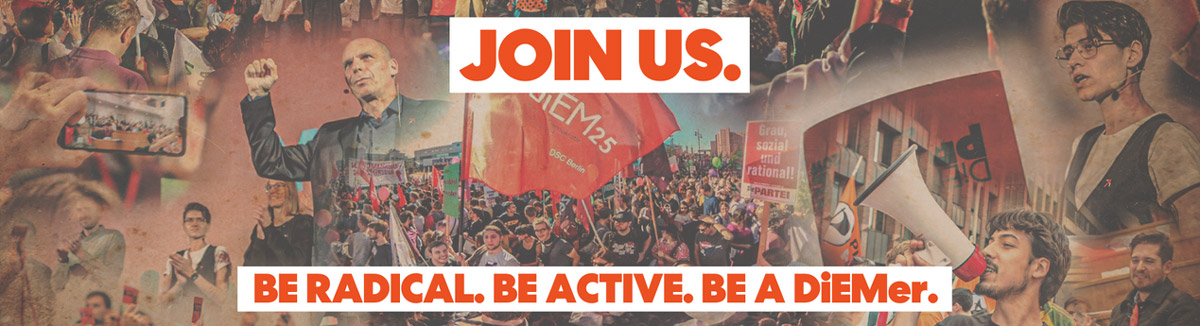
DiEM25 “is a pan-European, progressive movement that aims to democratise the EU before it disintegrates”. Its most prominent member is economist and former Greek finance minister, Yanis Varoufakis. In a recent speech in the Greek parliament, Varoufakis presented allotted bodies as a central proposal of his party.

DiEM25 is now setting up a “Deliberative Democracy collective” which will “explore” the topic and is inviting members of the public to participate by contacting them at thematic@diem25.org.

Sortition Foundation answers criticism regarding the Herefordshire Climate Assembly

Tom Lord, the director of the Sortition Foundation, responds in a letter to the editor of the Hereford Times to an earlier letter to the editor claiming that the makeup of the Herefordshire Climate Assembly, whose members were selected by the Sortition Foundation, was biased.

This is how we chose Herefordshire Climate Assembly members

FRANK Myers raises concerns (Who are they? April 22) that participants in the Herefordshire Citizens’ Climate Assembly had preconceived ideas about climate change.

The reason that over 80 per cent of participants had preexisting concerns about climate change is simply because that reflects the broader population’s views at the time, according to national statistics gathered every three months.

This issue of the potential for some people to be more likely to sign up than others is exactly why we asked people about their existing opinion about climate change when registering.
Continue reading

Timo Rieg is skeptical about citizens’ councils

Below is an extended excerpt from a translation of a piece by Timo Rieg (originally in German).

Everything speaks for the drawing of lots – called “aleatoric democracy” as a method of social control, after the Latin word for dice “alea” and known, among other things, from Asterix: “Alea iacta est,” “the die is cast,” or in the classic German phrase “die Würfel sind gefallen.”

But precisely because everything speaks for the democratic drawing of lots, the current hype about citizens’ councils must make one skeptical. For the strengths of aleatory democracy are a frontal assault on the real ruling aristocracy.

In its egalitarianism, the drawing of lots takes no account whatsoever of party careers; it knows no hierarchy, no compulsory factions, no empty election promises. Parties and lobbyists may exist even in an aleatory democracy, but they would forfeit most of their current influence on public life as a whole.

Of course, it is not impossible that professional politicians in particular, some of whom have known for many decades about the insane autonomy of parties, might long for a change of system and therefore be open to experimentation (some politicians and ex-politicians have written entire books about this).

Good lobbyists could be trusted to convince drawn citizens of their positions; good lobbyists do not rely on political backrooms, on covert influence, on strong-arming. But there will be only a very small minority willing to give up their special role for the sake of a fair democracy.

It is therefore to be feared that some advocates of aleatory democratic citizen participation are wolves in sheep’s clothing. After all, hardly any of the protagonists of this new civil rights movement would like to make their own influence or their own (economic) advantages dependent on a lottery, which means: giving up special rights in favor of the general public.
Continue reading

Understanding the present by listening to the past: Walter Lippmann’s “The Public Philosophy”

I thought readers of this blog might be interested in a post I’ve just put on my own blog on Walter Lippmann’s The Public Philosophy. It does not directly reference sortition, but I think it’s an excellent illustration of the value that sortition can bring — and it provides a corroborative context for the ideas I sketched out here.

oooOOOooo

One way to get beneath the surface of what’s going on is to read people who were writing about issues as they emerged rather than in more modern times when they’d become the norm and become infused in our commonsense.

I was browsing in one of the few remaining second-hand bookshops around (as is my wont) when I came upon Walter Lippmann’s 1955 book, The public philosophy. Walter Lippmann was one of the great journalists and thinkers of the 20th century. He wrote a series of books that were landmarks in their day, despite uniformly bland titles. Public opinion. The good life. And this one — The public philosophy

Reading part 1. I was shocked to discover a critique of democracy that I had not really crystallised for myself. It comprehends two tendencies both of which are at their most disastrous in the avoidance of war on the one hand and the fighting of wars on the other.

In the first place there’s what I’ll call temporal mismatch. It can take an electorate years to catch up with emerging developments and so public opinion can be a disastrous guide to the exigencies of a particular situation. A further aspect of public opinion is its capacity for wild swings in sentiment which I’ll call temperamental amplification.

Lippmann explains how democracies wildly overshoot. They’re not good at avoiding war by preparing properly for it. It is easy to understand why that is. Wars are very expensive. So preparing for them is expensive too. That means that politicians get the choice between warning the electorate and preparing for war and winning elections. If they call for more military spending their democratic opponent will say that it can be handled without serious financial pain — either because the threat is overblown or because it can be managed via borrowing or some other evasively defined expedient.

Then as war looms larger, far greater sacrifice than would otherwise have been necessary is called for, alongside industrial scale demonisation of the enemy. We’re somewhat familiar with this narrative from WWII, but Lippmann extends it back to the insouciance of war before WWI, the imposition of the Carthaginian Peace of 1919 which in humiliating Germany made Round Two of the Great War all the more likely. (Lippmann became fast friends with Keynes when they were both in Versailles. Coming to terms with the cataclysm of that war and its peace burned itself deeply into both men’s thought.)

Of course, this is directly relevant to today’s circumstances where the economic hangover from both COVID and Europe’s first major war in eighty years is intensifying the scarcity of energy and food, and in so doing undermining living standards. A further demand is to get Ukraine the arms it needs to fight off the Russians — but that’s expensive too.

But how much are our political leaders leveling with their populations? They’re not of course. Because to do so they’d have to say something like “Here’s the plan. We need to reduce living standards compared to what they would otherwise be by 2-3%. Then their opponents will denounce this as the counsel of despair and incompetence and come out and say they can do all they need to do without such hardship.

An extract from Lippmann is over the fold.

Continue reading

Another Herefordshire citizen council letter to the editor

The Herefordshire citizen council for the climate has been the subject of a couple of critical letters to the editor of the Hereford Times last year. In a new letter, Frank Myers MBE from Ross-on-Wye is critical of the process as well, and in particular is unhappy about the fact that the identities of the members of the council are not made public.

Why won’t Herefordshire Council name Climate Assembly members?

LAST year a Citizen’s Climate Assembly was formed. Some 50 or so members were recruited and each were paid £300 for their participation.

The group was chosen, with the help of the infamous Sortition Foundation, in such a way that almost 90 per cent had preconceived concerns about climate change.

As we approach the local elections I think it is important to know how many of these people have put themselves forward for election for posts where they are paid nothing.

So I asked Herefordshire Council for their names and the council refused to disclose them.

So we are not allowed to know but Councillor Ellie Chowns, the leader of the Greens, who chaired the foundation proceedings, obviously knows their identity and has had the opportunity to share the Green message with them.

Is this democracy?