Buchstein: Democracy and lottery: Revisited

Ten years ago Hubertus Buchstein pinned some high hopes on the application of sortition in government (“Reviving Randomness for Political Rationality”, Constellations 17(3), 2010):

[T]he horizon for further development of randomly selected councils boils down to two options. One can either stay on the beaten path and continue working with the experiments and projects described above with their non-binding status. That would amount to supporting commendable projects instructive about democracy, which admittedly remain mere ornaments of the political system’s routines, projects that participants expect to have little tangible influence, thus engendering the problems of motivation. Or the standing of randomly selected councils could be reinforced; their integration in existing institutional arrangements with a clearly defined and binding set of competencies would form the culminating point of such a reform policy.

There is much to be said for the fact that random selection, if used wisely, could prove a useful complement to the procedures in place until now. And if we have the courage to make such changes, there is reason to believe that judicious integration of components of lotteries in modern democracies can contribute to a reform policy model, relevant beyond nation-states and the example of the EU, for coping with the institutional demands of the spatial transformation of democracy beyond the framework of the nation-state currently on the agenda. Resorting to chance in such a program of policy for democracy is not an expression of resignation or fatalism, but instead of democratic experimentalism striving to increase democracy’s potential for rationality.

A decade later, Buchstein is singing a very different tune (“Democracy and lottery: Revisited”, Constalleations 26(3), 2019). Buchstein now opens his article with some accusations directed toward sortition advocates and with some skeptical questions:
Continue reading

Étienne Chouard: Public decision-making from the perspective of the common good, Part 5/5

Previously published parts of this essay are the Introduction, Part 1, Part 2, Part 3 and Part 4.

(ii) Constitutional workshops, a practical tool for popular education for training a multitude of citizen constitution-writers, guardians of the common good
Representative government (falsely called “representative democracy” – a deceptive oxymoron) is a regime of domination of the voters by the elected, was never willfully adopted and was imposed from the outset by the elected (Sieyes, Madison, etc.). The solution will not come from the elected, who are the problem since they usurp the constitutive power. The solution must come from elsewhere: from the citizens themselves.

The emancipation of the voters, their transformation into citizens, demands the institution of their political empowerment and it should therefore be the voters who practice constitution-writing themselves.

1. A citizen worthy of this name must be vigilant, and therefore a constitution-writer

Vigilance has long been described as an essential quality of a citizen.

Plato:

When a man will not himself hold office and rule, his chief penalty is to be governed by someone worse [Republic, Book 1, p. 347c].

Thucydides:

A man who takes no part in political matters we regard not as unambitious but as useless [Pericles’s Funeral Oration, The Peloponnesian War, Book 2.34-46].

Continue reading

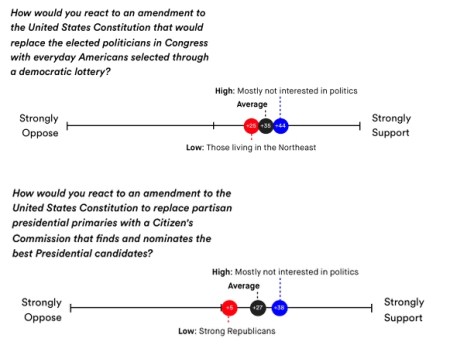
Americans support constitutional amendments replacing voting with lotteries

The chart below is excerpted from the results of an opinion survey conducted for “of by for” – an organization working “to get past parties and politicians and put everyday people front and center”. The organization has high profile sortition advocates such as Lawrence Lessig, James Fishkin and Jane Mansbridge as advisors.

US Sortition Foundation meeting this Sunday

Announcement by Owen Shaffer.

The US chapter of the Sortition Foundation is featuring a presentation from of by for at it’s Sunday online meeting, with a particular emphasis on the work they have done regarding messaging related to sortition. They have passed along some links that provide useful context for the upcoming conversation:

  • Sharing Sortition With Some Soul is an essay that explains some of the major stumbling blocks we run into when talking about sortition and deliberative democracy
  • of by for Polling Results shares key findings from a United States survey they conducted related to messaging and appeal of lottery selection at the highest levels of government
  • Their website (www.joinofbyfor.us) attempts to incorporate their approach to messaging to pitch and generate excitement around a Citizens’ Congress

That’s Sunday 3 May at 4pm Eastern US Time, 3pm Central, 2pm Mountain and 1pm Pacific. Email Owen Shaffer at dShaffer@Lander.edu by Saturday to ensure you receive the connection information in a timely manner, or you can join our email list at http://lists.sortitionfoundation.org/subscribe/usa.

Advantages and Disadvantages of Sortition

This is the second post in a series on Barbara Goodwin’s classic work on sortition Justice by Lottery, University of Chicago Press, Chicago, 1992. The first post is here.

At the start of Justice by Lottery, Barbara Goodwin gives an overview of the history of sortition, which in the beginning was bound up with war and religion. Victory in war meant division of the spoils and since most warriors were full time farmers in their day job (professional soldiers were an innovation of Phillip of Macedon), land grants (hence “lots” of land) to veterans for their service served as a sort of pension.

Tangibles as well as intangibles like power have been distributed by lot since early times. God instructed Moses to order the Jews to divide up tracts of land by lots, and this method of distribution is frequently mentioned in the Old Testament. Land in Athenian colonies was distributed by lot to cleruchs (veterans), and the Romans also parcelled out landholdings for veteran soldiers by lot, to ensure that the most fertile land was impartially distributed: this too, presumably, was God’s reasoning in the case of the Jews.

The Greek word for veteran, “cleruch,” was bound up with clerisy or random distribution. It is also the root of a common word for Christian leaders, clergy. In Christianity, the practice of electing officers at every meeting by lot may have been common in early centuries, but later the clergy disapproved and the practice was restricted to heretical outliers, such as the Gnostics. In Hellas, random choice was not primarily religious, as Goodwin points out. “Despite the Greek predilection for giving political rituals a religious gloss, it appears that no divine weight was accorded.” It was also a Roman tradition, though in different form.

In Rome, the augurs had special responsibility for supervising lots as well as for reading entrails, and they adopted as their symbol the urn, from which lots were drawn. But the reasoning behind their usage of the lot also seems to be common-sense and secular: the lot was chiefly used as a convenient means of determining which of various necessary tasks would be performed by officers of equal rank, such as the two consuls.

Continue reading

Levinson likes Sortition

Noted American Constitutional scholar Sanford Levinson seems to have recently read David Van Reybrouck’s Against Elections. He is full of praise for the book and for sortition in general. His main concern about elections is apparently about rational ignorance, so he focuses on the idea of elections by jury. Displaying an interesting mix of elitist and democratic sentiments, Levinson makes the following comments:

We could obviously discuss at length the degree to which the restricted list generates truly “representative” candidates, given the role played by money or well-located interest groups. That’s the subject for other postings. Rather, let’s assume for the moment that the candidate-selection process is acceptable, and we’re concerned only with how we should structure the choice by the citizenry of who should occupy the offices in question.

I am assuming that any and all trained social scientists would agree that a well-chosen representative sample will produce more “representative” outcomes, whether one is testing the distribution of public opinion or, as in the hypothetical case the selection of a president, than does the baroque process by which we conduct elections. The laity, on the other hand, I suspect would be appalled at this suggestion because we have built up over the years a true mystique about elections per se. Continue reading

Barbara Goodwin’s Justice By Lottery

This is the first post in a series dealing with the book Justice by Lottery by Barbara Goodwin, University of Chicago Press, Chicago, 1992.

Barbara Goodwin’s Justice by Lottery is a classic overview of sortition, covering its practical applications and the many speculative proposals in literature and political theory. The book begins with a headpiece, a quotation from King Lear. Since this play was written while Shakespeare was confined in quarantine, it rings differently now that virtually every nation in the world is in lockdown. King Lear planned for a gradual, honourable retirement, but is rejected and enters into a sudden isolation that dislocates and impoverishes.

The scene in question has the former king, betrayed by two of his daughters, in a homeless state, beginning to perceive what his ascendancy had blinded him to. He asks Gloucester, who recently had been brutally blinded for loyalty to Lear, whether he can see how this world goes? Gloucester ruefully answers that he “sees it feelingly.” That is, he understands by touch, not sight. This cartoon depicts how he “sees feelingly,”

Lear then says (and this is Goodwin’s headpiece),

What, art mad? A man may see how this world goes with no eyes. Look with thine ears. See how yon justice rails upon yon simple thief. Hark in thine ear: change places and, handy-dandy, which is the justice, which is the thief? (King Lear, Act IV, Sc. vi)

Continue reading

Étienne Chouard: Public decision-making from the perspective of the common good, Part 4

Previously published parts of this essay are the Introduction, Part 1, Part 2 and Part 3.

It remains to examine the different applications of sortition in politics:

Part II. Comparison of different applications of sortition

Having seen how poorly the common good is served by elections and how well it is defended by sortition, we can ask (i) what are the principal applications of allotment for appointing representatives, and (ii) how could this procedure become part of a constitutional, institutional structure.

(i) Principal applications of sortition in politics

Elections among candidates are generally used to award privileges, whereas sortition is used to assign duties.

In addition, to fill a post or carry out a function we elect a single person for an extended duration, during which time there is little or no control over that person. With sortition, a group of people are allotted for a short period, during which time they are closely monitored.
Here are three notable models for the use of sortition in politics (keeping the most important one for the end):

1. Sortition for appointing oversight bodies

It is often asserted in the literature of political philosophy how important it is for citizens to closely control all forms of political power. Here is Montesquieu:

It is the universal experience that any man who carries power comes to abuse it. He abuses it up to the point where he finds his limits. Even virtue needs to have limits! In order to prevent abuse of power it is necessary to match power against power [The Spirit of the Laws, Book XI, Chapter IV].

Continue reading

Altman: Strengthening Democratic Quality: Reactive Deliberation in the Context of Direct Democracy

A 2014 paper by David Altman, professor of political science at the Pontificia Universidad Católica de Chile, proposes using citizen juries as part of the intiative/referendum process in a way that goes beyond Citizen Initiative Review.

Strengthening Democratic Quality: Reactive Deliberation in the Context of Direct Democracy

David Altman

Kellogg Institute for International Studies – Working Paper Series #400

Abstract: Acknowledging that mechanisms of direct democracy can fall prey to narrow and egoistic interests (regardless of how legitimate they may be) and that legislatures do not always have the incentives to articulate responses to those narrow interests, I propose a hypothetical reform: any time a popular vote (i.e., initiative, referendum, or authorities’ referendum) is held, representative and direct institutions should be supplied with a stratified random sample of eligible voters convened to advance citizens’ counterproposals. This original institution—which does not exist even in the places where direct democracy is most developed—would discuss, deliberate, and offer an alternative or an improvement to a policy question that is to be decided in the near future; it would refine and enlarge public views on a contentious topic, providing meaningful political choices, and thus strengthening democratic quality. In arguing for this, my research takes insights from two real-world situations—Uruguay’s two 2009 initiatives for constitutional reform—in which citizens’ counterproposals could have played a crucial role in informing public views on a contentious topic and offered an alternative to both sides of the debate.

Lafont: Democracy without shortcuts

Cristina Lafont is a professor of philosophy at Northwestern University whose research is about normative questions in political philosophy concerning democracy and citizen participation, global governance, human rights, religion and politics.

Lafont is the author a new book, Democracy without shortcuts, devoting a fair amount of attention to allotted citizen juries.

This book articulates a participatory conception of deliberative democracy that takes the democratic ideal of self-government seriously. It aims to improve citizens’ democratic control and vindicate the value of citizens’ participation against conceptions that threaten to undermine it. The book critically analyzes deep pluralist, epistocratic, and lottocratic conceptions of democracy. Their defenders propose various institutional “shortcuts” to help solve problems of democratic governance such as overcoming disagreements, citizens’ political ignorance, or poor-quality deliberation. However, it turns out that these shortcut proposals all require citizens to blindly defer to actors over whose decisions they cannot exercise control. Implementing such proposals would therefore undermine democracy. Moreover, it seems naïve to assume that a community can reach better outcomes “faster” if it bypasses the beliefs and attitudes of its citizens. Unfortunately, there are no “shortcuts” to making a community better than its members. The only road to better outcomes is the long, participatory road that is taken when citizens forge a collective will by changing one another’s hearts and minds. However difficult the process of justifying political decisions to one another may be, skipping it cannot get us any closer to the democratic ideal. Starting from this conviction, the author defends a conception of democracy “without shortcuts.” This conception sheds new light on long-standing debates about the proper scope of public reason, the role of religion in politics, and the democratic legitimacy of judicial review. It also proposes new ways to unleash the democratic potential of institutional innovations such as deliberative minipublics.

Continue reading