Loïc Blondiaux: “Nobody believes anymore that the system can reform itself”

An interview with Loïc Blondiaux, professor of political science at the Sorbonne in Paris and a researcher at the European Center for Sociology and Political Science (CESSP) and the Center for Policy Research (CRPS) of the Sorbonne, in International Politics and Society journal:

New instruments of participatory democracy, such as citizen meetings with participants drawn by lot, are sometimes presented as the solution to the crisis of representative democracy. What does that reveal about the current state of French society?

It’s striking about the current democratic crisis in France, but also in the entire Western world, that instruments such as the sortition-based community meetings, where participants are selected at random, are spreading so successfully, and that such democratic innovations are generating high hopes. Who would have thought that political actors would advocate the idea of a third parliamentary chamber, determined wholly or partly by lot, or even the idea of replacing the Senate with a similar process? This interest in sortition attests to the great disrepute that traditional institutions of representative politics have fallen into. The same also applies to the “RIC” (référendum d’initiative citoyenne) promoted by the gilets jaunes, which aims to enable both citizens’ initiatives in constitutional and legal matters and the repeal of laws and the dismissal of elected representatives.

How do you explain the high expectations people have of these participatory instruments?
Continue reading

Cancio: Sortition and the Allotted Chamber as Institutional Improvements to Democracy

Here [PDF] is an automated translation (with a few touch-ups) of Jorge Cancio’s 2010 paper “Invitación a un Debate: El Sorteo y las Cámaras Sorteadas Como Mejoras Institucionales de la Democracia”.

Abstract:

I start off inviting my readers to exercise their imagination and then explaining a proposal of creating new “sortition chambers” on all administrative levels – from a chamber at the same level as the present-day Spanish Congress and Senate down to sortition chambers for each municipality. They essentially would be an addition to present-day institutions and would partake in the powers which are held today by elected representatives and officials, although the proposal envisages that in the short run they could be out-voted by the elective institutions. They would exercise their powers according to deliberative procedures.

After that introduction I offer a short account of present-day theoretical and practical proposals and implementations of sortition-based systems in the political field – highlighting the fact (following Manin) that mainstream discussions on democracy tend to ignore sortition altogether (including those made by the political left), but also making the point that since Dahl and others (inter alia, Burnheim, Goodwin, Barber; and the more recent works now appearing in Imprint Academic) there seems to be an increasing renaissance of this subject. I also point to the practical experiences of the Planungszelle and the voters’ and citizens’ juries.

Thereafter I try to explain why sortition is mainly ignored nowadays – here I follow again Bernard Manin – identifiying the contractualist bias of the XVII and XVIII century revolutions (which sought to establish a rule of consent for being governed) as the main reason for opting for elections instead of sortition as mechanism for the selection of political office-holders. Afterwards, the emergence of the political parties as oligopolical forces in the political market (here I refer to the work of C.B. Macpherson) and their growing distance from society and increasing autonomy vis-à-vis societal needs have led to a “party democracy” or “cartel party” system (Katz and Mair). The facade of autonomous decision in electing public officials covers, therefore, a system where political offers are very limited, allowing me to speak about an “election-fetish”. Contrasting to this evolution I then underline the paradox of identifiyng democracy with elections (and political parties) when we consider that democracy was linked in Athens with sortition whereas elections were considered aristocratic.
Continue reading

Radical reform: selecting 5-10% of councillors by lot

Vernon Bogdanor, Research Professor at the Institute for Contemporary British History at King’s College London and Professor of Politics at the New College of the Humanities, advocates bold, radical reforms:

Local government reform

One way that our democratic system can face these challenges is by making local government `Self Government’ once again. […] Local government is the best arena for the next phase of constitutional reform, but something much more radical than elected mayors is needed.

Selection by lot

That more radical innovation might be found in the principle of sortition—selection by lot. That principle was first adopted in fifth‐century Athens, a direct democracy, but it is perfectly feasible to extend participation in a modern democracy.

A small proportion of councillors—say 5 per cent or 10 per cent—could be selected randomly by lot from the electoral register. Participation would be voluntary but most of those selected would probably be willing to do so. That would increase the representation of the young and of members of ethnic minorities, groups markedly under‐represented in most local authorities. These councillors could decide what was best for their communities without being beholden to party.

Van Reybrouck: Belgium’s democratic experiment

David Van Reybrouck has a piece in politico.eu about the new sortition-based bodies in Belgium.

Those looking for a solution to the wave of anger and distrust sweeping Western democracies should have a look at an experiment in European democracy taking place in a small region in eastern Belgium.

Starting in September, the parliament representing the German-speaking region of Belgium will hand some of its powers to a citizens’ assembly drafted by lot. It’ll be the first time a political institution creates a permanent structure to involve citizens in political decision making.
Continue reading

Delanoi: Sortition does not replace elections, it complements them

Simon Blin interviews Gil Delanoi in the Liberation. Original in French.

Gil Delanoi, a researcher at Sciences-Po, a sortition expert, promotes this procedure as a fundamental improvement of the democratic system, provided that it is used in an ad-hoc fashion. [Editor’s note: This sub-headline seems to be a misrepresentation of Delanoi’s position – see below. – YG.]

Gil Delannoi, professor at Sciences-Po and researcher at Cevipof, has just published a new book Sortition: how should it be used? (Sciences-Po Press). According to him, this procedure, if it is well-established, could improve the representation of the diversity of the electorate.

How can sortition cure the malaise of democratic representation and participation?

As opposed to voting, sortition does not aggregate voices but rather subsamples people from a group in order to delegate a task to them, whether a deliberative, an advisory or a decision-making task. From this perspective, sortition complements voting because it allows breaking out of the legislative logic where only representatives make the law and are concerned with it and where the administration applies it. This way, sortition does not replace elections but completes them. It is certainly possible to combine the two processes.

What form should it take?

Sortition is adaptable. There are at least as many ways to allot as there are to vote. It all depends on the objective that is sought. Sortition can be mandatory or volutary. In the first case it is a duty, in the other it is a right. The size of the sample is also very important. If the allotment aims to construct a mirror of the population, it is preferable to have a large number of people involved in order to create a detailed picture. That said, even if we allot a few people, we already a sample that is more representative than that of a simple vote, particularly in terms of age, gender and profession. We may need allotments of size 10,000 or 1,000 people. Logically, the larger the number the more accurate is the representation. In the case of court juries, where sortition is regularly used in France, it is evident that the group must be able to really have a discussion. Here the optimal size is on the order of 10 to 50 people. The larger the sample, the more difficult this is.
Continue reading

The Principle of Rotation

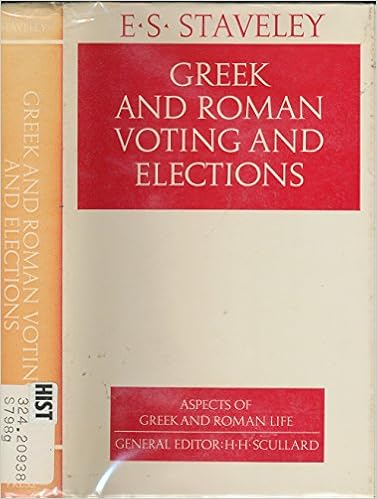
Let me share part of the section called “The Principle of Sortition” in E. S. Staveley’s 1972 book, Greek and Roman Voting and Elections. In spite of its title, the section might better have been titled, “The principle of rotation,” since Staveley argues that rotation in Athens was “more fundamental by far” than sortition. I am not an academic, and I would be interested in hearing what the reception was for Staveley’s thesis among his colleagues. Only a few reviews of the book are available to me, and they seem to have been written by specialists in Roman rather than Greek politics. He seems to be shooting across their bow. Was anybody listening?

It certainly stands to reason mathematically that the more posts are available only once in a lifetime, and the shorter their term limit, the more rotation would become the operating principle. This would set up what the Romans later would call a Cursus Honorum, a career trajectory where the average Athenian would gain active experience in every aspect of local governance, from finance to foreign policy. Unlike the Cursus Honorum, though, the order or life stage in which the citizen held a position mattered less than variety of exposure to various workshops in what Pericles called the “school of Athens.”
Continue reading

Sénat Citoyen and Citizens’ Assemblies

Sénat Citoyen is a French organization whose manifesto offers the following principle:

For every authority, government or elected assembly, there must exist an allotted citizen assembly which monitors, creates proposals and controls this authority.

Citizens’ Assemblies is a book by the Polish activist Marcin Gerwin which he describes as “a step-by-step presentation of how to organise a citizens’ assembly, with the primary focus on the city level”. It is available online for free in 6 languages.

On the website Gerwin lists “Basic standards for organizing citizens’ assemblies”, which are:

  1. Random selection of participants
  2. Demographic representation
  3. Independent coordination
  4. Citizens’ assembly can invite experts
  5. Inclusion of a widest practical range of perspectives
  6. Inviting all stakeholders
  7. Deliberation
  8. Openness
  9. Sufficient time for reflection
  10. Impact
  11. Transparency
  12. Visibility

Politics as a profession

In a recent debate with Etienne Chouard, among quite a few fallacies and hypocritical talking points, Raphaël Enthoven makes an interesting point regarding the role of training in politics (about 23 minutes into the recording) [my transcription and translation, corrections welcome]:

The fact is that, as Plato argues, politics is a profession.

[ Chourad interjects: “Plato was an aristocrat!” ]

Politics is a profession, even if you ask a democratic such as yourself. Even if you ask yourself. How would you explain the place that you accord in [your book] “Notre Cause Commune” [“Our Common Cause”], in your work, in your blog, always, since 2005, to constituent workshops? The fundamental role that you assign to instruction and to training of citizens? Isn’t it in order to give citizens the means to exercise correctly, properly and competently (if you excuse the adverb) the powers they were temporarily entrusted with?

It is obvious that politics is a profession and requires information. This profession, this information, must be open to all. There should be an equality of opportunity, there should be a wealth of opportunities for democratic practice and learning, including through sortition. Saying, however, that the equality of rights, the equality of competence would justify that each and every person would govern successively, as they did in Athens – a very small city – appointed by sortition and as a part time job, ignores the fact that it is the exercise of power that relieves incompetence, unprofessionalism, and lack of skills.

An unpublished column on sortition and Brexit

From around January this year I’ve tried to get the column below published – in the Guardian UK where my previous column was published. Unfortunately, and even after endless cajoling via the Guardian at this end, I couldn’t get a reply which is piss poor but there you go. Martin Wolf tried for me at the FT. At least they responded – but with a ‘no’, which is fair enough given the oversupply of articles on Brexit. Anyway as it fades into irrelevance and the Brexit Brouhaha Burbles on I thought I’d pop it up here.

The result of the 2016 Brexit referendum looms over the career politicians assembled in the Palace of Westminster as the black monolith loomed over the apes in the movie 2001.

It’s taken over thirty months of thrashing through actual options – as opposed to the wild partisan imaginings in the campaign – for a ghastly, if entirely foreseeable realisation to dawn. Despite the people’s clear instruction to Leave, any specific way of doing so would command far less than the 48 percent vote for Remain.

In the teeth of the greatest crisis of British statecraft since World War II, the institutional imperatives of political combat ensure the politicians perform rather than deliberate. Not only Corbyn, but extraordinarily enough, May has clung to fantasies about getting a better deal, though the end game will presumably see her change her tune.

How did it come to this? Continue reading

Legislature by Lot: Transformative Designs for Deliberative Governance

[This is repost from https://www.bretthennig.com/legislature_by_lot_published]

Legislature by LotLegislature by Lot: Transformative Designs for Deliberative Governance has just been published by Verso a few days ago. I contributed a chapter, “Who Needs Elections? Accountability, Equality, and Legitimacy Under Sortition” that questions the premise of the opening chapter of the book: that sortition should only accompany an elected chamber.

However, even as I’m excited by the publication of this new book, I’m thinking today about Erik Olin Wright, who conceived of the “Real Utopias” series and brought so many challenging and brilliant insights to this and his many other works, but sadly passed away recently. It was another book in this series, Deepening Democracy, which he co-edited as well, that started me down the path I’m now on. It was such an honour to meet him and get to know him – and to sing “Bella Ciao” together with him at his house a few short years ago.