A Dutchman offers sortition to the Scots

Dr Jasper Kenter, an ecological ­economist at the Scottish Association for Marine Science and Honorary Fellow of the University of Edinburgh, writes in The Scotsman:

Being Dutch, Westminster politics and ­elections horrify me. […] In Holland, […] [c]oalition agreements mean ­ministers can get on with their jobs without being threatened by reshuffles. They are even expected to have expertise relevant to their post.

Yet, proportional representation faces the same issues as first past the post: policies in the long-term interest of society are hard to sell because of short-term impacts. This is exacerbated by the commercial and political interests of media, with power to sway opinion by triggering fear, anger and envy, deluding people into thinking the extraordinary is more ­common.

For example, air pollution leads to 40,000 deaths a year, far more than terrorism and homicide. Addressing this would require policy overhauls and investment opposed by ­powerful lobbies, so we stick our heads in the sand.

Another example: preserving healthy ecosystems is the most important thing we can do for future generations – but the UK’s environment department has had more severe cuts than any other, with barely anyone noticing.

There is a solution: replace MPs with randomly selected citizens called up for parliamentary duty, a ­system called sortition. Imagine ­parliament being a true reflection of the public, with mothers and teachers thinking through education and childcare, health workers influencing how to run and fund the NHS. MPs would be ­independent of wealthy donors and no need to be popular, so would be better at making difficult decisions.

They would be supported by an office providing independent expertise, like the current Parliamentary Office for Science and Technology. By changing a third of MPs at a time, experience could be passed on.

In Scotland, there is an ideal opportunity to try sortition: Holyrood does not have a ­second chamber and, regardless of Indyref2, will receive more powers after Brexit, so arguably needs one.

New Scientist letter

I was lucky enough to get the following letter on sortition published in New Scientist, (not quite as I penned it). I’m hoping there will be an exchange of letters, so if anyone wants to comment, there is an opportunity.

Letters should be sent to:

letters@newscientist.com

or:

Letters to the Editor, New Scientist,
110 High Holborn, London WC1V6EU

They like them to be short (250-300 words maximum). Be sure to include your full postal address and telephone number, and a reference (issue, page number, title) to articles. In this case you should include “Campbell Wallace (Letters, 20 May, p53)…” if you comment on my letter; or, if you comment on another letter, the name of the writer and the date of publishing.

As published:

Dave Levitan (22 April, p 24), and Alice Klein (p 25) rightly deplore politicians such as Donald Trump and Malcolm Turnbull, who disregard scientific evidence in favour of policies chosen for short-term electoral advantage or to further special interests. But the problem is a consequence of the electoral system itself, which repeatedly brings to power people unfit to use it.

Since the 18th century we have assumed that elections are both necessary and sufficient for democracy, and that without them tyranny results. Yet the Greeks of Aristotle’s day knew that elections could lead to oligarchy, not democracy, and that a democratic alternative existed. Athenian democracy selected decision-makers by lot to get a statistically representative sample of the whole community: this is called “sortition“. It is perfectly feasible to design a system with the means to ensure that those chosen are well-informed on each issue that comes before them. Sortition would end the reign of big money, greatly reduce corruption, and would make intelligent decisions, taking into account the interests of all.

It’s high time we abandoned the myth that elections equal democracy.

Sortition – doing democracy differently | Brett Hennig | TEDxDanubia

I gave a TEDx talk on sortition a few weeks ago – the video has just come out…

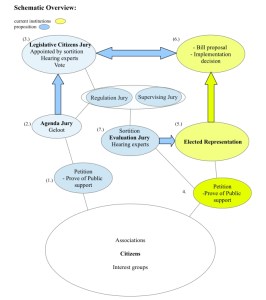
Sortition as a direct democratic system to appoint a real citizens representation, also called “citizen jury“

INTRODUCTION

According to historical sources our political system was developed AGAINST democracy (sovereignty of the people). An “Electoral Aristocracy” was installed (18 century). Nevertheless, this can be seen as a positive evolution compared with ruling by inheritance.

Later on some “democratic” elements were installed, for instance “free” or so called “democratic” elections with universal suffrage, the equality principle, freedom of speech, freedom of organisation, free press, … but some of them were weakened or eliminated afterwards.

But a “democratic element” is not yet a “democracy”. Freedom of organisation may be a “democratic element”, without it a democracy can not exists, on his own it is no democracy. This way “free elections”, to appoint a governor for instance, can be a democratic element but on his own it is by no means a democracy.
Continue reading

The Paradox of Democratic Selection: Is Sortition Better than Voting?

Book chapter just uploaded to academia.edu by Anthoula Malkopoulou

Sortition, or the selection of political officers by lot, has its antecedent in the direct democratic tradition of ancient Athens. Its transfer into a modern context of representative democracy poses rightful scepticism not only about the practical difficulties, but more so about the theoretical inconsistencies that arise. Modern systems of political representation are based on the aristocratic idea of ‘government by the best’, who are to be selected through a competitive call for candidates (Manin 1997). Sortition, on the other hand, replaces this aristocratic criterion of competition and evaluative election with the democratic mechanics of direct and equal distribution of political office by chance. Hence, the very expression ‘democratic (s)election’ includes a paradoxical contradiction in terms, between the democratic concept of equal access to public office and the aristocratic idea of government by the (s)elected best. My aim in this chapter is to shed some light on this contradiction by critically discussing the benefits and pitfalls of using sortition today, comparing it throughout the chapter with voting and the general effects of electoral representation.

Full text

Constitutional reform: could the Irish approach be useful also for Italy?

More from Improving Democracy:

Constitutional reform in Italy
Italy has incurred a stalemate situation similar to that in which Ireland found itself some time ago relating to a project of constitutional reform. On December 4th 2016 Italians were called to vote on a constitutional reform, previously approved by Parliament, but without the necessary qualified majority, for definitive approval. The electoral turnout at the referendum was quite high in relation to similar prior experiences, recording a vote of over 65% of people eligible to vote. As for the outcome: 40,88% of the voters voted “YES”, while nearly 60% voted “NO”.

[…]

Could the Irish approach be a viable solution for Italy?
Here is precisely where the Irish approach, based on the creation of an advisory body of citizens, may come to rescue the opportunity of change and assure alignment with the real thoughts and feelings of the people.

In Ireland, after the economic crisis, citizens developed a sense of mistrust towards the political parties. There has been a strong movement pressing to change parts of the Constitution, which in that country always requires final approval through a referendum in the end. The political parties, on the other hand, were unable to come to an agreement. The Labour Party in its 2011 program for elections included the promotion of a Convention on the Constitution with the intent of involving citizens directly in the process. After the elections, the program was approved by Parliament. The Convention, proudly referring to itself as “a new venture in participative democracy in Ireland” on its own web site, was formed at the end of 2012 and started its work in January 2013. The body was formed by 100 people, 66 citizens randomly selected and broadly representative of the Irish society, 33 parliamentarians, nominated by their respective political parties and an independent chairman skilled in coaching complex assemblies. The Convention had a mandate to debate and elaborate specific proposals on 8 constitutional issues, plus 2 to be autonomously selected by the Convention itself. Parliament was committed to debate the proposals in the following four months and to prepare the consequent bill for approval through referendum.

Full text: 1, 2 (PDF).

Improving Democracy: Open letter to the institutional and political leaders – No. 3

Roberto Barabino sent the latest open letter issued by the Improving Democracy campaign.

Leaders’ action or the alliance of intermediate bodies to renovate democratic systems?

In summer 2016, as every year, the world’s elite gathered in Davos, Switzerland, for the World Economic Forum, which showed a significant discontinuity compared with previous editions. Instead of trying to propose forced globalization as an advantage for everyone, as it had done in the past, they chose to tell the truth: the assertive technological innovation and, in particular, artificial intelligence, will not benefit everyone, but it will lead to an unemployment rate never seen before and possibly irreversible. The first solutions suggested by the founder of Microsoft Bill Gates (to tax robots) and by Klaus Schwab, the organizer of the Forum (universal basic income) show that the fears of those in power regarding social and political consequences of such a reality are high.

The full letter (PDF).

New Law Requiring Deliberative Poll Process for Constitutional Amendment in Mongolia

Here is an email from today (May 3, 2017) from James Fishkin to the National Coalition for Dialogue & Deliberation (NCDD) listserv:

Dear all: I am just off the plane from Mongolia where a national Deliberative Poll considered several proposed elements of a constitutional amendment, as now required by law. National random sample of 669 deliberated a whole weekend and produced results, now with the parliament. Here is a pre-event press report and video:

http://news.stanford.edu/2017/05/02/collaboration-stanford-leads-mongolian-parliament-passing-law-public-opinion-polling/

This development raises interesting possibilities for how citizen deliberation can be institutionalized. Hope you will find it of interest. More information will appear on the http://cdd.stanford.edu web site when available.  Best regards to the NCDD list. Jim Fishkin

Of particular interest, the above-linked press release announces:

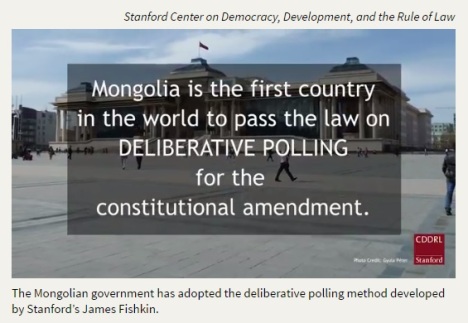
The Mongolian government recently passed a law requiring that an immersive research method that analyzes public opinion developed by Stanford’s James Fishkin be conducted before its constitution could be amended. According to Fishkin, who devised the process called deliberative polling almost 30 years ago, it marks the first time that a country has incorporated the process into its law. … The measure was supported and passed into law on Feb. 9.

Fishkin.jpg

See also: http://www.news.mn/r/328704.

The allotted Irish Citizens’ Assembly sends its recommendations to the Oireachtas

Wikipedia:

The Citizens’ Assembly (Irish: An Tionól Saoránach) is a citizens’ assembly established in Ireland in 2016 to consider several political questions: abortion, fixed term parliaments, referendums, population ageing, and climate change. It will produce reports to be considered by the Oireachtas (parliament).

[…]

On 26 July 2016, Mary Laffoy, a judge of the Supreme Court of Ireland, was chosen by the government as chairperson of the assembly.

The 99 other members are “citizens entitled to vote at a referendum, randomly selected so as to be broadly representative of Irish society”. As with the 66 citizen members of the Constitutional Convention, these 99 plus 99 substitutes were selected by an opinion polling company; Red C won the tender and began selection at the start of September. The Electoral (Amendment) Act 2016 was passed to enable the electoral register to be used in this process. Media were asked not to photograph the citizen members before the inaugural Assembly meeting. By the 27 November 2016 meeting, 11 of the 99 had been replaced by substitutes.

The Irish Post:

THE Irish Citizen’s Assembly has voted overwhelmingly in favour of abortion in a landslide vote.

[…]

The citizens involved in the vote had attended five two-day meetings since November 2016 and had heard from a series of legal and medical professionals.
Continue reading

Ganesh Sitaraman’s sortition version of the Roman tribunes

Ganesh Sitaraman proposes a sortition version of the tribunes of the Roman Republic in his new book The Crisis of the Middle-Class Constitution: Why Economic Inequality Threatens Our Republic.

Angus Deaton, the Nobel Prize winning Princeton economist, describes the proposal in his review of the book in the New York Times (March 20, 2017):

Perhaps the least familiar and most intriguing policy proposal that Sitaraman discusses is the idea of reviving the Roman tribunate: 51 citizens would be selected by lot from the bottom 90 percent of the income distribution. They would be able to veto one statute, one executive order and one Supreme Court decision each year; they would be able to call a referendum, and impeach federal officials.

Such a proposal seems fanciful today, but so is campaign finance reform, or greater redistribution. Yet we do well to remember Milton Friedman’s dictum that it takes a crisis to bring real change, so that our job in the meantime is to develop alternatives to existing policies that are ready for when “the politically impossible becomes politically inevitable.”

Sitaraman is an associate law professor at Vanderbilt Law School.